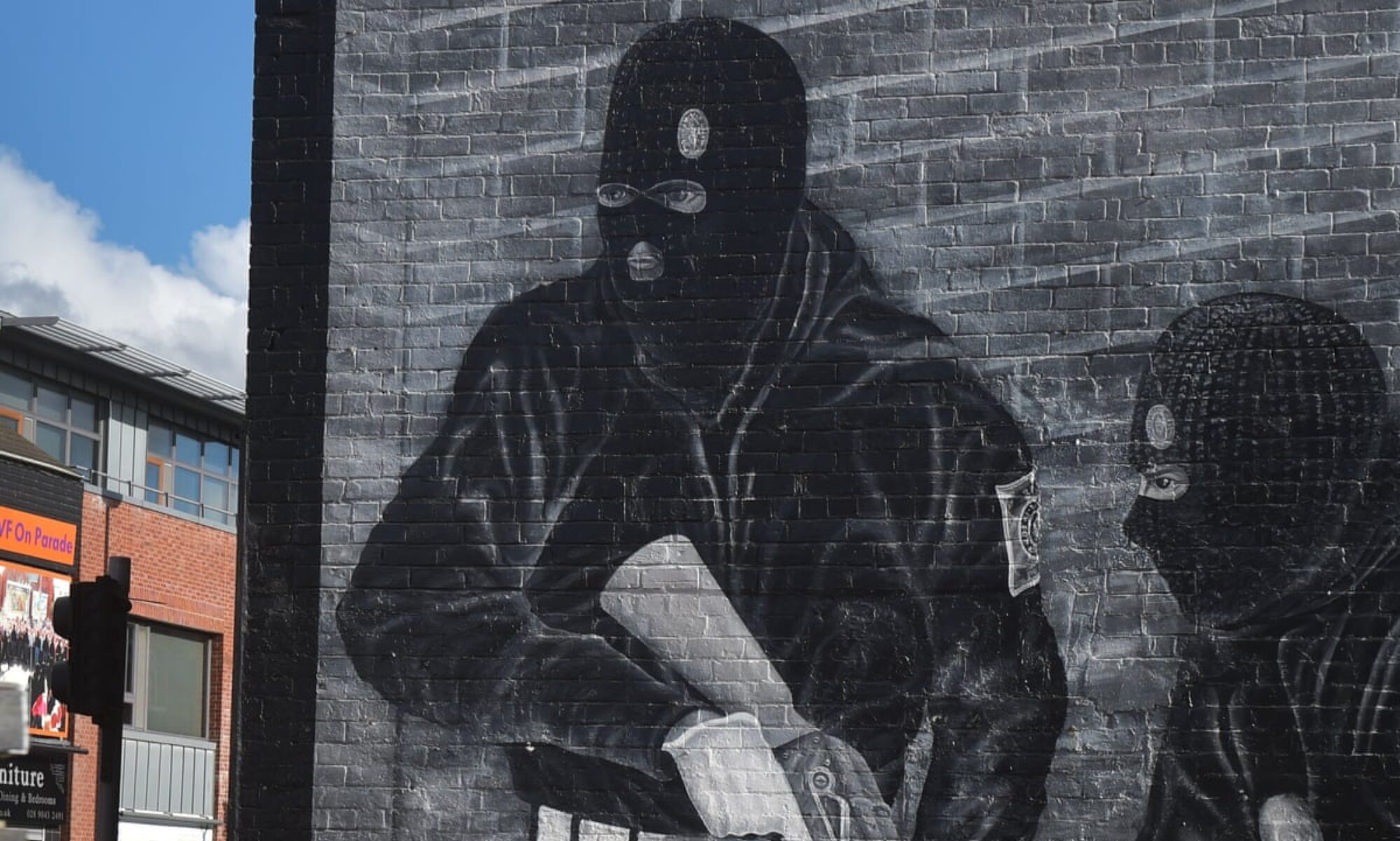
Modern Western conceptions of childhood rely on the notion that the child is distinctly different from the adult; typical coming of age stories introduce individuals that transition from pure, dependent children into enlightened and independent adults, positing innocence as a key marker of childhood (Brocklehurst 2006). But in regions of conflict, such as Northern Ireland, where violence is as present as play in the lives of children, young people threaten traditional understandings of the child. As external actors attempt to reconcile these discrepancies, two competing narratives of the child in conflict emerge—that of the helpless victim or the war-provoked militant. This exhibit will examine the limitations of these essentialist constructions, and how they compare to the real experiences of the children of the Troubles.
The notion of the “innocent victim” emerges in many combat zones, as Western media sources latch on to perceived ideas of purity. In the case of Northern Ireland, the children of the Troubles were, and still are, sensationalized by news sources. Throughout the conflict, television outlets and on-site photographers captured footage of Northern Ireland’s children, showing them playing on deserted streets, or walking past heavily armed soldiers (Newby 2021). As childhood was juxtaposed with the violence, young people became symbols of the tragedy of the conflict– a generation of children needing to be saved. Films depicting the Northern Irish youth similarly capitalized on images of war, constructing the child in conflict as a powerless victim (Newby 2018).
But in conjunction with this depiction, a competing narrative also began to emerge; that of the radicalized combatant. As newspaper articles picked up on stories of adolescent violence, and photographers captured images of teens throwing stones, the public began to see the youth of Northern Ireland as traumatized and unstable (Cairns 1987). The unpredictable youth thus became not only a victim of violence, but also a potential threat to social order. Heightened levels of paramilitary involvement amongst young people further stoked fears of the children-in-conflict gone rogue, blurring the lines between victim and perpetrator (Reinisch 2020).
These two imagined formations of the Northern Irish child attempt to make their struggle more visible; however, in making the symbol of innocence visible, they ultimately reduce the youth of the Troubles to that innocence, or lack thereof, effectively silencing chlidrens’ authentic experiences growing up within the conflict. In response to these narratives, the now grown up children of the Troubles are aiming to retell their stories. These newer modes of looking back at the Troubles have destabilized the victim-combatant trope of the child in conflict, suggesting that Northern Irish youth often lived in tight-knit communities, and had happy and loving childhoods. This exhibit will look at these accounts in conjunction with tropes about Northern Irish youth, examining how the child in conflict can be given agency.
Artifact #1: Nationalist Mural Commemorating the Dead

Plastic Bullets Plaque and Mural. Islandbawn Street, Belfast.
This photograph, taken by Martin Melaugh, captures the Plastic Bullets Mural in Belfast. The Nationalist mural is located at the intersection of Islandbawn Street and Falls Road, in a predominantly Catholic area. Painted after 1989, it commemorates the victims of rubber and plastic bullet shootings, which were controversially used by security forces to subdue rioters.
The headline of the painting, which reads, “Since 1970 Seventeen People killed-including 8 Children, ” underscores the ways in which children came to personify the horrors of war. Children, acting as symbols of innocence, were posited as the most undeserving victims, consequently becoming metaphors for the tragedy of all lost lives.
But although the mural seeks to honor the victims of the Troubles, it also transforms them into involuntary martyrs, as they are painted onto plastic bullet caps, and are made to look friendly, approachable, and quasi-angelic. Thus, the bullet caps, which resemble candles found in Church services, serve to not only memorialize the “victims,” but to further attach a narrative to their lives.
The separation of the mural’s 8 children from the other dead, marked by a darker plastic cap commemorating Norah McCabe, emphasizes their distinctive position within the role of the victim. McCabe’s identity as the only mother among the dead is not accidental; as she stands between the lost children and the other martyrs, the viewers understand that violence has done more than just take McCabe’s life; it has also impacted the children she has left behind. Similarly, newspaper articles about McCabe’s death define her first and foremost as a mother (McConville 2021).
As the mural tells the dead’s names, and shows their faces, it attempts to make them more visible. However, it ultimately still compromises their agency. In the case of the “8 children,” the victims remain defined by their youth, becoming unconsenting vehicles to represent all of the innocent lives lost in the Troubles.
Artifact #2: “Summer of 69” Mural

“Summer of 69 Mural,” Belfast.
This loyalist mural, coined “The Summer of 69,” depicts two young protestant boys in front of a decimated street. The mural is located at Hopewell Crescent near Crumlin Road in Belfast in a predominantly Unionist area, and commemorates the riots during the summer of 1969, which marked the beginning of the Troubles. That summer almost 2,000 families had to evacuate their homes, with rioters looting properties and dumping civilians’ belongings onto the streets. These boys were likely affected by the looting, as they disappointingly stand in front of a crumbling street.
As the boys are depicted without colorl and alone, they evoke the image of displaced youth, unprotected from the destruction around them. The black spiked barbed wire and jagged pieces of broken furniture are juxtaposed with the boys’ smooth and white clothing, as they are set apart from their decayed street as symbols of life and purity. The colors of Britain, found in the flags behind them and on their drum sets, reveal a source of hope for the children amidst violence. At the same time, the flag turns them into sectarian figures, politicizing the childrens’ innocence and robbing them of their agency. Ultimately, children come to represent the purity of the Unionist cause.
Artifact #3: The Petrol Bomber Mural

“The Petrol Bomber” mural, Belfast.
“The Petrol Bomber” is a mural painted in 1994 in honor of the 25th anniversary of Battle of the Bogside. The mural is located in the Bogside neighborhood of Derry, and replicates Clive Limpkin’s iconic photograph of a little boy throwing a petrol bomb during the Bogside riots of 1969.
The boy’s mask serves both to physically protect him from the gas and to preserve his anonymity, a feature that allows him to stand in for all of Nationalist Ireland. The boy’s badge further cements his connection to the nation, as the image of the innocent child fighting back against its oppressor becomes a personification of a United Ireland.
As the mural transforms the boy into a symbol of rebirth, growth and resilience, it politicizes him in the eyes of the public. The child, who is normally seen as delicate and innocent, now becomes a combatant, which is meant to discomfort the audience and upend ideals of childhood purity. This narrative maintains the notion that youths in conflict are both undeserving receptors of violence, emphasized by the gas creeping up to the boy in the background, and perpetrators of violence, since their vulnerable position in society makes them more likely to emulate the actions of the adults around them.
Artifact #4: Headline of Youth Rioting

Youth Battle Troops in Five Cities in Northern Ireland. New York Times, 1981.
The headline “Youth Battle Troops in Five Cities in Northern Ireland” was published in a 1981 issue of the New York Times. The article outlines “youth” riots in Belfast, (London)derry and other cities following the funeral of two catholic teens who had been killed by British troops.
It consequently demonstrates the opposing public perception of the youth; on one end, the dead teens are presented as victims of war, and on the other, young rioters are constructed as threats to social order. This article is one of many that highlights adolescent violence, as teenage riots became a fixture of media coverage of the Troubles (Cairns 1987).
Public piqued interest in adolescent combatants is partially sound; in both Loyalist and Republican paramilitary groups, young people were key demographics in the recruitment process. Many times having grown up with paramilitary neighbors or relatives, adolescents were attracted to these groups, which offered a source of security and stability amidst uncertain times. Mostly male combatants found agency through recruitment, which allowed them to protect their communities and make the transition into manhood (Reinisch 2020)
But through the media, young combatants were simultaneously discredited, as their actions were abstracted by their position as children. Thus, the young militant became a fixture of public imagination, coming to represent the ultimate corruption of innocence.
Artifact #5: Photograph of Belfast Children Making Petrol Bombs

This photograph, taken by Ian Berry in 1981, portrays a group of Nationalist boys preparing Molotov cocktails to throw at British troops.
The two younger boys in the image keep their faces uncovered, while the older boys are masked to protect their identities. In this way, childhood, and the perceptions associated with childhood, serve as protectors for the young boys, allowing them to behave violently without fear of legal repercussions. As they physically risked their bodies, children were able to remain press-friendly, revealing their complicated position in the public eye.
But while the media was generally sympathetic to children, it also helped further the notion that the traumatized children of the Troubles were inherently violent. Berry was unsettled to find that his images of children gained more traction among the public than his photographs of security force violence (Genova 2008). This suggests that although violence against children was a powerful media weapon throughout the Troubles, violence caused by children was equally sensationalized. As children were lured by older boys into joining their ranks, they were seen as individuals who were vulnerable to paramilitary recruitment, and were destined to become future actors in a cycle of destruction.
Artifact #6: The End of War as an End to Childhood in “Derry Girls”
https://drive.google.com/file/d/12y0FgERhQecnyLlkICzyWYRkD8UHNDE5/view
“The Agreement.” Derry Girls, created by Lisa McGee, season 3, Episode 7, Hat Trick Productions, 2022.
Lisa McGee’s sitcom “Derry Girls” tells the story of four teenage girls and a teenage boy growing up in Northern Ireland during the mid 1990s. McGee centers traditional coming-of-age themes within her narrative, creating distinct identities for the girls outside of their proximity to the Troubles, and portraying conflict as only one of many shaping influences on the girls’ journey through adolescence, a journey that is characterized by laughter, love, and a strong sense of community.
In the series finale “The Agreement,” a newly-of-age Orla, Michelle, Clare, and Erin vote on the Good Friday referendum, which marks a potential end to both the Troubles and their childhoods.
Throughout the episode, McGee highlights the protagonists’ girlhood to subvert notions of conflict-traumatized youth; Orla dresses colorfully, makes faces for her voting card picture, and remarks she has just read the Lion the Witch and the Wardrobe. The schoolgirls’ exaggerated reenactment of the Troubles later on in the episode, and girl-group background music like “I Know Where It’s At” further cement the Derry Girls’ youth.
But the potential end to the conflict also marks the girls’ transition from childhood into adulthood. As a montage of Derry’s citizens voting, along with footage of the conflict and children playing on a spinning wheel, plays in the background, Erin reflects that “There’s a part of me that just wishes everything could stay the same. That we could all just stay like this forever. There’s a part of me that doesn’t really want to grow up.” By complicating Erin’s perception of the Troubles’ ending, and riddling the conflict with sentiments of McGee’s own nostalgia, McGee suggests that the young people of Northern Ireland were not hopeless victims robbed of their childhoods. Instead, they were a generation bolstered by their remarkably tight-knit communities, and who were able to find joy and connection despite the landscape of conflict.
Artifact #7: Remembering Childhood in Northern Ireland in Kenneth Branagh’s “Belfast”
Kenneth Branagh’s film “Belfast” is a coming of age story about Buddy, a young boy living in Belfast at the start of the Troubles. Taking inspiration from his own life, Branagh sets the Troubles as a backdrop for the boy’s childhood, which is filled with love and curiosity, but also with sacrifice.
At the start of the scene, as Buddy works on a puzzle with his mother, grandfather and grandmother, Branagh emphasizes Buddy’s positionality as a young boy within the Troubles. Despite asking about Santa, he is aware of his family’s difficult financial situation, which was exacerbated by the start of the conflict; Branagh uses this contrast to reveal the coexistence of innocence and loss of innocence in the lives of Northern Irish youth.
Although “Belfast” focuses on the impact the Troubles have on Buddy’s life, Branagh emphasizes the moments of happiness and love that are present throughout the young boy’s childhood. When Pop talks to Buddy about his move to England, he tells him to remember, “You’re buddy, from Belfast 15. Where everybody knows you and your pop looks out for you and your mommy looks out for you and your daddy looks out for you and your granny looks out for you your brother looks out for you and the whole family looks out for you.” Despite Belfast being a place rife with violence, Pop encourages Buddy to be proud of his roots, as they are a testament to the people in his life who have supported him, and the strength of community in the face of conflict.
Buddy’s aspirations for film, as seen in his love for “Chitty Chitty bang-bang,” reveal his developing passions amongst the turmoil of the Troubles.
Artifact #8: “Guerillas” by Northern Irish Poet Seamus Deane
When the Portuguese came in
from manoeuvres in the North
Atlantic, they brought a scent
Of oranges and dark tobacco
To our Arctic streets. Norwegians,
However, were tall and cold,
Drinkers of cheap wine
That blued their eyes more
Than was good for anyone
Who bothered them. Some women
Became sailors’ dolls and others
Disapproved. We smelt corruption
In the hot grease of liquor
And foreign language that spat
Around us in ‘The Moonlight Club’.
Some pleasure writhed there
And some fear. A fight occurred
And then there came the Military
Police who hammered silence out
With night sticks, wall to wall.
And then we’d steal the drinks
Left on the tables they had pushed
Aside to clear the floor.
The whiskey was watered, we could tell,
A medical treacle had been served
As rum. But that was business.
Pollution entered everything and made it
Fierce. Real life was so impure
We savoured its poisons as forbidden
Fruit and, desolate with knowledge,
Grew beyond redemption. Teachers
Washed their hands of us.
Innocent of any specific crime,
We were beaten for a general guilt,
Regular as clockwork. We watched
And questioned nothing. There would be a time
When the foreign sailors would be gone.
Business would still be business.
Whiskey would still be watered,
Some girls would still be dolls
The Arctic would have inched nearer,
Pollution have gone deeper
And life, entirely domestic, would carry on.
Seamus Deane’s poem Guerillas outlines a scene from Deane’s childhood in Derry in the mid 1940s-1950s during the years leading up to the Troubles.
Throughout the poem Deane maintains a childlike voice, displaying both his wonder at the sight of foreign sailors, and a general understanding that the scenes around him are in some way tainting his innocence. As Deane writes “We smelt corruption in the hot grease of liquor” and later, “Real life was so impure / We savoured its poisons as forbidden / Fruit and, desolate with knowledge / Grew beyond redemption,” he rejects the notion that children are passive onlookers in a world that they don’t understand. Instead, he posits them as aware contributors of society who ultimately endure the beatings of those who wish to shield them, children who comprehend that despite corruption, “life, entirely domestic, would carry on.”
The presence of violence in Seamus’ early life, as evidenced by the actions of the Military Police, reveal the role of the conflict throughout his childhood, despite having grown up over a decade before the Troubles began. As a young Seamus coexists with the military, and even steals liquor from officers that are breaking up a bar fight, an older Seamus suggests that adolescence manifests itself similarly universally, even in regions prone to conflict.
Works Cited
Brockelhurst, Helen. 2006. Who’s Afraid of Children?: Children, Conflict and International Relations. Burlington: Ashgate Publishing Company.
Cairns, Ed. 1987. Caught in Crossfire: Children and the Northern Ireland Conflict. Syracuse: Syracuse University Press.
Derluyn, Ilse, Wouter Vandenhole, Stephan Parmentier, et al. 2015. “Victims and/or perpetrators? Towards an interdisciplinary dialogue on child soldiers.” BMC Int Health Hum Rights 15(28).
Duffy, Joe and Freya McClements. 2019. “Children of the Troubles: They took a child off the road, put a hood over his head and killed him.” The Irish Times, 5 October (https://docs.google.com/document/d/1jim-2x5MiW_-fx6g_Ls25EVR0TL_GqwOvDsx3JEwq0I/edit).
Genova, Alexandra. 2008. “The Troubles: Capturing the Conflict.” Retrieved May 29, 2023 (https://www.magnumphotos.com/newsroom/northern-ireland-troubles-capturing-the-conflict/).
McConville, Mary Louise. 2021. “Family of Plastic Bullet Victim Calls for ‘Deadly Weapon’ to be Disbanded.” Irish News, 12 August (https://www.irishnews.com/news/northernirelandnews/2021/08/12/news/family-of-plastic-bullet-victim-call-for-deadly-weapon-to-be-disbanded-2415269/).
Newby, Lucy and Fearghus Roulston. 2018. “Innocent Victims and Troubled Combatants: Representations of Childhood and Adolescence in Post-conflict Northern Irish Cinema.” Pp. 23-38 in Representing Agency in Popular Culture: Children and Youth on the Screen and in Between, I. Castro and J. Clark, eds. Lanham: Lexington Books.
Newby, Lucy. 2021. “Troubled Generations? (De)Constructing Narratives of Youth Experience in the Northern Ireland Conflict.” Journal of War & Culture Studies, 14(1): 6-24.
Reinisch, Dieter. 2020. “Teenagers and young adults in dissident Irish republicanism: a case study of Na Fianna Éireann in Dublin.” Critical Studies on Terrorism, 13(4): 702-723.
Tabak, Jana. 2023. “‘Children Without Childhood’: Representations of the Child-Soldier as an International Emergency.” Pp. 161-180 in The Politics of Children’s Rights and Representation: Studies in Childhood and Youth, B. Sandin, J. Josefsson, K. Hanson and S. Balagopalan, eds. Palgrave Macmillan.
