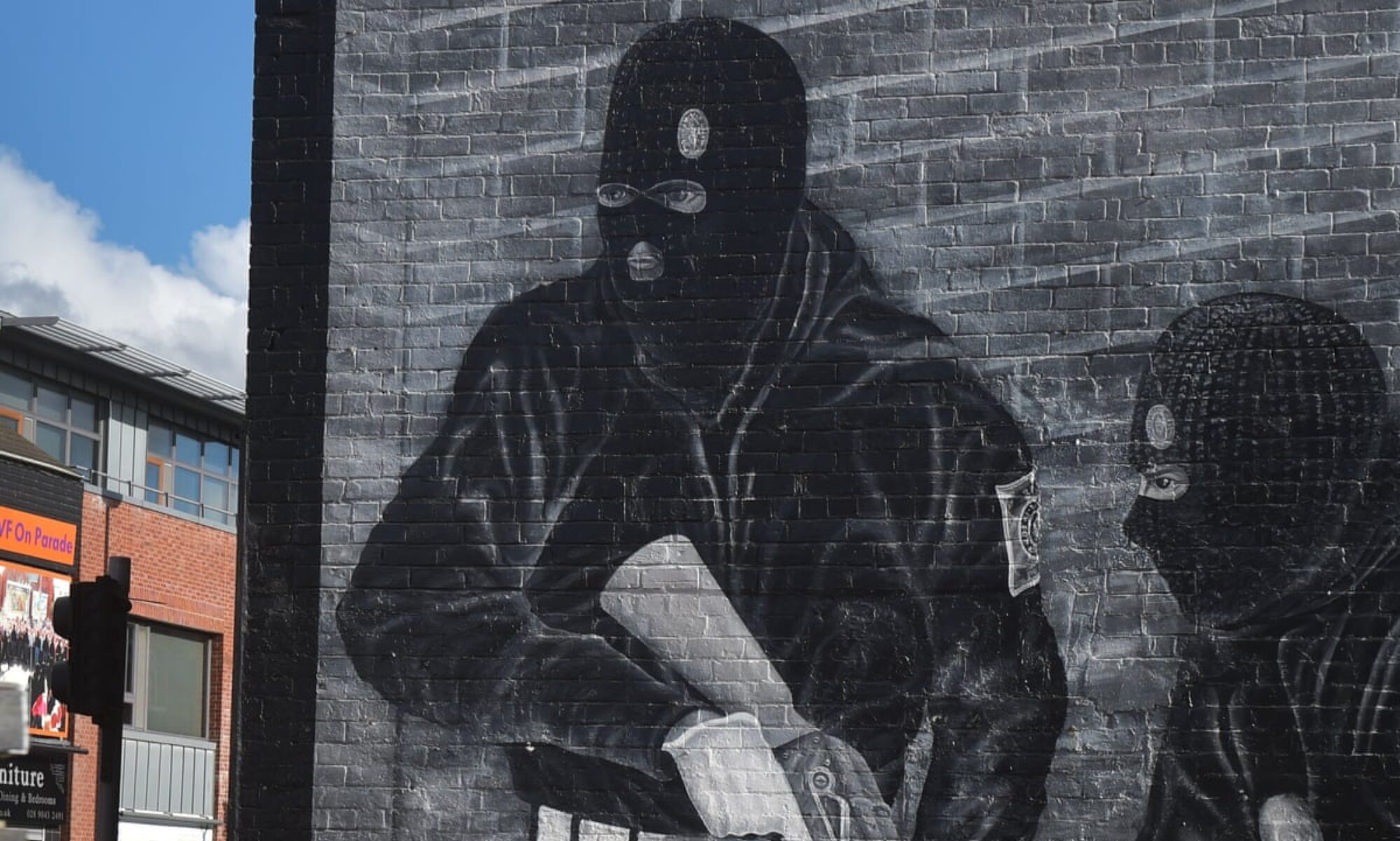
In a deeply sectarian community like Northern Ireland, history and memory are powerful weapons. Both the nationalists and the unionists reached deep into the past to obtain historical precedent and to justify their tactics during the Troubles. The opposing communities each used “regional and historical happenings” to invent the “logic of their respective nations” (Mac Laughlin 2001). The nationalist community used historical events as far back as the original conquest of Ireland in the 12th century as the basis of an ideological canon that justified their cause throughout the Troubles and in turn perpetuated the conflict. Martyrization and memorialization are central to these narratives, which attempt to discredit the foundation myths of their opponents (Loughlin 2007). In particular, the nationalist-endorsed “Fenian cult of political martyrdom” has a strong tradition of building these mythologies through music, utilizing emotional appeals to reinforce their position (Beiner 2018). Nationalist music has been wildly successful in perpetuating pro-nationalist narratives, enduring far beyond the official end of the Troubles. Though the Troubles are over, the divide in Northern Ireland persists, and the continued popularity of nationalist music reflects the stamina of the sectarian struggle in the region.
There is a fine line between memorializing suffering through artistic expression and using art to glorify or romanticize aspects of conflict. Instead of solely honoring tragedy, sometimes music becomes a tool to further entrench one’s own faction and perpetuate a message of righteousness at the cost of dialogue or resolution. The nationalists walk this line, and according to their opponents, frequently cross over to participate in the “glorification of terrorism” (Hargan 2022). Nationalist music employs historical motifs to immortalize the conflict, frequently referencing tragedies such as the Easter Rising and Bloody Sunday in order to drag every grievance of the past 900 years into the present and make it immediate and therefore threatening. By concentrating on incidents of Catholic oppression, this music casts nationalist groups like the IRA as victims, martyrs, and righteous actors rather than perpetrators and reactionaries in their own right. This process transforms the contention between the residents of Northern Ireland from a mere sectarian struggle into a holy war.
The reasoning behind this behavior is not unfounded. British and Protestant oppression of the native Irish and the Catholic minority was real, brutal, and lasted hundreds of years. However, the rhetorical nature of the nationalist case doesn’t leave any room for discourse between the actors in Northern Ireland. A holy war can’t end in a truce. Therefore, it leads to perennial violence with no end in sight. However, there are also songs from Irish and Northern Irish musicians that refute this nationalist rhetoric, denouncing the conflict as a whole rather than denouncing just the unionists and British position. These songs are not pro-nationalist, but anti-conflict, and they offer a far more honest and productive perspective on the situation. They recognize the impossibility of either community winning the Troubles through continued violence, and advocate for an end to the armed conflict through pragmatism.
Artifact 1 – Aftermath of the Easter Rising
War In Ireland – Easter Rebellion. 1916. YouTube. https://www.youtube.com/watch?v=zOlrtS2nsCE
This video was recorded after the Easter Rising in 1916, and shows the rampant destruction in Dublin in the wake of the uprising. Burned and bombed buildings are visible, as well as remnants of barricades that had been erected to block off streets. The Easter Rising was initially unpopular with the people of Ireland, but when the British retaliated by crushing the rebels brutally and mercilessly, then executing their leaders, support grew exponentially for Sinn Féin and the Republican movement, as the public viewed the harsh punishment as an overreaction (Parfitt 2017). As a result, executed republican leaders like Patrick Pearse and James Connolly quickly became martyrs.
The Easter Rising grew into a key moment for the nationalist movement, often referenced as an example of British cruelty and suppression. Any mention of the year 1916 in nationalist messaging is shorthand for the uprising and its effect on the nationalist community. Nationalist music draws heavily on the events of 1916; songs such as The Foggy Dew and Grace were written as direct reactions and memorials, and were performed throughout the twentieth century as a way to connect the events of the Troubles to the larger nationalist struggle for freedom and reunification. Musical representations of the Easter Rising “provided nationalists with subjects and grievances on which to pontificate and exercise political energies” (Parfitt 2017).
Artifact 2 –The Foggy Dew
The Foggy Dew. 1995. YouTube. https://www.youtube.com/watch?v=keWnPZOd2cw (June 1, 2023).
“The Foggy Dew,” written by Father Charles O’Neill in 1919 after attending the first sitting of the Dáil (BBC 2014), recounts the 1916 Easter Rising, invoking nationalist pride in its audience. It refers to nationalist history throughout, including events like the Irish nationalist refusal to fight in World War I, saying “‘Twas better to die ‘neath an Irish sky than at Suvla or Sud-El-Bar. Suvla and Sud-El-Bar are both on the Gallipoli peninsula, where Britain’s forces suffered crushing losses. Irish nationalists at the time maintained that the fight was at home, against British occupation, rather than overseas in support of their oppressors. This reference to glorious Irish resistance helps to drive home the nationalist themes of the song.
The lyrics lament Irishmen who fought and died overseas, calling their graves “lonely” and expressing the wish to connect fallen Irishmen with their republican ancestors. The line “had they died by Pearse’s side or fought with Cathal Brugha / Their names we’d keep where the Fenians sleep” links the leading figures of the Easter Rising and the historical tradition of Irish republicanism by naming the Fenians, who were Irish nationalists active since the mid 19th century and named after the mythological hero Finn MacCool (Britannica 2022). The reference to the Fenians demonstrates the historical precedent for Irish nationalism and thus legitimizes the nationalists who participated in the Easter Rising. In turn, the righteous deification of the leaders of the Easter Rising legitimized the cause of the nationalists in the Troubles, allowing them to rely on a greater continuity of rebellion.
Vibrant, sentimental Irish imagery shines through this song, with frequent reference to the “Irish sky,” “foggy dew,” and “Liffey’s swell” that create a “heightened sense of place” (Mac Laughlin 2001) in order to strengthen the mental image of an Irish nationalist nation. This strategy effectively strengthens the collective consciousness of nationalist Northern Ireland, supported by an enormous continuity of nationalist martyrdom.
This song named for Grace Gifford tells the tragic story of her wedding to Joseph Plunkett in Kilmainham Gaol, hours before Plunkett was sentenced to execution for his participation in the Easter Rising of 1916.
“Grace” as a political tool effectively serves to create a pair of martyrs for the nationalist cause as a tragic, somewhat melodramatic lament for their doomed romance. For the nationalists, the story of Grace and Joseph Plunkett could be considered akin to that of Romeo and Juliet, a tragedy for the ages.
The song masterfully connects the sorrowful parting conversation between the two main characters to the rebel cause, as the narrator, Joseph, says that he knows “it’s hard for you, my love, to ever understand/The love I bear for these brave men, my love for this dear land,” aggrandizing the narrative from one of personal pain to one of noble sacrifice for a cause greater than the individual.
“Grace” is a perfect example of the process of deification that Irish songwriters often apply to historical figures with the goal of providing support to one side or the other in the Catholic/Protestant conflict. Though the events of the song occurred seventy years before it was written, it still produces outrage in its audience, illustrating the staying power of this kind of strategy.
Artifact 4 – The Men Behind the Wire
The Men Behind the Wire. 2007. YouTube. https://youtu.be/0anTH5qHbjc (June 1, 2023).
“The Men Behind the Wire,” written in 1971, describes the practice of internment in Northern Ireland, which has its foundations in 1916 with the Easter Rising. The uprising “heralded executions for the leaders and imprisonment for many more rebels and sympathizers. In excess of 1,800 men and women were interned without charge or trial,” (Lowry 268) beginning the long tradition of imprisonment without trial for nationalists in Northern Ireland. As a result of the harsh retribution that the British government dealt to the rebels in 1916, “Irishmen began to perceive internment as a continuing legacy of the rebellion. The internees became hero figures and acted as catalysts for revolutionary activity in Ireland” (Lowry 268). Those sentenced to internment became heroes to their communities and operated within British prisons with a high degree of solidarity, often rendering the punishment less effective than hoped. Rather than stopping rebel sentiment in its tracks, “martyrs had been made, then the survivors were turned loose to an admiring audience” (Lowry 269).
The practice of internment was reintroduced in 1971 with Operation Demetrius, interning hundreds of men suspected of aiding the rebel cause, and prompting the writing of this song. The author, in the tradition of Irish political music, harkens back to the seventeenth century, warning that “CromweIl’s men are here again,” despite the three hundred years separating the two events. He calls his audience to continue the Irish tradition of rebel solidarity, reminding them that “every man will stand behind/The Men Behind the Wire.”
Artifact 5 – Photos from Bloody Sunday
Title: Arrest operation – Kells Walk (5) British troops (Parachute Regiment) conduct mass arrest of civilians during a lull in the shooting. Title: Civilian ambulance (2) A civilian ambulance that tried to pick up the wounded. A group of by-standers are finding cover at the front of the ambulance. At the rear, one man is holding a white handkerchief in an attempt to signal to the soldiers nearby.Title: Blood on the street Caption: One of the pools of blood left after the body had been removed by British soldiers. “Photographs by William L. Rukeyser.” Conflict and Politics in Northern Ireland. https://cain.ulster.ac.uk/rukeyser/rukeyser-derry/ (June 1, 2023).
These color photos were taken in the Bogside neighborhood of Derry, Northern Ireland, by William L. Rukeyser, an American reporter for the United Press International during the events of Bloody Sunday in 1972. This was the bloodiest year of the Troubles, with the casualty count reaching 479. The violence of the day began with a civil rights march in Derry, and ended with British soldiers shooting indiscriminately into a crowd of civilians, killing 13. As one of the most important events of the Troubles, Bloody Sunday took its “place in Irish history as a formative moment which…hardened attitudes, increased paramilitary recruitment, helped generate more violence, and convulsed Anglo-Irish relations” (McKittrick and McVea 2002, 77). These photos show a merciless perspective of the brutality of Bloody Sunday, and were revolutionary due to their global distribution. Bloody Sunday had unprecedented media coverage, which sparked a kind of worldwide outrage and support for the nationalist cause that was theretofore unheard of.
The atrocity of Bloody Sunday stands unfaltering in the collective consciousness of Northern Ireland as a prime reason for the prioritization of victory over the British and by extension the Unionists at all costs. It’s the perfect event to point at and claim that vengeance is an appropriate, necessary form of justice. However, while the horror of Bloody Sunday is undeniable, that kind of reasoning only serves to fuel the conflict, encouraging an inescapable cycle of violence and revenge.
Artifact 6 – Interview with Reverend Edward Daly
“Audio Clips of Bloody Sunday and the Immediate Aftermath.” Conflict and Politics in Northern Ireland. https://cain.ulster.ac.uk/rukeyser/rukeyser-derry/ (June 1, 2023).
This recorded interview with the Reverend Edward Daly, days after the events of Bloody Sunday in 1972, provides a valuable firsthand account of the violence. Thanks to the extensive media fallout after Bloody Sunday Daly became one of the most recognizable figures from the Troubles, as a photo of him waving a white handkerchief to escort a victim out of the line of fire appeared in newspapers and on screens all over the world. In this interview, Daly calls the events “cold-blooded murder, nothing else” verifying that when the paratroopers began shooting, the citizens were all unarmed and attempting to leave the area. The public was outraged by the brutality of the British troops on Bloody Sunday, which radicalized civilians and created a surge in membership in the Provisional IRA (McKittrick and McVea 2002).
The indiscriminate murder of unarmed citizens was unforgettable, and provided valuable fuel for the republican cause. The actions of the British troops were widely considered “completely disgraceful,” a sentiment expressed by Daly. Bloody Sunday became a widely-referenced event in nationalist music and art, held up as a contemporary injustice on par with the Easter Rising. Songs such as “Sunday Bloody Sunday” by U2, “Go On Home British Soldiers”, and “Give Ireland Back To The Irish” were written with references or in response to Bloody Sunday. This constant rehashing of the event ensured that Bloody Sunday would never fade from memory
Artifact 7 – NORTHERN IRELAND: 1972 WORST YEAR YET (AP)
This clip from the Associated Press on January 5, 1973 provides a contemporary perspective on Bloody Sunday from the world at large, and an example of the kind of press coverage that ensured that it would be permanently etched into the recollections of the global community. It was clear even at the time that the events of that day “when death itself became a cliche” would be remembered by the Catholic community as a core tenet of the list of grievances that nationalists could lay at Britain’s feet. For them, “the troops were murderers and the dead were martyrs, and the events of that confused afternoon became indelibly engraved on catholic consciences in the phrase Bloody Sunday.” Though this anger and sorrow was certainly justified, it would also in turn be used by violent paramilitaries to justify further retaliation, extending the bloodshed for decades.
Bloody Sunday shifted public opinion away from the British troops, “bolstered support for the IRA, which many Catholics saw as their only means of defense against both the Protestants and the British Army,” and marked the beginning of the bloodiest year of the Troubles, with 479 total casualties. Previously, the Catholic citizens had had a relatively positive opinion of the soldiers, who had purportedly been sent to protect civilians from sectarian violence.
Artifact 8 – Go on Home British Soldiers
Go on Home British Soldiers. 2022. YouTube. https://www.youtube.com/watch?v=UbTSvNcAAJc (June 1, 2023).
The lyrics of this song, written by The Wolfe Tones, extend the narrative of British oppression centuries into the past, to the very beginnings of an English presence on the island of Éire (Ward 1980). Beginning in the 13th century, the Wolfe Tones illustrate a timeline of Irish suffering at the hands of the British, drawing on specific, traumatic events like Operation Motorman where British soldiers shot four people while trying to take control of Catholic neighborhoods in Derry, the killing of children with plastic bullets, and Bloody Sunday to create a chronicle of oppression and resistance. This song vindicates Irish nationalists who “perceive Anglo-Irish relations as a tale of over seven-hundred years of conquest, savage exploitation and repression” (Ward 1980, 30). The Irish suffering and resistance recalled in this song is intended to maintain nationalist and more specifically, anti-British–sentiment by making it effectively impossible to forgive or forget the Troubles.
According to Jim Smyth, “remembering the Troubles was always part of the Troubles” (2017, 5). Collective memory is a powerful tool in Irish nationalism, often invoked by the IRA to ensure that the conflict remains in the forefront of people’s minds. The Wolfe Tones play to the sense of Irish pride, bravery, and perseverance, asserting that “we’ve fought you without fear” and that the British will “never ever beat the I.R.A,” neglecting to mention the ways in which the IRA uses self-defeating methods, alienating the communities that they claim to protect by killing innocents.
This way of thinking perpetuates divisions in Northern Irish society, particularly when songs such as “Go On Home British Soldiers” continue to be performed. The recording of this song is from a concert in Belfast in 2022. Even though the performance of pro-IRA music does not explicitly endorse communal divisions, it makes no effort to renounce them or acknowledge the harm caused by the IRA.
Artifact 9 – Give Ireland Back To The Irish
Give Ireland Back to the Irish. 1972. YouTube. https://www.youtube.com/watch?v=JQAPZ4KBYyo (June 1, 2023).
“I see the trouble now being that certain people think that the British shouldn’t be there, and if they are there they certainly shouldn’t be shooting the Irish people. I think they shouldn’t be, you know? It’s a bit much.”
”The morning after what they call in the newspapers Bloody Sunday, I read the newspapers and it just looked a bit wrong, what the British Army was doing in there… A bit wrong for me.”
Paul McCartney, Interview with ABC News, 1972
“Give Ireland Back To The Irish” was written and recorded by Paul McCartney and his band, Wings, directly after Bloody Sunday (McCartney and McCartney). The BBC swiftly banned the song due to its inflammatory nature, but it nonetheless reached number 1 on the charts in Ireland and Spain (McCartney and McCartney). Similarly to “Go On Home British Soldiers,” this song denounces the British presence in Ireland. Written by the British McCartney, it takes a somewhat more forgiving stance to Great Britain, as demonstrated by the lyrics “Great Britain you are tremendous / And nobody knows like me.” The deep-seated righteous anger clear in “Go On Home British Soldiers” is, understandably, less present in the lyrics of “Give Ireland Back To The Irish,” which were described by critics at the time as clumsy and simplistic, yet well-intentioned (McCartney and McCartney). Critic Chris Ingham stated that this song “managed to irritate everyone, not least for its naive, simplistic attitude to a complex situation” (Ingham 2003).
This song, written hastily by an outsider, lacks the same enduring spirit present in the nationalist songs written by Irish citizens. Notable features of other nationalist songs are their extension into Ireland’s past and reference of specific atrocities in order to stir up traumatic memories. Lacking these features, which are critical to a successful mythologization, “Give Ireland Back To The Irish” exemplifies a sloppy approximation of nationalist music, without the poignancy or staying power of its peers.
Artifact 10 – Pro-IRA Chanting At Feile An Phobail
The Wolfe Tones. “The Wolfe Tones Official Site Home.” Retrieved May 23, 2023 (https://www.wolfetonesofficialsite.com/).
During a Wolfe Tones performance at a festival called Feile An Phobail in Belfast in 2022, the crowd took part in chants such as “Up the Ra” and “Brits out.” The willingness of the crowd to verbally support the IRA and by extension the republican movement points to the success of nationalist mythmaking, over 20 years after the official end of the conflict. Even if members of the crowd might not approve of sectarianism in practice, they signaled support through their participation in the chant. A member of the DUP condemned the chanting, calling it a “hate fest” and saying that “glorifying that… is never an acceptable form of cultural expression” (Hargan 2022). She went on to say that “this is not the Northern Ireland we need to be building” (Hargan 2022).
The Wolfe Tones, named after a leader of the Irish Rebellion of 1798, describe themselves as “living Irish legend of ballads, folk and traditional music” (The Wolfe Tones). Their image relies on the rich past of Irish music and Irish nationalism; they bring historical events and attitudes into the present, ensuring that history and the mythology stemming from it cannot be forgotten. The Wolfe Tones continue the tradition of using song to “capture the hearts and minds of the Irish people,” just as the United Irishmen did in the 1700s (McCann 1995, 56). Rhetoric alone is not enough to build a movement; there must be an appeal to culture and tradition through varied means. Music in particular has the power to reinforce beliefs (Stuckenschmidt 1976, 133), and has proved essential to the nationalist movement in Northern Ireland.
Released by U2 in 1983, “Sunday Bloody Sunday” is a rejection of the entrenched sectarianism in Northern Ireland, challenging the basis of the conflict itself. During their concert in Belfast that same year, Bono spoke to the audience, asserting that “It’s not a rebel song. It’s a song of hope and a song of disgust.” Larry Mullen, the band drummer, shared his perspective on the paramilitaries that fought the Troubles: “During the hunger strikes, the IRA would say, “God is with me. I went to Mass every Sunday. “And the Unionists said virtually the same thing. And then they’d go out and murder each other.” Despite being from the Republic of Ireland themselves, the members of U2 grew up within the context of division between Catholics and Protestants in Ireland, and personally experienced the horror that the world felt on Bloody Sunday.
With “Sunday Bloody Sunday,” U2 emphasizes the futility of the fighting, asking their audience “how long, how long must we sing this song” with no end in sight? They outline the failings of nationalist and unionist rhetoric, pointing out that within the paradigm of grievance politics the rallying cry has been “the battle’s just begun” for hundreds of years, but although “there’s many lost,” they want to know, “who has won?” Though they use some of the same methods as traditional nationalist music by using striking imagery of an important event in the Troubles to make their point, the song breaks from the nationalist perspective by taking an unequivocally nonsectarian, pacifist stance on the rhetoric of the Troubles.
Artifact 12 – Zombie
Mueller, Andrew. 1994. “Eire and Graces.” VOX. 50: 69.
The lyrics of Zombie by the Cranberries provide what Vox called at the time a “seething condemnation of the IRA” and the continuing conflict between nationalism and unionism in Northern Ireland, with “Dolores bringing forth a fearsomely angry vocal from a previously untapped reservoir of bile.”
The Cranberries rejected the glorification of violence in the name of nationalism, highlighting the realities of armed conflict and angrily rejecting the methodology of the IRA. In a 1994 Vox interview, Dolores O’Riordan said “The IRA are not me. I’m not the IRA. The Cranberries are not the IRA. My family are not. When it says in the song, ‘It’s not me, it’s not my family,’ that’s what I’m saying. It’s not Ireland, it’s some idiots living in the past, living for a dream… there was no reason why that child should have been taken, why that woman would have gone through that.” With “Zombie,” the Cranberries try to force their audience to confront the outcomes of violence.
The lyrics address the misuse of martyrs and eye for an eye thinking, reminding the audience that “it’s the same old theme since 1916,” the two sides continue to engage in the same struggle without real progress.
Traditional nationalist rhetoric relies on the narrative that Catholics have been victims for the past 700 years, and that revenge must be attained in order to make it right, through violence if necessary. The Cranberries confront the senselessness of that argument, asking “what’s in your head,” and holding responsible the perpetrators of violence who refuse to let their martyrs die, instead choosing to resurrect them like zombies and use the same old undead rebel saints to justify vengeance over and over again.
References
BBC. 2014. “1916 Easter Rising.” Retrieved May 24, 2023 (https://www.bbc.co.uk/history/british/easterrising/songs/rs04.shtml).
Beiner, Guy. 2018. “A Short History of Irish Memory in the Long Twentieth Century.” Pp. 708-725 in The Cambridge History of Ireland, T. Bartlett, ed. Cambridge: Cambridge University Press.
Britannica. 2022. “Fenian”. Retrieved May 24, 2023 (https://www.britannica.com/topic/Fenians).
Hargan, Garrett. 2022. “Feile an Phobail branded a ‘hate fest’ after video shows pro-IRA chanting at Wolfe Tones concert.” Retrieved May 20, 2023 (https://www.belfasttelegraph.co.uk/entertainment/music/feile-an-phobail-branded-a-hate-fest-after-video-shows-pro-ira-chanting-at-wolfe-tones-concert/41912431.html).
Henke, J. 1983. “Blessed Are the Peacemakers, U2.” Rolling Stone 397: 11.
Ingham, Chris (2003). The Rough Guide to the Beatles. London: Rough Guides.
Loughlin, James. 2007. “Creating ‘A Social and Geographic Fact’: Regional Identity and the Ulster Question, 1880s-1920s.” Past & Present, 195(1): 159-196
Lowry, David R. 1976. “Internment: Detention without Trial in Northern Ireland.” Human Rights, 261-331.
Mac Laughlin, Jim. 2001. Reimagining the Nation-State: The Contested Terrains of Nation-Building. London: Pluto Press.
McCann, May. 1995.“Music and Politics in Ireland: The Specificity of the Folk Revival in Belfast.” British Journal of Ethnomusicology, 4:51–75.
McCartney, Paul and Linda McCartney. “Interview with ABC News, 1972.” Retrieved May 28, 2023 (https://www.the-paulmccartney-project.com/interview/interview-with-abc-news/).
McKittrick, David and David McVea. 2002. Making Sense of the Troubles: The Story of the Conflict in Northern Ireland. Chicago: New Amsterdam Books.
Parfitt, Robert. 2017. “Musical Culture and the Spirit of Irish Nationalism, c. 1848-1972.” PhD diss., University of Oxford
Smyth, Jim. 2017. “INTRODUCTION: From Popular Mythology to History and Memory.” Pp. 1-8 in Remembering the Troubles: Contesting the Recent Past in Northern Ireland, J. Smyth, ed. Notre Dame: University of Notre Dame Press. https://doi.org/10.2307/j.ctvpj7cpp.
Stuckenschmidt, H.H. 1976. Twentieth Century Music. Translated by Richard Deveson. New York: McGraw-Hill.
The Wolfe Tones. “The Wolfe Tones Official Site Home.” Retrieved May 23, 2023 (https://www.wolfetonesofficialsite.com/).
Ward, Alan J. 1980. The Easter Rising: Revolution and Irish Nationalism. Wheeling, IL: Harlan Davidson.