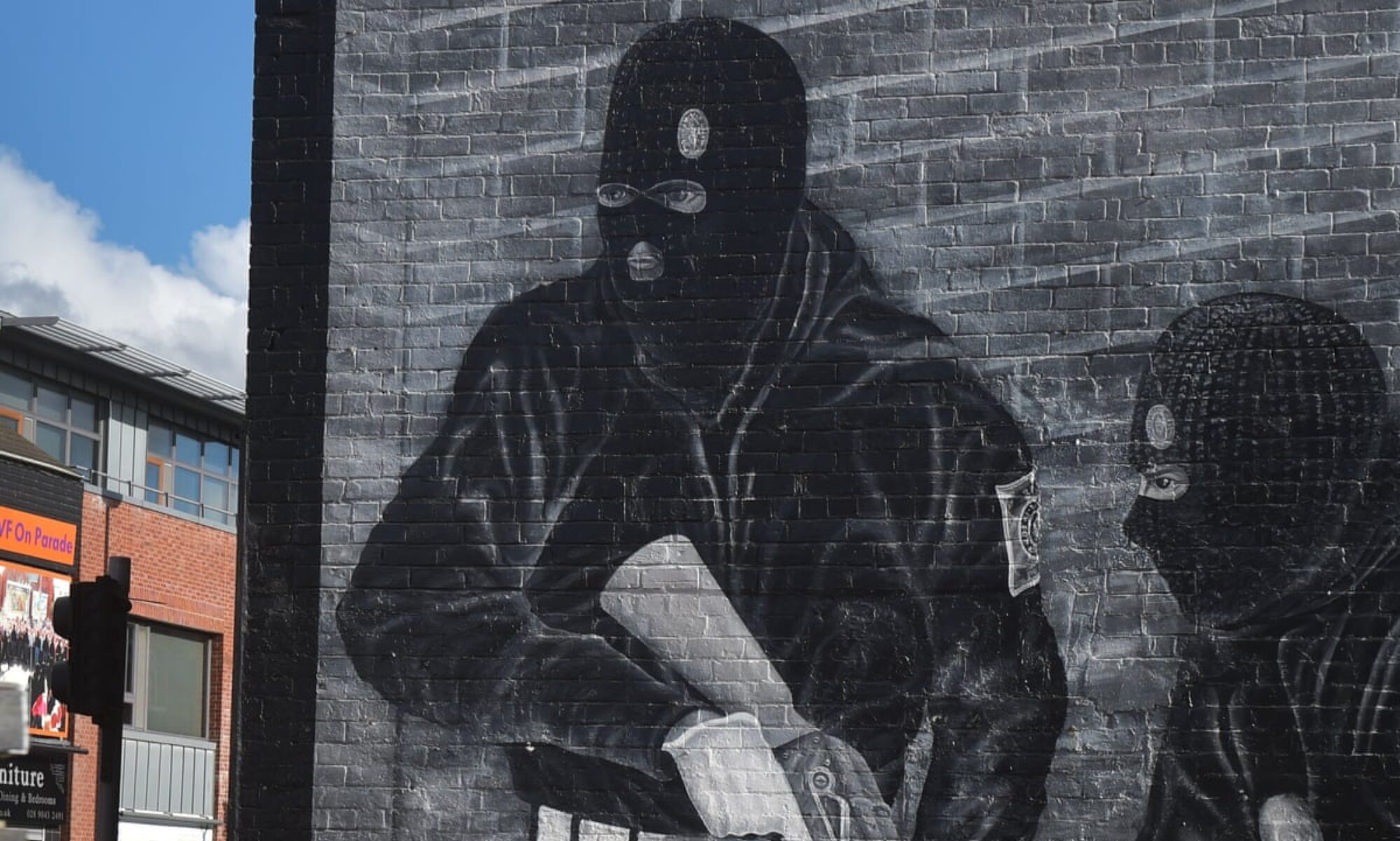
The signing of the Good Friday Agreement in 1998 marked an end to the conflict and a sense of peace for many. However, almost 25 years after the signing of the Agreement, a standing narrative on the conflict remains in large part ‘all my side were heroes, all your side were terrorists.’ The futility of an agreed perspective feels rather prescient when considering the way in which the world learned to view the conflict; the way in which the conflict was documented for the world to see.
In the early 1970s the genre of war photography was budding as a form of international activism. A collective of photographers made their living traveling between the conflict hot spots, such as Vietnam, Guatemala, and, eventually, found Northern Ireland to be the next newsworthy war1. These photojournalists from international media began imposing what had become the broadly accepted representation of violence onto the conflict in Northern Ireland2.
Views from the United Kingdom of Northern Ireland as a politically backwards and socially archaic nation contributed to the simplification of these images to what the world saw3. The coverage of the conflict was largely influenced by the events of Bloody Sunday and the Widgery Reports. The Widgery Reports were set up following Bloody Sunday to understand the civilian deaths on this day and relied largely on photographic evidence4. Despite the creation of many of the photos meant to record the violence of the British, the outcome of the Reports saw more consideration, controversially, given to the British soldiers than to the victims and their families, instead putting the blame on the march organizers1. In the international, and particularly British, perspective of focusing on the acts of violence, the pain felt in those photos for the communities affected has been somewhat divorced from the events themselves as the media focus has been put on the narrative of violence not sadness or loss.
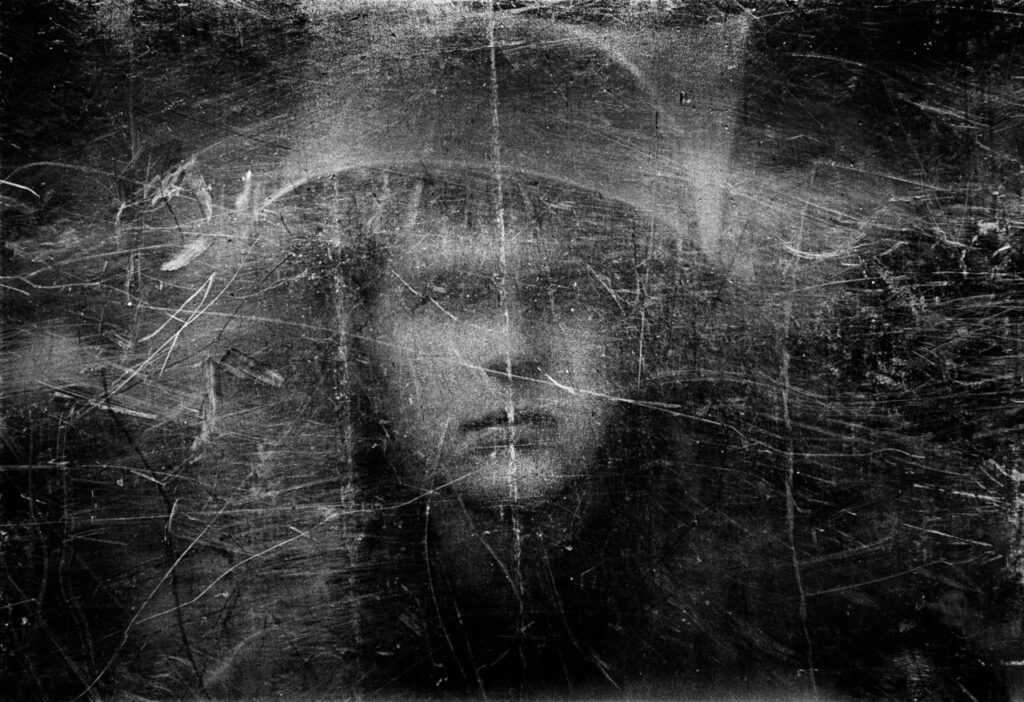
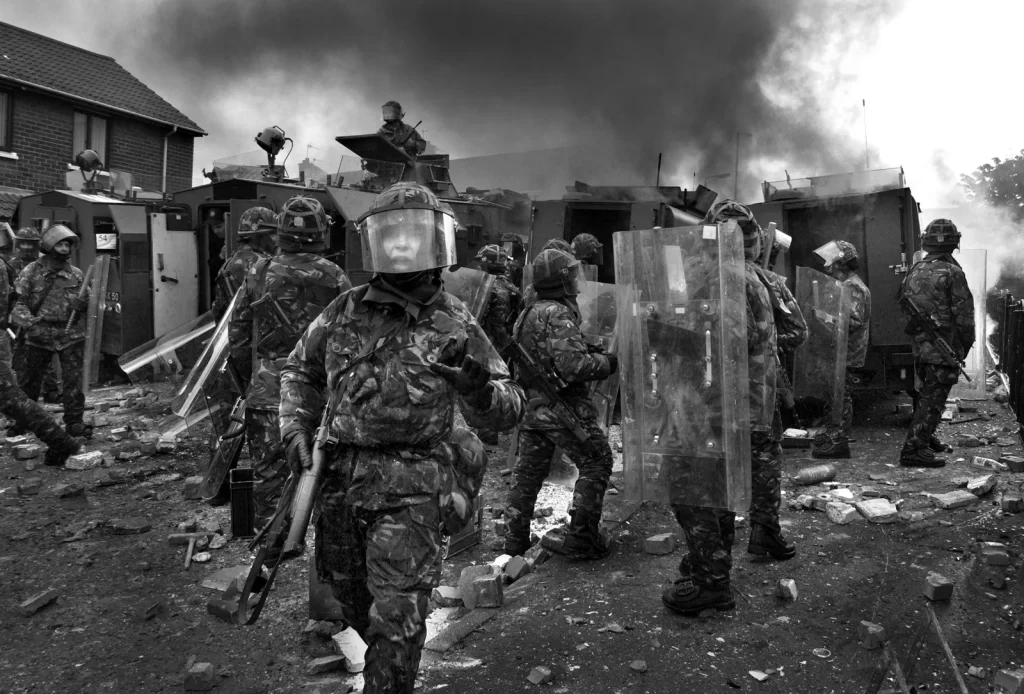
Boys at H-Block hunger strike demonstration. Belfast, Northern Ireland. 1981 (Ian Berry)A British soldier holds up a plexiglass shield with dimmed visibility due to many blasts, 1973. (Philip Jones Griffith)
This narrative can be followed into the works created in this period. In comparing the photography and the approach to photographing of British and International photojournalists to that of their Northern Irish counterparts, there is a distinct disconnect between their processes, their images, and their concerns. Patterns of urban conflict and rural idyll dominate many of the internationally recognized photos4 in a design to respect neutrality and objectivity, while Northern photographers are able to capture the violence as it unfolds, allowing the viewer linked to the conflict to decode what is happening given the constructed narrative2.
Exploring the documentation coming out of the nation at this time is that living in and experiencing the trauma produced vastly different visual responses. For these international photojournalists they could fly out to Belfast or Derry for a few days or a few weeks and return to their real lives. For the photographers of Northern Ireland, they went from photographing weddings, awards ceremonies, and sporting events to shooting funerals and soldiers walking down your own streets, many of the perpetrators or victims of the photos being neighbors or friends.
The international perspective on violence in general and specifically towards Northern Ireland created a narrative to be understood throughout the media as one of violence, hatred, and bigotry. In some cases the vision of international photojournalists matched this. The backgrounds and understandings of the conflict played an influential role in the experiences and images created by international photographers and the ones truly living through the Troubles.
Content Warning: Some of the material in the following exhibit may be distressing to some individuals due to the violent nature of select images.
Kids spraying soldiers. Belfast, 1972. (Philip Jones Griffiths)A soldier warns Rodwell during rioting following an Orange Order march, North Belfast, 2005. (Crispin Rodwell)
The Good Friday Agreement is generally considered to have signaled the end of the Troubles (Morrison, 2020, 152). It is perhaps ironic, then, that the single deadliest incident of sectarian violence in Northern Ireland occurred after the agreement was created: the Omagh bombing (Morrison, 2020, 156). This attack, carried out in the town of Omagh a few months after the signing of the Good Friday Agreement, was perpetrated by the Real IRA, a splinter group of the Provisional IRA that was formed by those opposed to Sinn Fein’s participation in the peace talks leading up to the agreement (Class lecture, 05/17/2023).
The Real IRA hoped that the bombing would derail the peace process and reignite republican violence, but in the aftermath of the bombing, Northern Ireland became even more committed to ending sectarian violence (Class lecture, 05/17/2023). The attack caused a greater than intended number of casualties, due in part to either the Real IRA relaying incorrect information when it informed the authorities of the bomb or errors on the part of police in interpreting the Real IRA’s message, depending on who is asked (Class lecture, 05/17/2023). Additionally, the casualties consisted largely of civilians, including a handful of Spanish tourists, and many nationalists, due to Omagh being a predominantly Catholic town (Morrison, 2020, 157). None of these groups of people were generally considered to be acceptable targets of sectarian conflict the same way that security services or police officers might be (Morrison, 2020, 157). These factors led to the Real IRA receiving immense backlash from everyone involved in the Northern Ireland peace process (Morrison, 2020, 157). While this backlash would have been expected from governments and unionists, even nationalist groups such as Sinn Féin forcefully condemned the bombing (Class lecture, 05/17/2023). These reactions demonstrated that Northern Ireland at large stood in opposition to the Real IRA’s actions.
This universal backlash negatively impacted the Real IRA’s reputation, and they were forced to significantly alter their tactics in order to maintain the organization’s survival (Morrison, 2020, 157). They even went so far as to declare a ceasefire in the days following the attack, and while the Real IRA eventually resumed violent activities, the response to the Omagh bombing permanently altered their approach to violence; future attacks were generally designed to avoid the risk of causing a high number of civilians casualties (Morrison, 2020, 161). Indeed, the Omagh bombing would be the last major bombing committed by the Real IRA (Bloom and Horgan, 2008, 610). The powerful backlash also allowed the British and Irish governments to pass draconian anti-terrorism laws that further weakened the Real IRA (Morrison, 2020, 157). In addition, the event increased pressure on the Provisional IRA to engage in decommissioning (Parker, 2009, 11). Ultimately, the Omagh bombing demonstrates how actions meant to stir up violence can actually have the opposite effect if they end up generating a unified backlash, resulting in the weakening of the group behind the act and inspiring a more determined push for peace among everyone else involved.
Artifact 1: Photo of the car containing the bomb shortly before the explosion
This photograph was obtained from a camera found buried in rubble by investigators (Johnston). It depicts the red Vauxhall Cavalier that contained the 300 pounds of fertilizer based explosive used in the Omagh bombing (Johnston). It was taken mere minutes before the explosion occurred and underscores just how many civilians were nearby when the bomb went off (Johnston). Indeed, the image prominently shows a man with a child on his shoulders standing in front and just off to the side of the rigged vehicle. The photo also depicts numerous people walking or standing on the sidewalks closest to the car, all of whom are oblivious to the horror that is about to unfold. It was a busy day in Omagh, and to make matters worse, police ended up unintentionally moving people closer to the bomb, due to allegedly vague information from the Real IRA’s warning message (Johnston).
The death of so many innocent civilians played a major role in generating unified backlash against the Omagh bombing and the Real IRA. Unlike security personnel or police officers, who could be seen as extensions of the British state, civilians were not considered to be acceptable targets, especially not on such a large scale (Morrison, 2020, 157-158). Going forward, the Real IRA was careful to target its violent actions (including bombings) more narrowly so as to avoid large-scaled civilian casualties, which, as the photograph emphasizes, is a stark contrast from how they planned the Omagh bombing (Morrison, 2020, 158).
Artifact 2: Photo of Omagh after the explosion
This image, produced by the Associated Press in the aftermath of the attack, depicts a plethora of emergency workers and police officers surveying the damage caused by the explosion. A twisted mess of wood and steel, along with a heavily damaged car, lie at the center of the photo. Off to the left, one can see the ruins of buildings close to the explosion. As was typical for bombings carried out by republican paramilitary groups, the Omagh bombing was not intended to create a large number of civilian casualties, with the Real IRA instead hoping the attack would cause economic damage (Class lecture, 05/17/2023). This goal is seen with the decision to place the rigged car next to a clothes shop named SD Kells (Johnston). Of course, the Real IRA’s intentions of causing economic damage instead of perpetrating a mass casualty event did not stop the bomb from killing twenty-nine people (Morrison, 2020, 156). Photos such as these highlight the extent of the Omagh bombing’s devastation, making it clear why there was such a strong, unified backlash to the Real IRA. Had this attack been more carefully targeted, perhaps the Real IRA could have avoided the mass condemnation of its actions and the extremely negative impacts that came with it (Morrison, 2020, 157).
These audio recordings of eyewitness accounts from people who witnessed the Omagh bombing paint a powerful picture of the horror the attack inflicted on the town (Caplin and RTE Archives, 1998). The first interviewee describes the sense of disbelief she felt in the immediate aftermath of the explosion, along with her dismay at the fact that people had unintentionally been driven closer to the bomb (Caplin and RTE Archives, 1998). The second interviewee recalls his frantic search for his wife and child, highlighting the chaotic nature of the scene (Caplin and RTE Archives, 1998). He goes on to describe how there was blood everywhere and that the street was littered with debris from the destroyed buildings (Caplin and RTE Archives, 1998). The final interviewee describes a similarly horrific scene, mentioning how she saw fathers trying to console their crying children (Caplin and RTE Archives, 1998). However, another memory of hers that sticks out is a much happier one: seeing a mother discover her daughter alive (Caplin and RTE Archives, 1998).
Heart-wrenching personal accounts of this nature emphasize the severe trauma that the bombing inflicted on the entire town of Omagh. Its effects were not limited to just one religious or sectarian group, as the attack occurred at the heart of a religiously mixed community (Johnson, 2012, 242). Catholics and Protestants alike were killed in double digit numbers (Johnson, 2012, 242). This aspect of the Omagh bombing goes some way towards explaining why it generated such a unified backlash against the Real IRA, as the deaths, injuries, and trauma it inflicted stretched across the sectarian divide (Johnson, 2012, 242).
Artifact 4: BBC article about the Real IRA apologizing
This article from the BBC, published a few days after the Omagh bombing, covers the Real IRA’s public apology for the attack. It was completely unprecedented for a paramilitary group to issue an apology in this manner (Class lecture, 05/17/2023). Therefore, the fact that the Real IRA felt the need to do so demonstrates just how powerful the backlash to the Omagh bombing was, with the Real IRA likely viewing the statement as something necessary in order to maintain its survival (Morrison, 2020, 57). However, the statement issued by the Real IRA also attempted to deflect some of the blame onto the police officers who had mistakenly driven people towards the bomb, maintaining that their operatives had not provided vague information (BBC News, 1998). This tactic demonstrated how the organization was already trying to distance itself from the attack, something it would continue to do for years to come even after it resumed its violent activity (Morrison, 2020, 159). Naturally, people were not keen to accept the Real IRA’s so-called apology, with the article featuring quotes from Northern Ireland Secretary Mo Mowlam harshly criticizing the statement (BBC News, 1998). Mowlam also rejected the notion that police shared responsibility for the death toll, contending that the blame rested squarely with the Real IRA (BBC News, 1998). Finally the article also contains a quotation from someone highlighting the importance of decommissioning, which underscores how the Omagh bombing led to an increased push for this process to be carried out (Parker, 2009, 11).
Artifact 5: Guardian article about Sinn Féin condemning the bombing
This article from The Guardian, written by Henry McDonald and published the day after the Omagh bombing, discusses Sinn Féin’s public condemnation of the attack. McDonald highlights that the nature of Sinn Féin’s statement represents a stark change from past responses to instances of republican violence. Traditionally, Sinn Féin would not take part in the “politics of condemnation”, but that philosophy was completely abandoned in its response to the Omagh bombing (McDonald, 1998). This decision by Sinn Féin to forcefully criticize the attack went a large way towards demonstrating how united Northern Ireland was in its desire to continue the peace process and parlaying the grief in the aftermath of the bombing into increased support for the peace process (Class lecture 05/17/2023).
Interestingly, the tone of McDonald’s article towards the peace process is not all that optimistic, as after outlining Sinn Féin’s condemnation, he speculates that the Omagh bombing will give credence to hardline unionist arguments that the peace process is not working. McDonald also identifies that the purpose of the attack was to derail the peace process, which puts unionists who might advocate for a crackdown in the awkward position of playing into the Real IRA’s hands. Next, the article mentions how the attack might increase support for the Irish government to enact selective internment for dissident republicans (McDonald, 1998). Finally, McDonald states that the Omagh bombing has destroyed support for the Real IRA among the nationalist community. The article is quite fascinating from a modern context due to the contrasting outcomes of its predictions and speculations; some (increased crackdown on dissident republicans by the Irish government) proved true, but others (fears that unionists would play into the Real IRA’s hands by derailing the peace process) ultimately did not play out (Class lecture 05/17/2023).
Artifact 6: Michael Farrell Omagh bombing artwork
This artwork by Michael Farrell is a tribute to those killed in the Omagh bombing, as shown by the accompanying description and poem. The latter text makes a clear plea for unity, declaring that orange and green (the colors of the Irish flag) does not matter and hoping that the attack won’t “shatter our dream”. This quotation can be interpreted as referring to the peace process, given that the Omagh bombing’s purpose was to derail the peace process (Class lecture, 05/17/2023). As highlighted by the artwork description, Farrell’s work powerfully underscores the horrific violence inflicted by the bombing. This is seen by how the trail of blood leading away from the pair of shoes is the only instance of color in the work, which naturally draws more attention to it. Another notable aspect of the work is the menacing figure standing behind the shoes, perhaps representing the Real IRA.
Farrell’s art stands as yet another example of how the Omagh bombing united Northern Ireland and strengthened many’s resolve to continue the peace process, a stark contrast from the Real IRA’s goal (Class lecture, 05/17/2023). The artwork also depicts the long-lasting trauma that the Omagh bombing inflicted, serving as just one example of the multiple memorials of and tributes to the victims of the attack, memorials that have continued in the decades since (Johnson, 2012, 237).
Artifact 7: Excerpt of the Criminal Justice (Terrorism and Conspiracy) Act of 1998
Above is the first substantive page of the Criminal Justice (Terrorism and Conspiracy) Act of 1998. Below it is a link to the act in its entirety. This legislation was rushed through the British parliament in the wake of the Omagh bombing and designed to prevent similar attacks from occuring in the future (Walker, 1999, 879). The act can be broken down into two parts, with the first one targeting specific organizations and individuals trying to disrupt the Northern Ireland peace process (Walker, 1999, 879). This part of the act was explicitly designed to be draconian and granted the government additional broad powers when it came to arresting and prosecuting members of organizations deemed terrorist groups (Walker, 1999, 879). For example, the excerpt features a provision that the oral opinions of police officers above the rank of superintendent stating that the accused is a member of particular organizations can be used as evidence to convict someone on charges of certain offenses. In effect, the law elevates police officers above the rank of superintendent to the status of an expert witness who can provide opinions based on personal judgements and experiences, rather than being limited to the facts of the case (Walker, 1999, 883). This stands as just one example of the act giving the British government more leeway when prosecuting people from certain violent organizations like the Real IRA.
The second part of the act focuses more on foreign dissidents that seek to perpetrate violent action against the United Kingdom (Walker, 1999, 879). It is worth noting that the Irish government also passed similar anti-terror legislation after the Omagh bombing (Morrison, 2020, 156). The Criminal Justice Act of 1998 showcases a different dimension of how the Omagh bombing backfired for the Real IRA, as the attack allowed their primary opponent to rapidly grant itself more prosecutorial power (Walker, 1999, 879).
Artifact 8: Photo of the Garden of Light memorial
This image depicts the Garden of Light, a memorial in Omagh that commemorates the Omagh bombing. It was unveiled on the tenth anniversary of the attack and was years in the making (Johnson, 2012, 246-253). The process involved looking at multiple proposals and a delicate process of consulting community members and advocacy groups to determine what the memorial should look like (Johnson, 2012, 246-253). Ultimately, the metal poles with mirrors attached were selected as the primary memorial, with each pole bearing the name of someone killed (Johnson, 2012, 248-252). The Garden of Light was constructed in tandem with a more discrete glass obelisk and stone plaque that were placed directly at the site of the explosion (Johnson, 2012, 246-253).
The creation of the Garden of Light and its sister memorials was not completely without controversy; indeed, one advocacy group, the Omagh Support and Self-Help Group (OSSHG), was unhappy that the stone plaque did not explicitly name dissident republicans as the perpetrators of the bombing (Johnson 2012, 250). But overall, the memorial itself and the unveiling ceremony were a display of unity. With its focus on the victims, the Garden of Light is not an overtly sectarian memorial and does not directly convey a certain ethno-religious message (Johnson, 2012, 246-253). The unveiling ceremony was also attended by representatives of four different churches: Catholic, Presbyterian, Methodist, and Anglican (Johnson, 2012, 253). There were even representatives from all four churches at a separate ceremony held by the still dissatisfied OSSHG (Johnson, 2012, 253).
The Garden of Light undoubtedly exemplifies the continuing trauma felt by Omagh and Northern Ireland from the bombing, but its construction and overall reception demonstrates a high level of unity within a society that is usually highly divided along sectarian lines (Johnson, 2012, 240). I believe it is another sign that, even years later, the Real IRA’s attempt to derail the Northern Ireland peace process only strengthened people’s resolve to reject violence and continue seeking peace.
Belfast Telegraph. 2008. Floodlights illuminate the Omagh Memorial Garden last night following a silent tribute to the victims earlier in the day to mark the 10th anniversary of the bombing. https://www.belfasttelegraph.co.uk/news/omaghs-message-of-hope-amid-the-silence/28443703.html
Bloom, Mia and John Horgan. 2008. “Missing Their Mark: The IRA’s Proxy Bomb Campaign.” Social Research, 75(2), 579–614.
British Parliament. 1998. Criminal Justice (Terrorism and Conspiracy) Act 1998. https://www.legislation.gov.uk/ukpga/1998/40/pdfs/ukpga_19980040_en.pdf
Calpin, Mary and RTE Archives. 1998. “Witness accounts of the devastation following a car bomb in Omagh that killed 29 people and injured hundreds.” Retrieved May 28, 2023. https://www.rte.ie/archives/2013/0815/468282-eye-witness-accounts-of-the-omagh-bombing/
Johnson, Nuala C. 2012. “The contours of memory in post-conflict societies: enacting public remembrance of the bomb in Omagh, Northern Ireland.” Cultural Geographies, 19(2), 237–258.
McDonald, Henry. 1998. “Sinn Fein breaks with past to condemn ‘disgusting’ act.” The Guardian, 16 August, https://www.theguardian.com/uk/1998/aug/16/northernireland.henrymcdonald2
Morrison, John. 2020. “Reality Check: The Real IRA’s Tactical Adaptation and Restraint in the Aftermath of the Omagh Bombing.” Perspectives on Terrorism, 14(6), 152–164.
Parker, Michael. 2009. “Changing history: the Republic and Northern Ireland since 1990.” PP. 3-15 in Irish Literature Since 1990: Diverse Voices, Michael Parker and Scott Brewster, eds. Manchester: Manchester University Press.
PA/AP Images. n.d. Aftermath of the terrorist attack in Omagh, County Tyrone, Northern Ireland, August 15, 1998. https://www.britannica.com/event/Omagh-bombing Walker, Clive. 1999. “The Bombs in Omagh and Their Aftermath: The Criminal Justice (Terrorism and Conspiracy) Act 1998”. The Modern Law Review, 62(6), 879–902.
Walker, Clive. 1999. “The Bombs in Omagh and Their Aftermath: The Criminal Justice (Terrorism and Conspiracy) Act 1998”. The Modern Law Review, 62(6), 879–902.