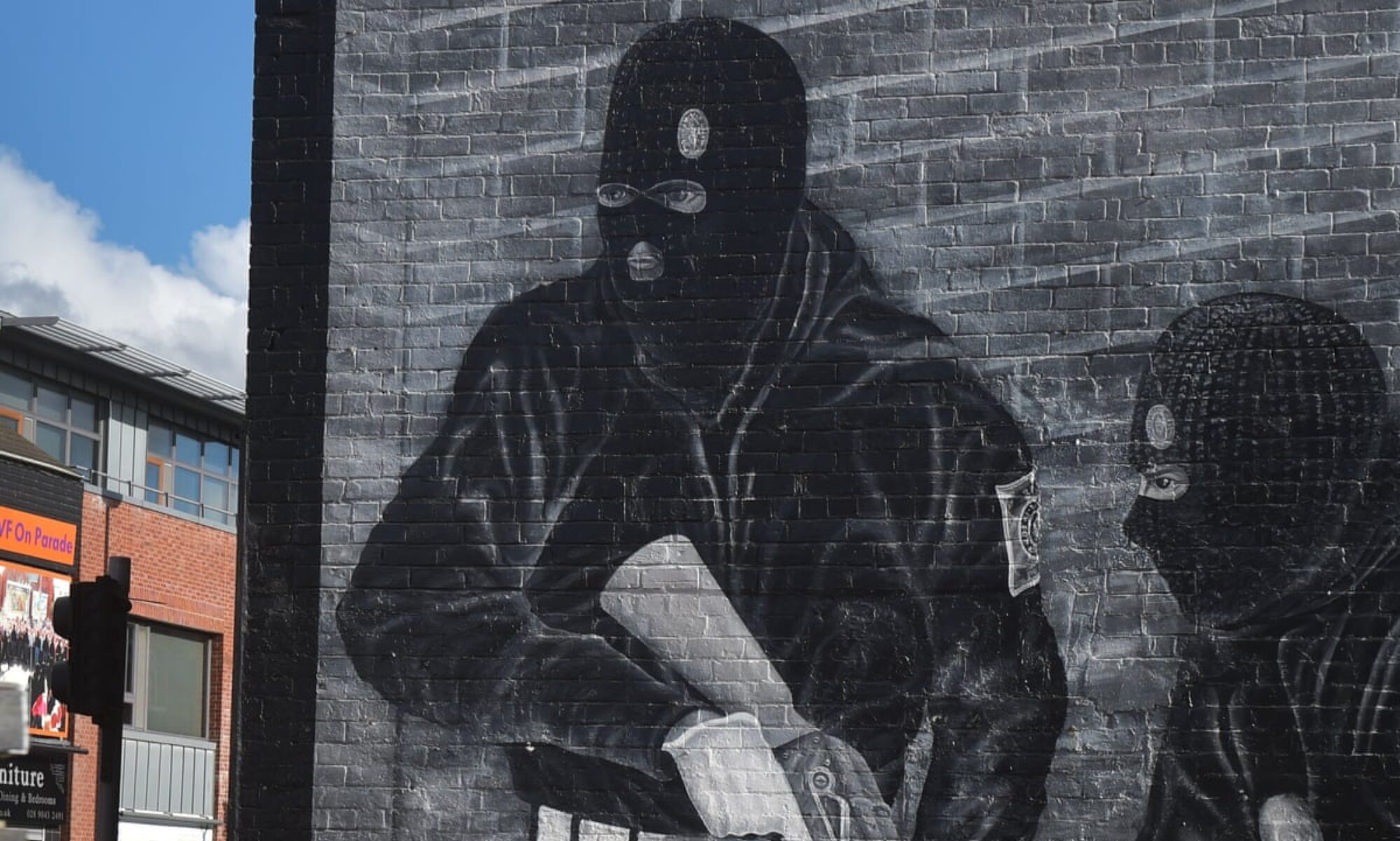
Each year since 2000, the Community Arts Partnership has run a Poet in Residence program for primary and secondary schools in Northern Ireland. Reaching over 10,000 students in sixteen years, the program aims to promote cross-community connection through art (Xerri 2017). The island of Ireland has a long tradition of poetry, which rose to prominence in the late 19th and early 20th centuries with the Irish Literary Revival (Murphy 2009). Poets such as Yeats drew inspiration from romanticized versions of Irish history and Celtic culture, cultivating a sense of place that exerts influence today (Murphy 2009). In Northern Ireland, a sense of place is more complex, begging the question, whose place? This collection explores the work of poets Seamus Heaney, Louis MacNeice, and John Hewitt, focusing on their musings on identity and conflict in Northern Ireland— post-Literary Revival and post-partition. By reading these poets’ work together, we can understand a story of place that is full of tension and nuance (Smith 1992). The conflict in Northern Ireland becomes more human, more personal, more haunting, when read through poetry.
Seamus Heaney wrote that his poetic project was to “grant the religious intensity of the violence its deplorable authenticity and complexity.” (Hufstader 1996) Heaney was Catholic, born in County Derry in 1939 (Poetry Foundation). His poetry establishes a sense of place that is different from Yeats and other Revival era poets in that it is more down to earth and rooted in finding beauty in everyday life in Ireland rather than in grand mythology (Murphy 2009). Heaney’s poetry is also more political than that of the Revivalists. He described a feeling among his creative contemporaries of “being called upon” (Heaney 2006; Murphy 2009). While Heaney leans toward nationalism and nativism in Ireland, he still makes an attempt at maintaining the duality of the place, recognizing nuance that is often lost in discussions of the Troubles (Murphy 2009).
John Hewitt was born Protestant in Belfast in 1907. Hewitt was a poet, historian, activist, and gallery curator. He was a founding member of the Belfast Peace League and the Committee for the Encouragement of Music and the Arts in Northern Ireland. Hewitt was anti-sectarian, believing in regionalism as a way of articulating one’s identity in Northern Ireland (Humanist Heritage).
Louis MacNeice was a poet of a slightly earlier generation, dying in 1963, before the official start of the Troubles. MacNeice’s complex Northern Irish identity and its expression in poetry establishes his importance in this collection. Born in Belfast in 1907, MacNeice was the son of a bishop of the Anglo-Irish Church of Northern Ireland. While this affiliation might have landed him squarely in the camp of the unionists, MacNeice’s father was pro-Home Rule and spoke out against Protestant violence (Kennedy-Andrews 2008; Poetry Foundation). MacNeice did not live in Northern Ireland for long before leaving for England to attend school, matriculating at Oxford and going on to work for the BBC (Murphy 2009). His poetry condemns people on both sides of the Northern Ireland conflict for being close-minded, while also celebrating the beauty of the place and the people (Murphy 2009). As Kennedy-Andrews writes, “MacNeice is the representative of Anglo-Irish hybridity, exile, and migrancy” (37).
Heaney explicitly placed himself in conversation with both MacNeice and Hewitt, grappling with the sense of place they each offer in relation to his own (Murphy 2009). Ultimately, Heaney believed his worldview to be more compatible with MacNeice’s detached and borderless notions than with Hewitt’s regional identity (Murphy 2009). This collection places poems by all three poets alongside one another so they can better be seen for the conversation they represent. In reading them together, we see an ever-more-complex web of meaning in which Northern Ireland and Northern Irish identities are suspended.
Artifact 1: “Carrickfergus” by Louis MacNeice (1937)
Carrickfergus
I was born in Belfast between the mountain and the gantries
To the hooting of lost sirens and the clang of trams:
Thence to Smoky Carrick in County Antrim
Where the bottle-neck harbour collects the mud which jams
The little boats beneath the Norman castle,
The pier shining with lumps of crystal salt;
The Scotch Quarter was a line of residential houses
But the Irish Quarter was a slum for the blind and halt.
The brook ran yellow from the factory stinking of chlorine,
The yarn-mill called its funeral cry at noon;
Our lights looked over the lough to the lights of Bangor
Under the peacock aura of a drowning moon.
The Norman walled this town against the country
To stop his ears to the yelping of his slave
And built a church in the form of a cross but denoting
The list of Christ on the cross in the angle of the nave.
I was the rector’s son, born to the anglican order,
Banned for ever from the candles of the Irish poor;
The Chichesters knelt in marble at the end of a transept
With ruffs about their necks, their position sure.
The war came and a huge camp of soldiers
Grew from the ground in sight of our house with long
Dummies hanging from gibbets for bayonet practice
And the sentry’s challenge echoing all day long;
A Yorkshire terrier ran in and out by the gate-lodge
Barred to civilians, yapping as if talking affront:
Marching at ease and singing ‘Who Killed Cock Robbin?’
The troops went out by the lodge and off to the Front.
The steamer was camouflaged that took me to England —
Sweat and khaki in the Carlisle train;
I thought that the war would last for ever and sugar
Be always rationed and that never again
Would the weekly papers not have photos of sandbags
And my governess not make bandages from moss
And people not have maps above the fireplace
With flags on pins moving across and across —
Across the hawthorn hedge the noise of bugles,
Flares across the night,
Somewhere on the lough was a prison ship for Germans,
A cage across their sight.
I went to school in Dorset, the world of parents
Contracted into a puppet world of sons
Far from the mill girls, the smell of porter, the salt-mines
And the soldiers with their guns.
Curatorial Notes:
We begin the collection with the poetry of MacNeice, who was writing the earliest out of the three poets whose work is in this collection. MacNeice’s life was one of displacement, exile, and hybridity. No poem of his articulates this better than “Carrickfergus.” All throughout this narrative, MacNeice emphasizes hybridity. Early in the poem, he describes the castle in County Antrim as being “Norman,” and he later describes how the Normans built this town. In doing so, he gives a reminder of Ireland’s history of conquest and migration, and also underlining the hybridity inherent in Irishness. Also early in the poem, MacNeice identifies the inequality present in Northern Ireland. The Scottish, or Protestant, live in “residential houses” while the Irish, or Catholics, live in a “slum.” MacNeice goes on to say how by his upbringing as anglican, he is now forever barred from an identity as Catholic, or truly Irish. This poem also details his immigration to England for school, during a time of war no less. The two stanzas before the last stanza see the word “across” repeated five times. Across seems an apt word for MacNeice’s identity: Irish, Protestant, nationalist, British-educated. His identity spans many identities and cannot fit neatly into one box. As someone who is in-between, MacNeice occupies a strange place in Northern Ireland, where the most important identities are sectarian ones. MacNeice’s poetry calls attention to the nuance in the histories and identities of Northern Ireland.
Artifact 2: Excerpt from “Autumn Journal” by Louis MacNeice (1939)
Autumn Journal XVI
Nightmare leaves fatigue:
We envy men of action
Who sleep and wake, murder and intrigue
Without being doubtful, without being haunted.
And I envy the intransigence of my own
Countrymen who shoot to kill and never
See the victim’s face become their own
Or find his motive sabotage their motives.
So reading the memoirs of Maud Gonne,
Daughter of an English mother and a soldier father,
I note how a single purpose can be founded on
A jumble of opposites:
Dublin Castle, the vice-regal ball,
The embassies of Europe,
Hatred scribbled on a wall,
Gaols and revolvers.
And I remember, when I was little, the fear
Bandied among the servants
That Casement would land at the pier
With a sword and a horde of rebels;
And how we used to expect, at a later date,
When the wind blew from the west, the noise of shooting
Starting in the evening at eight
In Belfast in the York Street district ;
And the voodoo of the Orange hands
Drawing an iron net through darkest Ulster,
Flailing the limbo lands
The linen mills, the long wet grass, the ragged hawthorn.
And one read black where the other read white, his hope
The other man’s damnation:
Up the Rebels, To Hell with the Pope,
And God Save—as you prefer—the King or Ireland.
The land of scholars and saints:
Scholars and saints my eye, the land of ambush,
Purblind manifestoes, never-ending complaints,
The born martyr and the gallant ninny;
The grocer drunk with the drum, The land-owner shot in his bed, the angry voices
Piercing the broken fanlight in the slum,
The shawled woman weeping at the garish altar.
Kathaleen ni Houlihan ! Why
Must a country, like a ship or a car, be always female,
Mother or sweetheart? A woman passing by,
We did but see her passing.
Passing like a patch of sun on the rainy hill
And yet we love her for ever and hate our neighbour
And each one in his will
Binds his heirs to continuance of hatred.
Drums on the haycock, drums on the harvest, black
Drums in the night shaking the windows:
King William is riding his white horse back
To the Boyne on a banner.
Thousands of banners, thousands of white
Horses, thousands of Williams
Waving thousands of swords and ready to fight
Till the blue sea turns to orange.
Such was my country and I thought I was well
Out of it, educated and domiciled in England,
Though yet her name keeps ringing like a bell
In an under-water belfry.
Why do we like being Irish? Partly because
It gives us a hold on the sentimental English
As members of a world that never was,
Baptised with fairy water;
And partly because Ireland is small enough
To be still thought of with a family feeling,
And because the waves are rough
That split her from a more commercial culture;
And because one feels that here at least one can
Do local work which is not at the world’s mercy
And that on this tiny stage with luck a man
Might see the end of one particular action.
It is self-deception of course;
There is no immunity in this island either;
A cart that is drawn by somebody else’s horse
And carrying goods to somebody else’s market.
The bombs in the turnip sack, the sniper from the roof,
Griffith, Connolly, Collins, where have they brought us?
Ourselves alone ! Let the round tower stand aloof
In a world of bursting mortar!
Let the school-children fumble their sums
In a half-dead language;
Let the censor be busy on the books; pull down the Georgian slums;
Let the games be played in Gaelic.
Let them grow beet-sugar; let them build
A factory in every hamlet;
Let them pigeon-hole the souls of the killed
Into sheep and goats, patriots and traitors.
And the North, where I was a boy,
Is still the North, veneered with the grime of Glasgow,
Thousands of men whom nobody will employ
Standing at the corners, coughing.
And the street-children play on the wet
Pavement—hopscotch or marbles;
And each rich family boasts a sagging tennis-net
On a spongy lawn beside a dripping shrubbery.
The smoking chimneys hint
At prosperity round the corner
But they make their Ulster linen from foreign lint
And the money that comes in goes out to make more money.
A city built upon mud;
A culture built upon profit;
Free speech nipped in the bud,
The minority always guilty.
Why should I want to go back
To you, Ireland, my Ireland?
The blots on the page are so black
That they cannot be covered with shamrock.
I hate your grandiose airs,
Your sob-stuff, your laugh and your swagger,
Your assumption that everyone cares
Who is the king of your castle.
Castles are out of date,
The tide flows round the children’s sandy fancy;
Put up what flag you like, it is too late
To save your soul with bunting.
Odi atque amo:
Shall we cut this name on trees with a rusty dagger?
Her mountains are still blue, her rivers flow
Bubbling over the boulders.
She is both a bore and a bitch;
Better close the horizon,
Send her no more fantasy, no more longings which
Are under a fatal tariff.
For common sense is the vogue
And she gives her children neither sense nor money
Who slouch around the world with a gesture and a brogue
And a faggot of useless memories.
Curatorial Notes:
This excerpt is just one section from MacNeice’s 24-section poem entitled, “Autumn Journal.” In this section, MacNeice turns his attention to the North of Ireland, which he describes as his home. This poem is rich with details criticizing the tribalism and sectarian divides in Ireland. MacNeice points out absurdities on both sides of the Protestant-Catholic divide, further demonstrating his hybrid identity and rejection of sectarianism. MacNeice has a wistful tone at the beginning of the poem, saying he envies his “Countrymen who shoot to kill and never / See the victim’s face become their own.” His wistfulness comes from a lack of understanding. MacNeice is between identities, he cannot fathom the conviction of those who kill without remorse. In some ways, he wishes he had that conviction— it would mean a certain amount of belonging in Northern Ireland. As the poem goes on, however, MacNeice begins to criticize the thoughtless violence and its romanticization: “The land of scholars and saints: / Scholars and saints my eye, the land of ambush / Purblind manifestoes, never-ending complaints, / The born martyr and the gallant ninny; / The grocer drunk with the drum.” Instead of violence and conflict being tragedies imposed on Ireland, MacNeice seems to be saying that people are choosing violence and conflict through their actions. Violence and conflict are part of the fabric of everyday life, baked into identities, inseparable from the notion of place. Towards the end of the poem, MacNeice asks, “Why should I want to go back / To you, Ireland, my Ireland?” He does not answer this question in his poem, instead ending with further ruminations of the futility of sectarianism and violence: “Put up what flag you like, it is too late / To save your soul with bunting.” This is a reference to the ways in which neighborhoods in Belfast and Derry are decorated with flags the colors of the dominant community. Protestant neighborhoods will have Union Jack Flags and orange bunting, while Catholic neighborhoods will have green flags and bunting. This poem is a powerful condemnation of the divides present in Ireland from someone who lives outside them, giving us a uniquely nuanced perspective on conflict in Northern Ireland.
Artifact 3: “Neutrality” by Louis MacNeice (1942)
Neutrality
The neutral island facing the Atlantic,
The natural island in the heart of man,
Are bitterly soft reminders of the beginnings
That ended before the end began.
Look into your heart, you will find a County Sligo,
A Knocknarea with for navel a cairn of stones,
You will find the shadow and sheen of a moleskin mountain
And a litter of chronicles and bones.
Look into your heart, you will find fermenting rivers,
Intricacies of gloom and glint,
You will find such ducats of dream and great doubloons of ceremony
As nobody today would mint.
But then look eastward from your heart, there bulks
A continent, close, dark, as archetypal sin,
While to the west off your own shores the mackerel
Are fat — on the flesh of your kin.
Curatorial Notes:
Writing earlier than Hewitt or Heaney, in this poem MacNeice writes of the Republic of Ireland’s decision to remain neutral in WWII. This decision was especially tense because Ulster Protestants did fight in WWII. Irish Neutrality became yet another point of distinction between “native” Irish and Protestant Irish (Class lecture, April 5). MacNeice’s life and poetry are both riddled with the theme of displacement. In this poem, the reader is asked to look into their heart, to interrogate their home and their position in the world. MacNeice’s beautiful depictions of Irish scenery give way to a darker ending for the poem. Upon “looking eastward from your heart,” the reader is asked to see a continent “close, dark, as archetypal sin.” In looking east, the reader is asked to see mackerels, “fat — on the flesh of your kin.” While the reader is asked to hold home in their heart, they are then shown the consequences of holding home so dearly above all else. Holding home safe requires the abandonment of the “dark” continent of Europe, even if the people living there are your neighbors. Privileging home above neighbors and kin also enables violence. While the Irish treasure their home countryside, MacNeice reminds them that people are dying. By kin, MacNeice seems to gesture to the fact that Northern Irish Protestants were fighting and dying in WWII while Ireland remained neutral. So the Irish get their idyllic home at the expense of “kin.” Not only is MacNeice questioning ideas of what home should be, he also challenges who, on the island of Ireland, is considered kin.
Artifact 4: “The bombed public house” by John Hewitt (1983)
The bombed public house
This was the pub where I once took that playwright
famous for broadcast brawl but witty sober.
He warned me going in he had no money,
and took a single pint of several offered.
This was the pub where I was called to meet
the foreign poet; when he asked my age
he kissed me on both cheeks and called me father.
This was the pub where the small bald barman
always called me Doctor or Professor
on my infrequent visits, being neither.
When this interior is restored, recovered
with fashionable surfaces and textures
will any mirror echo such reflections
or cushioned corner’s covers bounce them back?
Curatorial Notes:
In this poem, Hewitt revisits memories from a favorite pub in Belfast that has been bombed. All of the memories Hewitt describes are joyful, caring, and vulnerable. He describes a playwright too poor to buy any beer, taking only one beer offered. He describes a poet who, after just meeting, kissed him on both cheeks. And finally, he describes the bartender, who always called him Doctor or Professor out of respect, despite the fact that Hewitt was neither. All of these stories paint a picture of community. The pub was a place where people looked out for one another, where people could go to connect with others. The poem concludes with a stanza that takes stock of the damage and wonders what can be repaired. As Hewitt hints at, the physical repair of the building post-bombing will not restore the communal nature of the pub. The violence inflicted on it cannot be undone through interior design. This stanza is a metaphor for the Troubles on the whole. If or when the violence ends, cleaning up the damage may not be enough to move forward.
This poem was written in 1983, fourteen years after the beginning of the Troubles and fifteen years before the Good Friday Agreement was signed (CAIN). In the midst of all this violence, Hewitt wrote this poem, asking the questions of how the violence would end and what it would take to heal from that violence. While there is no outright blame or sectarian bias in this poem, there are a few implications that merit unpacking. For one, Hewitt himself was Protestant, even if he had largely non-Sectarian views. The fact that he was Protestant means that the pub he frequented was likely Protestant because everything in Northern Ireland was segregated during this time (Class lecture, April 3). So this poem is mourning the loss of an institution of his community. It is not a non-sectarian loss. Additionally, the title says the pub was bombed. During the Troubles, the groups who carried out the majority of bombings by far were Republican paramilitaries (Class lecture, May 17). By knowing this angle of the story in Hewitt’s poem, we gain further insight into the nuance of his view. Like Heaney in many ways, Hewitt does not overtly condemn any one group as being the problem. There are subtle ways that identity and difference of identity play out in this poem, but neither identity is written off.
Artifact 5: “Lines for a dead alderman” by John Hewitt (1983)
Lines for a dead alderman
Justice is done in the end,
the rascal who had his day
to party and prejudice friend,
lodged in non-partisan clay.
As the mourners drive away
they leave that bundle of lies
to the earthworms’ enterprise.
But, Lord, it is long to wait
till the wrong that that man did
and the hurt borne of his hate
lies under the coffin-lid;
the earth may never be rid
of that wrong this side of time
if I let it tarnish my rhyme.
Curatorial Notes:
In this poem, Hewitt lets loose a string of criticisms directed at the deceased local politician. Hewitt describes him as a liar and someone who sowed hate. Hewitt says that the man’s wrongs are so long-lasting that, “the earth may never be rid / of that wrong.” About his death, Hewitt writes that “Justice is done,” implying that the man did not die of natural causes. Hewitt shows utter lack of remorse for this man’s death, despite narrating as though he attended the funeral. This raises questions about his motivations and those of the mourners. His calling them mourners implies that they don’t share his negative opinions of the Alderman, but the reader is never explicitly given this information.
The way that Hewitt condemns this man is unretractable. There is no room for nuance in how he feels about the dead alderman. This poem does leave open some questions to consider, in the context of the Troubles. For one, we know that the politician had to be either Catholic or Protestant. Which was he? It is far more likely that he was Protestant, given that Protestants held most government positions and were the ethnic majority in Northern Ireland at the time of writing (McGarry & O’Leary 1995). Hewitt’s stance here is highly political and also indicative of his misgivings about the state. Throughout his life, he argued for a regional Ulster identity that was not tied to a state or to sectarian politics (Kennedy-Andrews 2008). His expression of distaste for the dead politician in this poem reflects this stance. By failing to name the politician’s sectarian identity, Hewitt demonstrates the best of his non-sectarian leanings.
Artifact 6: “Orange Drums, Tyrone, 1966” by Seamus Heaney (1966)
Orange Drums, Tyrone, 1966
by Seamus Heaney
The lambeg balloons at his belly, weighs
Him back on his haunches, lodging thunder
Grossly there between his chin and his knees.
He is raised up by what he buckles under.
Each arm extended by a seasoned rod,
He parades behind it. And though the drummers
Are granted passage through the nodding crowd,
It is the drums preside, like giant tumours.
To every cocked ear, expert in its greed,
His battered signature subscribes ‘No Pope’.
The goatskin’s sometimes plastered with his blood.
The air is pounding like a stethoscope.
Curatorial Notes:
This poem describes a phenomenon well-known to any resident of Northern Ireland: the lambeg drums of the Orange Parades. Lambeg drums are large, loud drums played by Protestants during summer marching season. Marching season celebrates the anniversary of the defeat of Catholic King James by Protestant King William of Orange (Channel 4 News 2022; Class lecture April 3). For Catholics, marching season is a tense time of year. This display of Protestant pride keeps Catholics mostly inside their homes, looking to avoid interaction with boisterous Protestants. The loud and aggressive-sounding lambeg drum adds to feelings of insecurity and inter-community conflict.
Heaney’s poem showcases this tension. As a Catholic and nationalist, Heaney would have a negative reaction to hearing lambeg drums. This is reflected in the language he uses in this poem, which is largely negative. He describes the drum as “ballooning” from the player’s belly “grossly there between his chin and his knees.” He also compares the drums to “giant tumors” and listeners as experts “in greed,” both of which emphasize the colonial and oppressive undertones of marching season. The line “He is raised up by what he buckles under” is rich with meaning and more nuance than the other negative language contains. Heaney recognizes that perhaps the oppressiveness of marching season is a weight on the Protestant community too, or at least reflects the burdens they bear as an isolated culture in Northern Ireland. The last line of the poem is especially powerful: “The air is pounding like a stethoscope.” If the air pounds like a stethoscope, it is measuring the powerful but deeply unsteady heartbeat of a divided Northern Ireland. While upon first glance this poem seems anti-Protestant, Heaney ultimately showcases the nuance and mutual pain and oppression of the conflict.
Artifact 7: “Summer 1969” by Seamus Heaney (1969)
Summer 1969
While the Constabulary covered the mob
Firing into the Falls, I was suffering
Only the bullying sun of Madrid.
Each afternoon, in the casserole heat
Of the flat, as I sweated my way through
The life of Joyce, stinks from the fishmarket
Rose like the reek off a flax-dam.
At night on the balcony, gules of wine,
A sense of children in their dark corners,
Old women in black shawls near open windows,
The air a canyon rivering in Spanish.
We talked our way home over starlit plains
Where patent leather of the Guardia Civil
Gleamed like fish-bellies in flax-poisoned waters.
‘Go back,’ one said, ‘try to touch the people.’
Another conjured Lorca from his hill.
We sat through death-counts and bullfight reports
On the television, celebrities
Arrived from where the real thing still happened.
I retreated to the cool of the Prado.
Goya’s ‘Shootings of the Third of May’
Covered a wall—the thrown-up arms
And spasm of the rebel, the helmeted
And knapsacked military, the efficient
Rake of the fusillade. In the next room,
His nightmares, grafted to the palace wall—
Dark cyclones, hosting, breaking; Saturn
Jewelled in the blood of his own children,
Gigantic Chaos turning his brute hips
Over the world. Also, that holmgang
Where two berserks club each other to death
For honour’s sake, greaved in a bog, and sinking.
He painted with his fists and elbows, flourished
The stained cape of his heart as history charged.
Curatorial Notes:
The Summer of 1969 was an important one in Northern Ireland. It marked the beginning of the Troubles, as the thirty-year conflict came to be known. In January 1969, Catholic peaceful protesters marching from Belfast to Derry to draw attention to Civil Rights were ambushed at Burntollet Bridge in what became a brutal attack. Loyalists and off-duty members of the RUC attacked the crowd of mostly university students. On-duty RUC members stood by, not intervening. This event sparked a turn for Catholics: from Civil Rights toward nationalist tendencies. Then, in August, a Protestant Apprentice Boys parade in Derry turned violent. Rioting broke out between RUC and nationalists. When RUC members and loyalists entered the Catholic Bogside Neighborhood to squash the rioting, their tactics became violent, further inflaming the conflict (CAIN; class lecture April 14; Munck 1992). Heaney was in Madrid during these events, and wrote this poem while far from home as the violence escalated.
Throughout the poem, Heaney projects thoughts and feelings about Ireland onto his surroundings in Madrid, contrasting the scenery of this cosmopolitan scenery and its history with the history and current events of Northern Ireland. In the first few lines, we see Heaney’s leanings: “While the Constabulary covered the mob / Firing into the Falls, I was suffering”. By describing the Constabulary, or police, as “covering” the mobs, he is emphasizing the discrimination and brutality faced by Catholics in Northern Ireland. The police, instead of protecting all citizens, are supporting loyalist groups in inflicting violence and destruction on Catholics. In describing his visit to the Prado, an art museum in Madrid, Heaney focuses on paintings that depict violence and conflict. There’s a painting where a figure is, “Jewelled in the blood of his own children” and another where “two berserks club each other to death / For honour’s sake, greaved in a bog, and sinking.” These lines seem to reference the violence in Northern Ireland directly while also showing Heaney’s recognition of nuance. While he leans toward condemning the RUC, he recognizes that both Catholics and Protestants are responsible for senseless violence.
Artifact 8: “The Other Side” by Seamus Heaney (1972)
The Other Side
I
Thigh-deep in sedge and marigolds,
a neighbour laid his shadow
on the stream, vouching
‘It’s as poor as Lazarus, that ground,’
and brushed away
among the shaken leafage.
I lay where his lea sloped
to meet our fallow,
nested on moss and rushes,
my ear swallowing
his fabulous, biblical dismissal,
that tongue of chosen people.
When he would stand like that
on the other side, white-haired,
swinging his blackthorn
at the marsh weeds,
he prophesied above our scraggy acres,
then turned away
towards his promised furrows
on the hill, a wake of pollen
drifting to our bank, next season’s tares.
II
For days we would rehearse
each patriarchal dictum:
Lazarus, the Pharaoh, Solomon
and David and Goliath rolled
magnificently, like loads of hay
too big for our small lanes,
or faltered on a rut —
‘Your side of the house, I believe,
hardly rule by the Book at all.’
His brain was a whitewashed kitchen
hung with texts, swept tidy
as the body o’ the kirk.
III
Then sometimes when the rosary was dragging
mournfully on in the kitchen
we would hear his step round the gable
though not until after the litany
would the knock come to the door
and the casual whistle strike up
on the doorstep. ‘A right-looking night,’
he might say, ‘I was dandering by
and says I, I might as well call.’
But now I stand behind him
in the dark yard, in the moan of prayers.
He puts a hand in a pocket
or taps a little tune with the blackthorn
shyly, as if he were a party to
lovemaking or a stranger’s weeping.
Should I slip away, I wonder,
or go up and touch his shoulder
and talk about the weather
or the price of grass-seed?
Curatorial Notes:
This poem explores Heaney’s relationship with Protestant neighbors in his youth as a larger metaphor for Catholic-Protestant relations in Northern Ireland. True to Heaney’s generosity and nuance, he describes the Protestant neighbor as respectful, saying that he waited for the family to finish the Rosary before coming to knock on their door and say hello. Throughout the poem, Heaney emphasizes the similarities that the neighbors share in relation to land and labor. Their lives are so parallel, lived on opposite sides of the stream separating their property. While Heaney references religious divides, he also emphasizes the shared life the neighbors have in the countryside, thereby centering a sense of place and identity that goes beyond religion.
Heaney’s poem “The Other Side” is a response of sorts to John Hewitt’s poem, “The Glens.” In “The Glens,” Hewitt writes of similar feelings of separation and sharedness. He also uses the metaphor of neighbors living on opposite sides of a fence (Murphy 2009). Both of these poems use connection to place to emphasize the artificial yet consequential divides between Catholics and Protestants (Murphy 2009). In responding to Hewitt, Heaney enters the conversation about regional identity. Ultimately, while Heaney and Hewitt’s poems express similar thoughts, Heaney cannot agree with Hewitt that regional identity should supersede sectarian divides. The imbalance of power between Catholics and Protestants makes such reconciliation impossible for Heaney (Murphy 2009). While Heaney can recognize individual relationships as nuanced, he ultimately holds to his nationalist leanings (Murphy 2009).
Works Cited
Class Lectures. April 3, April 5, April 14, May 17; 2023. Professor Devashree Gupta, Carleton College.
Heaney, Seamus. 1972. Wintering Out: “The Other Side.” Faber and Faber, London, UK.
Heaney, Seamus. 1975. North: “Orange Drums, Tyrone, 1966” “Summer 1969.” Faber and Faber, London, UK.
Heaney, Seamus. 2006. “The Peter Laver Memorial Lecture ‘Place and Displacement’: Recent Poetry from Northern Ireland (1985).” The Wordsworth Circle 37(3): 148–56. https://www.proquest.com/docview/214238599/abstract/BC24EE5A41AC4AEDPQ/1 (May 18, 2023).
Hewitt, John. 1983. Loose Ends: “The bombed public house,” “Lines for a dead alderman.” The Blackstaff Press, Northern Ireland.
Hufstader, Jonathan. 1996. “‘Coming to Consciousness by Jumping in Graves’: Heaney’s Bog Poems and the Politics of ‘North.’” Irish University Review 26(1): 61–74. https://www.jstor.org/stable/25484649 (May 24, 2023).
“Humanist Heritage: John Hewitt (1907-1987).” Humanist Heritage. https://heritage.humanists.uk/john-hewitt/ (May 29, 2023).
Kennedy-Andrews, Elmer. 2008. Writing Home: Poetry and Place in Northern Ireland 1968-2008. Suffolk, UK and Rochester, NY: D.S. Brewer, ch. 2.
MacNeice, Louis. 1990. Selected Poems: “from Autumn Journal” “Neutrality” “Carrickfergus.” Edited by Micheal Longley. Wake Forest University Press, North Carolina.
McGarry, John and Brendan O’Leary. 1995. Explaining Northern Ireland. Oxford and Cambridge, MA: Blackwell, ch. 3.
Melaugh, Martin. “CAIN: Key Events of the Northern Ireland Conflict.” https://cain.ulster.ac.uk/events/index.html (May 31, 2023).
Munck, Ronnie. 1992. “The Making of the Troubles in Northern Ireland.” Journal of Contemporary History, 27: 211-229.
Murphy, Andrew. 2009. “Heaney and the Irish Poetic Tradition.” The Cambridge Companion to Seamus Heaney, edited by O’Donoghue, Bernard. Cambridge: Cambridge University Press, 2009: 136-149.
Poetry Foundation. 2023. “Louis MacNeice.” Poetry Foundation. https://www.poetryfoundation.org/poets/louis-macneice (May 31, 2023).
Poetry Foundation. 2023. “Seamus Heaney.” Poetry Foundation. https://www.poetryfoundation.org/poets/seamus-heaney (May 29, 2023).
Smith, Stan. 1992. “Seamus Heaney: The Distance Between.” The Chosen Ground: Essays on the Contemporary Poetry of Northern Ireland, edited by Neil Corcoran. Seren Books, Bridgend, Mid Glamorgan: ch. 2.
Xerri, Daniel. 2017. “Inspiring Young People to Be Creative: Northern Ireland’s Poetry in Motion for Schools.” New Writing 14(1): 127–37. https://doi.org/10.1080/14790726.2016.1268166 (May 18, 2023).
