Shooting the Troubles: Visualizing Propaganda and Sense of Place through Conflict-era Photography

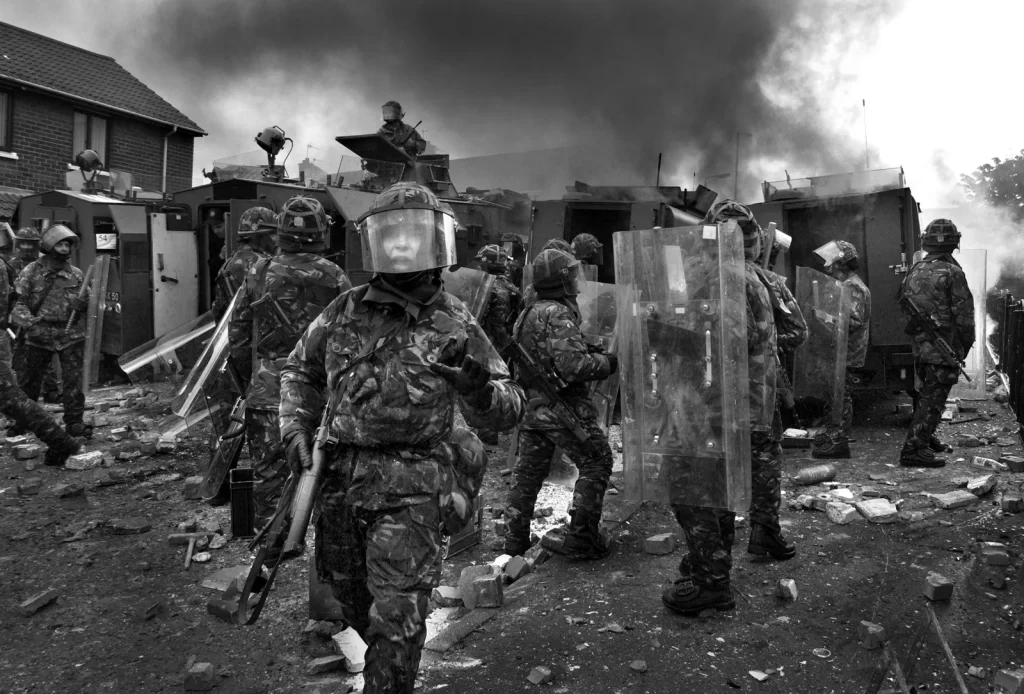
Time for Peace, 1994 (Crispin Rodwell)

The signing of the Good Friday Agreement in 1998 marked an end to the conflict and a sense of peace for many. However, almost 25 years after the signing of the Agreement, a standing narrative on the conflict remains in large part ‘all my side were heroes, all your side were terrorists.’ The futility of an agreed perspective feels rather prescient when considering the way in which the world learned to view the conflict; the way in which the conflict was documented for the world to see. 

In the early 1970s the genre of war photography was budding as a form of international activism. A collective of photographers made their living traveling between the conflict hot spots, such as Vietnam, Guatemala, and, eventually, found Northern Ireland to be the next newsworthy war1. These photojournalists from international media began imposing what had become the broadly accepted representation of violence onto the conflict in Northern Ireland2

Views from the United Kingdom of Northern Ireland as a politically backwards and socially archaic nation contributed to the simplification of these images to what the world saw3. The coverage of the conflict was largely influenced by the events of Bloody Sunday and the Widgery Reports. The Widgery Reports were set up following Bloody Sunday to understand the civilian deaths on this day and relied largely on photographic evidence4. Despite the creation of many of the photos meant to record the violence of the British, the outcome of the Reports saw more consideration, controversially, given to the British soldiers than to the victims and their families, instead putting the blame on the march organizers1. In the international, and particularly British, perspective of focusing on the acts of violence, the pain felt in those photos for the communities affected has been somewhat divorced from the events themselves as the media focus has been put on the narrative of violence not sadness or loss. 

This narrative can be followed into the works created in this period. In comparing the photography and the approach to photographing of British and International photojournalists to that of their Northern Irish counterparts, there is a distinct disconnect between their processes, their images, and their concerns. Patterns of urban conflict and rural idyll dominate many of the internationally recognized photos4 in a design to respect neutrality and objectivity, while Northern photographers are able to capture the violence as it unfolds, allowing the viewer linked to the conflict to decode what is happening given the constructed narrative2.

Exploring the documentation coming out of the nation at this time is that living in and experiencing the trauma produced vastly different visual responses. For these international photojournalists they could fly out to Belfast or Derry for a few days or a few weeks and return to their real lives. For the photographers of Northern Ireland, they went from photographing weddings, awards ceremonies, and sporting events to shooting funerals and soldiers walking down your own streets, many of the perpetrators or victims of the photos being neighbors or friends.

The international perspective on violence in general and specifically towards Northern Ireland created a narrative to be understood throughout the media as one of violence, hatred, and bigotry. In some cases the vision of international photojournalists matched this. The backgrounds and understandings of the conflict played an influential role in the experiences and images created by international photographers and the ones truly living through the Troubles.

Content Warning: Some of the material in the following exhibit may be distressing to some individuals due to the violent nature of select images.

Footnotes

  1. The Conversation, 2022
  2. Hutchinson, 2018
  3. Baker, 2017
  4. Hanna, 2015

The Influence of Music and Musicians During the Troubles

Art was a huge outlet for many during the Troubles.  In class we carefully examined many different murals from both sides.  Music during the Troubles was another key outlet for loyalists and nationalist.  The music during this period however has not limited to just this.  Musicians from Northern Ireland made music that depicted their points of view and different events of the Troubles.  This effect was also not limited to Northern Ireland as many artists from the Irish Republic and Brittan took it upon themselves to raise awareness of the issues and plead for peace.  “I have decided to focus on music, because I believe that it has always been a major source of public opinion during the restless times of Ireland’s history (Markova, et. Al 2020).”  My motivation is like that of Markovas as the music made during the Troubles spoke to people on a different level.  The music was a way to express the fear and unrest that was going on and told some very emotional stories.  Music as an outlet is nothing new for Ireland.  During the Easter Rising in 1916 the Irish national anthem “The Soldier’s Song” was sung religiously and in a sense used as a revolutionary song (Markova, et. Al 2020).  This and many other examples show a long period of Irish people using music to carry themselves through violence, oppression, and protest.  As Rock and Roll became more popular the people in Northern Ireland began to shift away from these more classic songs.  “(Rock and Roll) became an outlet for bands to break barriers, defy rules, and express their sentiments about the world in which they lived (Thomas, 2021).”  With the emergence of this new music and new ideas certain Irish and British artists became known for expressing their beliefs about and pain from the conflict.  Thin Lizzy and U2 became the best at portraying this message as they “used their platform to defy rules, cross geographical and religious borders, and address the political, religious, social, and economic troubles in Ireland from the 1970s to the 1990s.”  The Cranberries, Paul McCartney, the Police, and Elton Jon were other very famous musicians that addressed the conflict in various ways even with them not being from Northern Ireland.  Through music artist during this time were able to raise awareness, fight for peace, depict pain, and give the people of Northern Ireland an outlet.  This exhibit will cover everything from Nationalist and Loyalist songs to Paul McCartney and Bono.

The Rising of the Moon is a famous Nationalist song.  This song was covered by the Clancy Brothers and the Dubliners and that is ultimately what made it more popular during the Troubles.  The song however dates to 1798 when United Irishmen fought against the British.  This was symbolic during the troubles for obvious reason and became a rally song for the Nationalists.  Both the Clancy Brothers and the Dubliners were supporters of the Nationalist movement.  The Nationalist also bonded with the song “The Minstrel Boy.”  This song was popular during the American Civil War because “It highlights one’s selfless devotion to the country (Markova, et. Al 2020).”  This song has withstood the test of time as it is still performed at the funerals of Irish service members.  The last popular Nationalist song was “God Save Ireland.”  This song was written for three Irish service members who were murdered by British police officers in 1867.  This song was sung during the troubles, but it was mainly used in 1916 during the Easter rising.  It is not a surprise that the Nationalist songs portray the British in a very negative light.

The Loyalist like the Nationalist have similar go to rally songs.  The Song featured above is called “The Sash My Father Wore.”  This song has been sung by the Loyalist since 1690.  The song talks about the Siege of Derry, Battle of Newtownbulter, Battle of Aughrim, and the Battle of the Bouyne.  This song like other Loyalist songs portrays a proud Gaelic culture along with honoring the sacrifice of Loyalist troops.  This song is still sung to this day and is a huge part of the July 12th Orange celebration where Loyalist celebrate King William of Orange’s win in the Battle of Bouyne.  Other Loyalist songs are still being sung at Northern Ireland and English soccer games.  Numerous songs have been banned as they mock Catholics and use hurtful language.  Many of these Loyalist hymns originated from the Troubles.  Billy Boys is an example of one of these songs.  The song Billy Boys has a line that says, “We’re up to our knees in Fenian blood.”  This unlike the other Nationalist and Loyalist songs is one that should no longer be sang.  This song celebrates the failure and death of Nationalist where the others are simply celebrating their own groups.

The songs above are by John Lennon and Paul McCartney who were both members of the Beatles.  Both Lennon and McCartney were born in England.  The two artists released these songs after Bloody Sunday in 1972.  The songs portray similar messages just in different ways.  Lennon’s song is much more critical of the British government.  In the song Lennon ultimately sides with the IRA and claims speaks of England very negatively.  The song says that Brittan invaded Northern Ireland and provides much more graphic details about what happened compared to the U2 song with the same title.  Paul McCartney’s song “Give Ireland back to the Irish” was banned instantly in Brittan.  McCartney was fueled by his strong family connections in Ireland, and he ultimately got to the point much faster in his song compared to Lennon.  McCartney did not criticize England as Lennon did.  However, ultimately the two artist ended up at the same conclusion which was that the British should no longer be involved (Markova, et. Al 2020).  Both songs fall in line with other Beatles songs as they are anti-war.  Just from reading the lyrics of the songs you can imagine that the Loyalist were not very happy with the messages that the former Beatles members were spreading.

This song by U2 is perhaps the most famous song about the troubles.  This live show was at a time when there was not yet peace.  U2 has always been anti-war as they also have a song about the Vietnam War.  The lead singer of U2 is Bono and because of his background he represents how Protestants and Catholics can get along.  Bono’s father is catholic, and his mom is protestant.  This video depicts just one song from an entire concert where Bono makes references to the troubles.  In the video Bono takes a break from the song twice to chant “No More” and “Wipe your Tears Away.”  This concert was also significant because it was in America.  Bono was raising awareness for the conflict in places that did not have as much knowledge about it.  While this may not have influenced any American action in Northern Ireland it is still important because America had a presence at the Good Friday Agreement talks.  U2 at the time was much bigger than just Ireland, they were one of the biggest rock bands in the entire world and the fact that they cared about the troubles so much helped people start moving towards a non-violent solution. 

Paul Brady is a singer from Northern Ireland.  He was born in Strabane which is a town that was affected greatly by the troubles as it was the most bombed town in all Northern Ireland (Markova, et al, 2020).  Brady credits his Irish heritage as being the influence of most of his music.  The above song is one of Brady’s most popular songs and the music video speaks volumes as it shows many images on violence.  The song was written in 1985 and it resonated with so many because Brady compares the events in Northern Ireland to the civil war in Lebanon.  Brady’s message throughout the rest of the song is a great one as he begs people to stop giving into the extremes and favor the middle (Thomas, 2021). 

“Everything I have tried to express in this time, whether in traditional music or in contemporary rock/ pop has been strongly coloured by my Irish environment and primarily aimed at Irish people no matter what creed or political persuasion. I am not a ‘Political’ songwriter… if that means someone whose main aim is to push a particular political line and uses the medium of music to do it. Nonetheless all good music is in a sense political with a small ‘p’ in that it highlights the beauty and pain of all existence and strives to communicate across all borders, be they political or in the mind. My song ‘The Island’ has been called a political song. In fact it is a love song sung by one person to another in a context where neither has any power to change the way things are or trust in those people whose policies of conflict claim to lead us out of the darkness. In time it became a kind of anthem for many people in Ireland who, like me, couldn’t see how hatred, violence, death and destruction would lead to anything but… more of the same.”
Paul Brady on his inspiration for his music

Thin Lizzy was different than U2 during the Troubles.  They were not as politically active, but they still played a role in helping Irish people through the conflict.  Thin Lizzy broke barriers because of their racial, geographical, and religious differences.  Thin Lizzy favored the Nationalist movement.  This is yet another difference from U2 as they were more on the loyalist side.  In the song “Erie” Thin Lizzy even points out how they thought the Irish were heroic for fighting the British

In 1998 U2 made history.  They were playing at the Say Yes concert in Belfast.  Say Yes of course was referring to the Good Friday Agreement that was going to be voted on shortly.  The picture above is Bono with the Unionist leader at the time David Trimble and the SDLP leader John Humme.  This picture is now famous as an image of peace and is used when talking about the end of the conflict.  Bono said U2 would only play at the show if the two shook hands first (Reid, 2023).  Bono stated later during the concert that Bob Marely was the inspiration for the move as he did something similar 20 years earlier.  The concert was wildly successful and “The Rockers did their Part” was the quote from William Booth (Booth, 2023). 

This video is from the Omagh Memorial concert.  This was a low after the high of the Say Yes concert just months previous.  This was after the Omagh Bombing which happened after the Good Friday Agreement.  In the video Bono pleads with people for this to be the end.  He recognizes that peace is a process and that it’s not all going to happen at once.  At this time you can only imagine the uncertainty as the people of Northern Ireland simply did not want to go back to how things were during the Troubles. Over u£200,000 was raised from the concert and the donations were matched by some of the artist that performed.  All of the money went to victims of the Omagh Bombings (Irish Times, 2000).

This is not an artifact, but instead something you can take with you from this exhibit. These are songs from the artists mentioned above and others that helped the people of Northern Ireland get through the Troubles

Bibliography

Balz, Dan. 1998. “IN NAME OF PEACE, U2 ROCKS IN BELFAST.” Washington Post. https://www.washingtonpost.com/archive/politics/1998/05/20/in-name-of-peace-u2-rocks-in-belfast/82e898e6-833c-4c1d-81f4-78befe425bd4/ (May 31, 2023).

“Bono: How Bob Marley Inspired Iconic Concert Image from 1998 Agreement Referendum Campaign.” 2023. BelfastTelegraph.co.uk. https://www.belfasttelegraph.co.uk/news/northern-ireland/bono-how-bob-marley-inspired-iconic-concert-image-from-1998-agreement-referendum-campaign/75938064.html (May 31, 2023).

Booth, William. 2023. “How Bono Helped Bring Peace to Northern Ireland.” Washington Post. https://www.washingtonpost.com/history/2023/04/12/bono-u2-northern-lreland-peace/ (May 31, 2023).

“Divisions in Omagh over Fundraising Efforts after 1998 Bombing.” The Irish Times. https://www.irishtimes.com/news/divisions-in-omagh-over-fundraising-efforts-after-1998-bombing-1.254489 (May 31, 2023).

John Lennon Sunday Bloody Sunday ( without Yoko Version).Wmv. 2012. https://www.youtube.com/watch?v=emzGfxJOpCg (May 31, 2023).

Marková, Kateřina. “Prohlašuji, Že Jsem Tuto Diplomovou Práci Vypracovala Samostatně a Uvedla v Ní Veškerou Literaturu a Ostatní Zdroje, Které Jsem Použila.”

N. IRELAND: BELFAST: ROCK BAND U2 STAGE SUPPORT FOR PEACE CONCERT. 2015. https://www.youtube.com/watch?v=zS93Hi8bLko (May 31, 2023).

newt, the. 2021. “That Time I Asked Gary Moore If He’d Ever Write a Song about ‘the Troubles’ in Northern Ireland.” earofnewt.com. https://earofnewt.com/2021/07/16/that-time-i-asked-gary-moore-if-hed-ever-write-a-song-about-the-troubles-in-northern-ireland/ (May 31, 2023).

NME. 1998. “OMAGH: STILL PICKING UP THE PIECES.” NME. https://www.nme.com/news/music/u2-638-1400238 (May 31, 2023).

“Paul Brady.” https://paulbrady.com/ (May 31, 2023).

“Paul Brady | Troubles Archive.” http://www.troublesarchive.com/artists/paul-brady (May 31, 2023).

Paul Brady – The Island. 2008. https://www.youtube.com/watch?v=vzW6RQ-5jqM (May 31, 2023).

“Rock ‘n’ Roll Saved Northern Ireland: Stuart Bailie’s Love for the ‘Soundtrack of the Troubles’ Prompted Him to Write the Definitive History of Music and the Conflict… but It Wasn’t All Sweetness and Light.” 2018. BelfastTelegraph.co.uk. https://www.belfasttelegraph.co.uk/entertainment/music/news/rock-n-roll-saved-northern-ireland-stuart-bailies-love-for-the-soundtrack-of-the-troubles-prompted-him-to-write-the-definitive-history-of-music-and-the-conflict-but-it-wasnt-all-sweetness-and-light/36824464.html (May 31, 2023).

Shteamer, Hank. 2019. “Flashback: Thin Lizzy Rock for Irish Pride on ‘Roisin Dubh.’” Rolling Stone. https://www.rollingstone.com/music/music-features/thin-lizzy-roisin-dubh-black-rose-live-821279/ (May 31, 2023).

Sir Paul McCartney & Wings – Give Ireland Back To The Irish [New Master Exp.]. 2012. https://www.youtube.com/watch?v=r0zGVVcsbPg (May 31, 2023).

Sunday Bloody Sunday (Live From Red Rocks Amphitheatre, Colorado, USA / 1983 / Remaste… 2009. https://www.youtube.com/watch?v=EM4vblG6BVQ (May 31, 2023).

“The Rising of the Moon – YouTube.” https://www.youtube.com/watch?v=MCKeIPS_NQQ (May 31, 2023).

Thomas, Jacey L. “Irish Rock Music Amid a Time of Troubles: Thin Lizzy and U2 as a Bridge during a Time of Division.”

U2 1998 TV SHOW LATE LATE OMAGH TRIBUTE. 2020. https://www.youtube.com/watch?v=cguulJdI3_8 (May 31, 2023).

Commemorating the Fallen and Sending a Message: Funerals and Tributes to Fallen IRA Volunteers

Michael Ge

The funerals of IRA volunteers would serve as an intersection of the Troubles. Various different people and organizations would come into contact with one another at this event. Over the course of the Troubles, the IRA lost many of its members due to deaths in combat against the state security forces, in prison, and in other incidents. The IRA would take care to honor its members who were killed in the line of duty. The IRA was a military organization with a strong and clear political focus. As such, it would ensure that its funerals would be conducted in a military style manner while also making sure to make a political statement by emphasizing the cause for which the IRA volunteer died for, a united Ireland. Thus, the funerals of IRA volunteers would attract considerable attention and allow the mourning of the fallen volunteer as well as sending a clear political message.

The deaths of republican paramilitaries would constitute a relatively small number of the total deaths during the Troubles (Sutton n.d.). Even though that is the case, many of their funerals would draw a significant amount of public attention and press coverage (Mulcahy 1995).

The funerals would often draw many spectators from the community where the funeral was being conducted as well as the neighborhoods that the funeral procession would pass through (Mulcahy 1995). There would also be Sinn Féin making an appearance and speech at these funerals, which is no surprise given the links between the political party and the IRA. The IRA would use these very public funerals to show their presence and honor its dead. The sacrifice of their volunteers would be able to be used to maintain their legitimacy as the organization leading the struggle for Irish unity (Sweeney 1993). The fallen volunteers would be remembered and honored at these funerals regardless of whether others in Northern Ireland would consider them to be terrorists and murderers. These public remembrances of IRA volunteers show a specific part of the human loss that was all too common during the Troubles and serve as a way of expressing republican identity.

Some of those being honored had taken lives and yet they were being honored. Their victims did not receive anywhere near as much coverage and attention as the funerals of IRA volunteers (Mulcahy 1995). This juxtaposition drew controversy from members of both communities in Northern Ireland. These funerals would gradually evolve from the Troubles to the present as the conflict winded down and some practices regarding funerals would have to change. The variety of ways the IRA was able to honor its members shows both its adaptability and consistency which it also demonstrated throughout its campaign against the British security forces.

Ultimately, the funerals of IRA volunteers would serve as a poignant reminder of the lives lost during the Troubles and remind all those observing the funerals, whether they agreed with the IRA or not, of what the volunteer believed in, fought for, and ultimately died for.

Artifact 1: The Funeral of Bobby Sands

Irish Times/Getty Images

This picture was taken at the funeral of Bobby Sands. Bobby Sands’ coffin is flanked by IRA volunteers as it is carried by the pallbearers. Sands’ family follows closely behind his coffin.

Bobby Sands, a well known IRA volunteer, had died on hunger strike as a protest against the policies of the British government. Sands’ actions received significant international attention, spreading awareness of the republican cause (McKeown 2021).

Looking at the picture, the funeral of Sands appears to have welcomed a large number of onlookers of all ages. Indeed, the funeral of Sands attracted thousands to mourn and watch in Belfast (Mulcahy 1995). The presence of the IRA would mean that its appearance would be at the very least tolerated by the family of Sands. Even with the presence of the IRA, Sands’ mother, Rosaleen, called for peace at the funeral (Downie Jr and Washington Post Foreigh Service 1981).

At the funeral, the IRA would conduct a volley salute and escort the coffin of Sands. Gerry Adams would also make an appearance at the funeral and he paid tribute to Sands (Downie Jr and Washington Post Foreigh Service 1981).

The funeral of Sands and this picture in particular represents the many complex and intertwining factors at play at the funeral of an IRA volunteer. There is the military and political aspect which would feature the volley salutes of the IRA and the tributes from Sinn Féin. Then there is the family of Sands and their wishes regarding the violence faced by the people of Northern Ireland. Finally, there is the public who have come to commemorate the life of Bobby Sands. The funeral would show the high degree of community support enjoyed by Sands (Mulcahy 1995). This support would allow for a political message that had the added bonus of legitimacy to be sent. All of these factors combined would allow for an effective political message to be sent with the funeral.

Artifact 2: The Three Volley Salute

Derek Speirs

This picture was taken at the funeral of hunger striker Joe McDonnell (Hanna 2016). At McDonnell’s funeral, there are three IRA volunteers front and center in military uniform and with their rifles raised. Surrounding them is a crowd of mourners and onlookers who have come to pay their respects to McDonnell.

In accordance with a military style funeral, there will be a three volley salute conducted. This form of salute would involve three soldiers each raising their weapons and firing three shots in unison, such an action would traditionally symbolize the continuation of fighting (Welch 2022). In this picture the three IRA volunteers performing this action.

The other eye-catching part of this picture is the Irish tricolor laid on McDonnell’s coffin. When combined with the presence of the IRA, there would be a strong message of Irish republicanism on display. The message would be clear for all to see, McDonnell had died for Ireland and the IRA would continue what McDonnell had fought for.

Despite its portrayal of itself as an army, its members still choose to hide their faces with masks and sunglasses. The IRA is aware that despite claiming to be an actual army, they would still have to hide their identities like how a fugitive would. Certainly the IRA would recognize that they were still fighting an insurgency as a paramilitary group and not as the military of a sovereign state.

The clear and elaborate way in which the IRA took to honor its dead shows how much it would value the sacrifices of its members. The military style funeral of an IRA volunteer is both one of commemoration and serves a large political purpose.

Artifact 3: The Unionist Response to the Funeral of Bobby Sands

It would be important to address how the unionist community of Northern Ireland would  respond to the funeral of IRA volunteers. The unionist community constitutes a significant part of Northern Ireland’s population and it would be important to note how they reacted to the funeral of Bobby Sands. The high profile funeral of Bobby Sands was met with a strong reply and condemnation of the life and death of Bobby Sands from the unionist community.

This gathering was held in the center of Belfast and around two thousand people attended it. The gathering was held at the same time as the funeral of Bobby Sands and served to commemorate those who were killed by the IRA. Civilians made up most of the deaths that occurred during the Troubles (Sutton n.d.). Furthermore, the gathering served as a condemnation as what they would perceive as the glorification of the IRA and paramilitary violence. 

The Union Jack is laid over the table next to Ian Paisley as he delivers a speech, sending a very explicit message of where they stood politically. Paisley’s speech can sum up the prevailing attitudes commonly associated with the Unionist community towards the IRA. Paisley condemned Sands as a terrorist and argued that the death of Sands was a suicide rather than a sacrifice. Bobby Sands would have a choice in choosing whether or not to live or die but the victims of the IRA did not have that choice is the feeling which sums up the attitude held by the unionists.

It is important to remember the highly polarized environment in which these funerals were held. The funeral of IRA volunteers would be no exception. The controversy which surrounded the funerals of IRA volunteers should be remembered. One side would view the funerals as honoring the fallen while the other would see it as glorifying the actions and lives of terrorists.

Artifact 4: The International Response

The deaths of IRA volunteers could often lead to a great deal of attention both on the island of Ireland and across the world. Oftentimes, the international response to these events would be much more sympathetic towards the nationalist cause. It is important to remember that the international condemnation of the British government was considerable (McKeown 2021). The IRA would be able to use the funerals for their political advantage by harnessing sympathetic coverage towards their movement.

This article from the Irish Press, a newspaper with its circulation based primarily in the Republic of Ireland. Here, the death of Bobby Sands received front page coverage from the newspaper. A collection of various responses from individuals and organizations were printed. The paper included a message from Taoiseach Charles Haughey who urged for peace and dialogue in the region. From the United States came a statement made by Senator Edward Kennedy which criticized the British government for allowing Sands to die.

What is most interesting from the front page is the statement from the IRA. The statement urged its members to have discipline while condemning the . The IRA would assert its authority over the death of Sands and make sure that any response would be by its order and not from any form of impulsive attack.

Importantly, the press coverage of the funerals would allow for the martyrdom of the IRA fighters to happen. And allowed for the IRA to maintain its legitimacy and authority as the face of the republican struggle. The IRA would also use these events to help drum up international support. With the funeral of Bobby Sands, Sinn Féin’s demands for no rioting were followed as they wanted the international media who arrived to cover the funeral to not be distracted by other events (Mulcahy 1995).

Artifact 5: Law Enforcement at Funerals

At the funerals of some IRA members, the state security services would try to actively thwart the IRA from paying tribute to its fallen members. This was the case at the funerals of IRA volunteers Edward McShaffrey and Patrick Deery. The RUC’s justification for their actions would be that they would be against the funerals becoming a display for paramilitary activities.


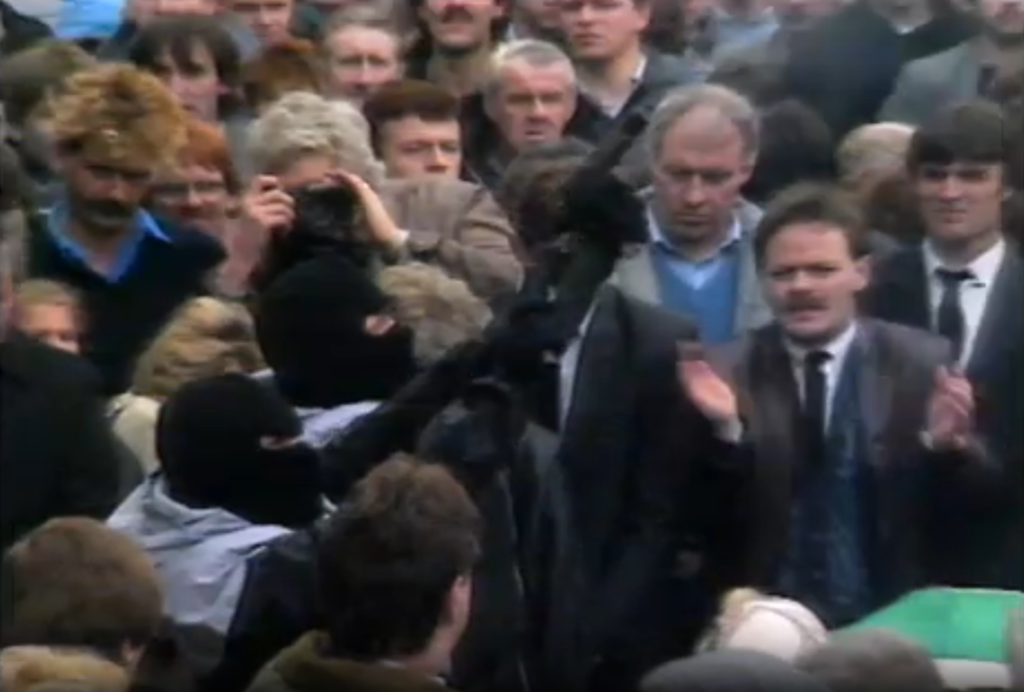
The RUC came out in large numbers and riot gear as they walked next to the crowd as they walked to a church. Afterwards, the RUC and the mourners would come into conflict and clash with one another. The clashes would initially be resolved and the cortege would continue towards the cemetery. When the cortege was moving towards the cemetery, a masked individual, presumably a member of the IRA, would fire off a volley near the two coffins. At first, the crowd would duck but they then broke out in applause once they realized what was happening. The RUC fired off plastic bullets at the mourners who responded with stones. Sinn Féin leader Gerry Adams would also be at the funeral and later condemned the RUC’s actions (Northern Ireland Conflict Videos 2022b).

The funerals of McShaffrey and Deery show a defiance against the might of the state security services. The goal of the RUC to prevent a paramilitary display was thoroughly thwarted.

The ability of the IRA and Sinn Féin to maintain their presence at the funerals of IRA members shows their tenacity even in situations where rendering a funeral with a clearer IRA presence was impossible. Even at funerals there would still be conflicts and violence. The funerals acted as a continuation of that violence.

Artifact 6: Public Criticism of IRA Funerals

Frame of Video from RTE Archives

https://www.rte.ie/archives/collections/news/21267090-ban-on-ira-funerals-lifted/

The manner in which the funerals of IRA members were conducted would draw scrutiny and condemnation from both members of the public and officials. Specifically, the firing of bullets into the air by IRA members when they were conducting a salute over the coffin of a fallen IRA Volunteer led to a ban on IRA funerals being conducted in 1987. The argument made by the clergy in implementing the ban would be that the usage of firearms should not be allowed on church grounds as they would be inappropriate for funerals. The presence of firearms and salutes using them would also be avoided by the IRA on certain occasions. A scuffle between the crowd of mourners and the RUC at the funeral of an IRA Volunteer meant that the IRA chose to avoid conducting the salute out of concerns toward the safety of the funeral attendees. The Secretary of State for Northern Ireland Tom King would argue that the funerals would have to be conducted lawfully and in a dignified manner. The definition of what would be considered dignified by the Northern Ireland Secretary would be much different from that of the IRA. Ultimately, the ban on IRA funerals was lifted by church authorities in 1988 (RTE 1988a).

The hastily conducted volley shows that it is much more disorganized than the elaborately conducted funeral of the hunger striker Joe McDonnell. The circumstances of the volley also showed the ability of the IRA to adapt to the situation at hand.

The condemnation that came towards the conducting of IRA funerals shows the scorn toward the IRA from many members of the community. It is important to remember that despite the large number of mourners at an IRA funeral, there would still be resentment and disdain towards the IRA. The views toward those who died and their activities did not draw universal support even from their own communities.

Artifact 7: Descents into Violence

Frame of Video from RTE Archives

https://www.rte.ie/archives/collections/news/21272007-soldiers-killed-at-ira-funeral/

IRA funerals were subject to violence during the Troubles. At Milltown Cemetery, an attack by a loyalist gunman would kill three and injure dozens more (Beiner 2007). One of the killed would be Kevin Brady, a member of the IRA. At the funeral of Kevin Brady, the mourners would descend upon two off-duty British soldiers, Derek Wood and David Howes, who were conducting surveillance duty at the funeral.

This video gives a clear view of the ensuing reaction of the mourners. The emotionally charged atmosphere of the funeral meant that when the two soldiers were discovered, the response was one of fury. Their car chaotically reverses as an enraged crowd surrounds it. The car tries to accelerate away, but its path is blocked by a car that maneuvers right in front of them. A furious crowd then surrounds the car preventing any means of escape. The next scene shows an individual in a light blue jacket breaking the passenger side window and kicking at the car door and the crowd then proceeds to surround the vehicle.

The actual killing of the two soldiers is not shown in the recorded footage. Later on, two bodies covered by blankets are shown following a police response.

This event shows how charged the atmosphere would be during the Troubles even at funerals. Even more so, the presence of or even hint of British security forces was not tolerated. The violence of the Troubles would continue even during times of mourning.

Artifact 8: Modern IRA Funerals

After the Good Friday Agreement, the IRA would decommission their weapons and end their military campaign (The Belfast Agreement 1998). This would mean that funerals would now have to be conducted differently from the way they were during the Troubles. This would mean that the previous way of conducting funerals for IRA members would have to change.

This video shows the funeral of Rita O’Hare, a member of Sinn Féin and the IRA. O’Hare would be arrested in Northern Ireland for attempted murder but ended up fleeing to the Republic of Ireland, and she would also serve three years in an Irish prison for explosives charges (Irish Times 2023). Afterwards, O’Hare would serve in a variety of high profile positions in Sinn Féin including as general secretary and represented the party in the United States. 

The leader of Sinn Féin Mary Lou McDonald, deputy leader Michelle O’Neill, and former leader Gerry Adams were all present at O’Hare’s funeral and served as pallbearers. Adams would deliver the eulogy for O’Hare as well. In the eulogy, Adams made O’Hare’s paramilitary activities no secret and proudly stated that she was a member of the IRA.

The funeral shows a more civilian feel to it than previous funerals, showing the end of the Troubles and the long road to peace. The Irish tricolor is still present, but the lack of a paramilitary presence is the most telling. Even though there is a lack of paramilitary symbolism, Gerry Adams did not hesitate to name O’Hare’s paramilitary activities as something that should be honored by her grandchildren. So, even while Sinn Féin peacefully pursues its goals through the political process, they do not forget to honor their past members even if their way of honoring former members of the IRA has changed.

Works Cited

Ban On IRA Funerals Lifted. 1988a. RTE. https://www.rte.ie/archives/collections/news/21267090-ban-on-ira-funerals-lifted/ (May 31, 2023).

Beiner, Guy. 2007. “Between Trauma and Triumphalism: The Easter Rising, the Somme, and the Crux of Deep Memory in Modern Ireland.” The journal of British studies 46(2): 366–89. http://dx.doi.org/10.1086/510892.

“Bobby Sands Died 35 Years Ago Today: How The Irish Times Covered the News.” 2016. Irish times. https://www.irishtimes.com/culture/books/bobby-sands-died-35-years-ago-today-how-the-irish-times-covered-the-news-1.2636487 (May 31, 2023).

Downie, Leonard, Jr, and Washington Post Foreigh Service. 1981. “Thousands Mourn at Sands’ Funeral.” Washingtonpost.com. https://www.washingtonpost.com/archive/politics/1981/05/08/thousands-mourn-at-sands-funeral/b3d0f22e-9693-404e-a9a8-5cdba17557db/ (May 31, 2023).

“Funeral of Rita O’Hare.” https://www.youtube.com/watch?v=3uPgU3M3gp4 (May 31, 2023).

Hanna, Erika. 2016. “Photographing the Hunger Strikes.” Irish times. https://www.irishtimes.com/culture/books/photographing-the-hunger-strikes-1.2552410 (May 31, 2023).

McKeown, Laurence. 2021. Time Shadows: A Prison Memoir. UK: Beyond the Pale Books.

Mulcahy, Aogán. 1995. “Claims-Making and the Construction of Legitimacy: Press Coverage of the 1981 Northern Irish Hunger Strike.” Social problems 42(4): 449–67. http://www.jstor.org/stable/3097041.

Northern Ireland Conflict Videos. 2022a. IRA Hunger Striker Bobby Sands’ Funeral, While Unionists Hold a Peaceful Rally to Remember Victims. https://youtu.be/-n9pdnPghuc?t=140 (May 31, 2023).

———. 2022b. “RUC Clashes with Mourners at the Funerals of IRA Members Edward McShaffrey and Patrick Deery, 1987.” https://www.youtube.com/watch?v=SD7SuvCa61g (May 31, 2023).

“Rita O’Hare Obituary: Leading Light in Republican Movement Had a Violent Past.” 2023. Irish times. https://www.irishtimes.com/obituaries/2023/03/11/rita-ohare-obituary-leading-light-in-republican-movement-had-a-violent-past/ (May 31, 2023).

Soldiers Killed at IRA Funeral. 1988b. RTE. https://www.rte.ie/archives/collections/news/21272007-soldiers-killed-at-ira-funeral/ (May 31, 2023).

Sutton, Malcolm. “CAIN: Sutton Index of Deaths.” Ulster.ac.uk. https://cain.ulster.ac.uk/sutton/tables/Status.html (May 31, 2023).

Sweeney, George. 1993. “Irish Hunger Strikes and the Cult of Self-Sacrifice.” Journal of contemporary history 28(3): 421–37. http://www.jstor.org/stable/260640.

The Belfast Agreement. 1998. https://assets.publishing.service.gov.uk/government/uploads/system/uploads/attachment_data/file/1034123/The_Belfast_Agreement_An_Agreement_Reached_at_the_Multi-Party_Talks_on_Northern_Ireland.pdf (May 31, 2023).

The Irish Press. https://www.irishnewsarchive.com/ina_wp/wp-content/uploads/2016/05/Irish-Press-1931-1995-Tuesday-May-05-1981.pdf (May 31, 2023).

Welch, Michael. 2022. “Consecrate and Desecrate.” In The Bastille Effect, Berkeley, CA: University of California Press, 171–83.

The Omagh Bombing and Its Aftermath

By: Tony Wilcox

The Good Friday Agreement is generally considered to have signaled the end of the Troubles (Morrison, 2020, 152). It is perhaps ironic, then, that the single deadliest incident of sectarian violence in Northern Ireland occurred after the agreement was created: the Omagh bombing (Morrison, 2020, 156). This attack, carried out in the town of Omagh a few months after the signing of the Good Friday Agreement, was perpetrated by the Real IRA, a splinter group of the Provisional IRA that was formed by those opposed to Sinn Fein’s participation in the peace talks leading up to the agreement (Class lecture, 05/17/2023). 

The Real IRA hoped that the bombing would derail the peace process and reignite republican violence, but in the aftermath of the bombing, Northern Ireland became even more committed to ending sectarian violence (Class lecture, 05/17/2023). The attack caused a greater than intended number of casualties, due in part to either the Real IRA relaying incorrect information when it informed the authorities of the bomb or errors on the part of police in interpreting the Real IRA’s message, depending on who is asked (Class lecture, 05/17/2023). Additionally, the casualties consisted largely of civilians, including a handful of Spanish tourists, and many nationalists, due to Omagh being a predominantly Catholic town (Morrison, 2020, 157). None of these groups of people were generally considered to be acceptable targets of sectarian conflict the same way that security services or police officers might be (Morrison, 2020, 157). These factors led to the Real IRA receiving immense backlash from everyone involved in the Northern Ireland peace process (Morrison, 2020, 157). While this backlash would have been expected from governments and unionists, even nationalist groups such as Sinn Féin forcefully condemned the bombing (Class lecture, 05/17/2023). These reactions demonstrated that Northern Ireland at large stood in opposition to the Real IRA’s actions.

This universal backlash negatively impacted the Real IRA’s reputation, and they were forced to significantly alter their tactics in order to maintain the organization’s survival (Morrison, 2020, 157). They even went so far as to declare a ceasefire in the days following the attack, and while the Real IRA eventually resumed violent activities, the response to the Omagh bombing permanently altered their approach to violence; future attacks were generally designed to avoid the risk of causing a high number of civilians casualties (Morrison, 2020, 161). Indeed, the Omagh bombing would be the last major bombing committed by the Real IRA (Bloom and Horgan, 2008, 610). The powerful backlash also allowed the British and Irish governments to pass draconian anti-terrorism laws that further weakened the Real IRA (Morrison, 2020, 157). In addition, the event increased pressure on the Provisional IRA to engage in decommissioning (Parker, 2009, 11). Ultimately, the Omagh bombing demonstrates how actions meant to stir up violence can actually have the opposite effect if they end up generating a unified backlash, resulting in the weakening of the group behind the act and inspiring a more determined push for peace among everyone else involved.

Artifact 1: Photo of the car containing the bomb shortly before the explosion

Photo of the car containing the bomb shortly before the explosion

This photograph was obtained from a camera found buried in rubble by investigators (Johnston). It depicts the red Vauxhall Cavalier that contained the 300 pounds of fertilizer based explosive used in the Omagh bombing (Johnston). It was taken mere minutes before the explosion occurred and underscores just how many civilians were nearby when the bomb went off (Johnston). Indeed, the image prominently shows a man with a child on his shoulders standing in front and just off to the side of the rigged vehicle. The photo also depicts numerous people walking or standing on the sidewalks closest to the car, all of whom are oblivious to the horror that is about to unfold. It was a busy day in Omagh, and to make matters worse, police ended up unintentionally moving people closer to the bomb, due to allegedly vague information from the Real IRA’s warning message (Johnston).

The death of so many innocent civilians played a major role in generating unified backlash against the Omagh bombing and the Real IRA. Unlike security personnel or police officers, who could be seen as extensions of the British state, civilians were not considered to be acceptable targets, especially not on such a large scale (Morrison, 2020, 157-158). Going forward, the Real IRA was careful to target its violent actions (including bombings) more narrowly so as to avoid large-scaled civilian casualties, which, as the photograph emphasizes, is a stark contrast from how they planned the Omagh bombing (Morrison, 2020, 158).

Artifact 2: Photo of Omagh after the explosion

Photo of Omagh after the explosion

This image, produced by the Associated Press in the aftermath of the attack, depicts a plethora of emergency workers and police officers surveying the damage caused by the explosion. A twisted mess of wood and steel, along with a heavily damaged car, lie at the center of the photo. Off to the left, one can see the ruins of buildings close to the explosion. As was typical for bombings carried out by republican paramilitary groups, the Omagh bombing was not intended to create a large number of civilian casualties, with the Real IRA instead hoping the attack would cause economic damage (Class lecture, 05/17/2023). This goal is seen with the decision to place the rigged car next to a clothes shop named SD Kells (Johnston). Of course, the Real IRA’s intentions of causing economic damage instead of perpetrating a mass casualty event did not stop the bomb from killing twenty-nine people (Morrison, 2020, 156). Photos such as these highlight the extent of the Omagh bombing’s devastation, making it clear why there was such a strong, unified backlash to the Real IRA. Had this attack been more carefully targeted, perhaps the Real IRA could have avoided the mass condemnation of its actions and the extremely negative impacts that came with it (Morrison, 2020, 157).

Artifact 3: RTE archive of eyewitness accounts

https://www.rte.ie/archives/2013/0815/468282-eye-witness-accounts-of-the-omagh-bombing/

These audio recordings of eyewitness accounts from people who witnessed the Omagh bombing paint a powerful picture of the horror the attack inflicted on the town (Caplin and RTE Archives, 1998). The first interviewee describes the sense of disbelief she felt in the immediate aftermath of the explosion, along with her dismay at the fact that people had unintentionally been driven closer to the bomb (Caplin and RTE Archives, 1998). The second interviewee recalls his frantic search for his wife and child, highlighting the chaotic nature of the scene (Caplin and RTE Archives, 1998). He goes on to describe how there was blood everywhere and that the street was littered with debris from the destroyed buildings (Caplin and RTE Archives, 1998). The final interviewee describes a similarly horrific scene, mentioning how she saw fathers trying to console their crying children (Caplin and RTE Archives, 1998). However, another memory of hers that sticks out is a much happier one: seeing a mother discover her daughter alive (Caplin and RTE Archives, 1998).

Heart-wrenching personal accounts of this nature emphasize the severe trauma that the bombing inflicted on the entire town of Omagh. Its effects were not limited to just one religious or sectarian group, as the attack occurred at the heart of a religiously mixed community (Johnson, 2012, 242). Catholics and Protestants alike were killed in double digit numbers (Johnson, 2012, 242). This aspect of the Omagh bombing goes some way towards explaining why it generated such a unified backlash against the Real IRA, as the deaths, injuries, and trauma it inflicted stretched across the sectarian divide (Johnson, 2012, 242).

Artifact 4: BBC article about the Real IRA apologizing

http://news.bbc.co.uk/1/hi/events/northern_ireland/focus/153629.stm

This article from the BBC, published a few days after the Omagh bombing, covers the Real IRA’s public apology for the attack. It was completely unprecedented for a paramilitary group to issue an apology in this manner (Class lecture, 05/17/2023). Therefore, the fact that the Real IRA felt the need to do so demonstrates just how powerful the backlash to the Omagh bombing was, with the Real IRA likely viewing the statement as something necessary in order to maintain its survival (Morrison, 2020, 57). However, the statement issued by the Real IRA also attempted to deflect some of the blame onto the police officers who had mistakenly driven people towards the bomb, maintaining that their operatives had not provided vague information (BBC News, 1998). This tactic demonstrated how the organization was already trying to distance itself from the attack, something it would continue to do for years to come even after it resumed its violent activity (Morrison, 2020, 159). Naturally, people were not keen to accept the Real IRA’s so-called apology, with the article featuring quotes from Northern Ireland Secretary Mo Mowlam harshly criticizing the statement (BBC News, 1998). Mowlam also rejected the notion that police shared responsibility for the death toll, contending that the blame rested squarely with the Real IRA (BBC News, 1998). Finally the article also contains a quotation from someone highlighting the importance of decommissioning, which underscores how the Omagh bombing led to an increased push for this process to be carried out (Parker, 2009, 11).

Artifact 5: Guardian article about Sinn Féin condemning the bombing

https://www.theguardian.com/uk/1998/aug/16/northernireland.henrymcdonald2

This article from The Guardian, written by Henry McDonald and published the day after the Omagh bombing, discusses Sinn Féin’s public condemnation of the attack. McDonald highlights that the nature of Sinn Féin’s statement represents a stark change from past responses to instances of republican violence. Traditionally, Sinn Féin would not take part in the “politics of condemnation”, but that philosophy was completely abandoned in its response to the Omagh bombing (McDonald, 1998). This decision by Sinn Féin to forcefully criticize the attack went a large way towards demonstrating how united Northern Ireland was in its desire to continue the peace process and parlaying the grief in the aftermath of the bombing into increased support for the peace process (Class lecture 05/17/2023).

Interestingly, the tone of McDonald’s article towards the peace process is not all that optimistic, as after outlining Sinn Féin’s condemnation, he speculates that the Omagh bombing will give credence to hardline unionist arguments that the peace process is not working. McDonald also identifies that the purpose of the attack was to derail the peace process, which puts unionists who might advocate for a crackdown in the awkward position of playing into the Real IRA’s hands. Next, the article mentions how the attack might increase support for the Irish government to enact selective internment for dissident republicans (McDonald, 1998). Finally, McDonald states that the Omagh bombing has destroyed support for the Real IRA among the nationalist community. The article is quite fascinating from a modern context due to the contrasting outcomes of its predictions and speculations; some (increased crackdown on dissident republicans by the Irish government) proved true, but others (fears that unionists would play into the Real IRA’s hands by derailing the peace process) ultimately did not play out (Class lecture 05/17/2023).

Artifact 6: Michael Farrell Omagh bombing artwork

Michael Farrell Omagh bombing artwork

This artwork by Michael Farrell is a tribute to those killed in the Omagh bombing, as shown by the accompanying description and poem. The latter text makes a clear plea for unity, declaring that orange and green (the colors of the Irish flag) does not matter and hoping that the attack won’t “shatter our dream”. This quotation can be interpreted as referring to the peace process, given that the Omagh bombing’s purpose was to derail the peace process (Class lecture, 05/17/2023). As highlighted by the artwork description, Farrell’s work powerfully underscores the horrific violence inflicted by the bombing. This is seen by how the trail of blood leading away from the pair of shoes is the only instance of color in the work, which naturally draws more attention to it. Another notable aspect of the work is the menacing figure standing behind the shoes, perhaps representing the Real IRA.

Farrell’s art stands as yet another example of how the Omagh bombing united Northern Ireland and strengthened many’s resolve to continue the peace process, a stark contrast from the Real IRA’s goal (Class lecture, 05/17/2023). The artwork also depicts the long-lasting trauma that the Omagh bombing inflicted, serving as just one example of the multiple memorials of and tributes to the victims of the attack, memorials that have continued in the decades since (Johnson, 2012, 237).

Artifact 7: Excerpt of the Criminal Justice (Terrorism and Conspiracy) Act of 1998

Artifact 7: Excerpt of the Criminal Justice (Terrorism and Conspiracy) Act of 1998

https://www.legislation.gov.uk/ukpga/1998/40/pdfs/ukpga_19980040_en.pdf

Above is the first substantive page of the Criminal Justice (Terrorism and Conspiracy) Act of 1998. Below it is a link to the act in its entirety. This legislation was rushed through the British parliament in the wake of the Omagh bombing and designed to prevent similar attacks from occuring in the future (Walker, 1999, 879). The act can be broken down into two parts, with the first one targeting specific organizations and individuals trying to disrupt the Northern Ireland peace process (Walker, 1999, 879). This part of the act was explicitly designed to be draconian and granted the government additional broad powers when it came to arresting and prosecuting members of organizations deemed terrorist groups (Walker, 1999, 879). For example, the excerpt features a provision that the oral opinions of police officers above the rank of superintendent stating that the accused is a member of particular organizations can be used as evidence to convict someone on charges of certain offenses. In effect, the law elevates police officers above the rank of superintendent to the status of an expert witness who can provide opinions based on personal judgements and experiences, rather than being limited to the facts of the case (Walker, 1999, 883). This stands as just one example of the act giving the British government more leeway when prosecuting people from certain violent organizations like the Real IRA. 

The second part of the act focuses more on foreign dissidents that seek to perpetrate violent action against the United Kingdom (Walker, 1999, 879). It is worth noting that the Irish government also passed similar anti-terror legislation after the Omagh bombing (Morrison, 2020, 156). The Criminal Justice Act of 1998 showcases a different dimension of how the Omagh bombing backfired for the Real IRA, as the attack allowed their primary opponent to rapidly grant itself more prosecutorial power (Walker, 1999, 879).

Artifact 8: Photo of the Garden of Light memorial

Photo of the Garden of Light memorial

This image depicts the Garden of Light, a memorial in Omagh that commemorates the Omagh bombing. It was unveiled on the tenth anniversary of the attack and was years in the making (Johnson, 2012, 246-253). The process involved looking at multiple proposals and a delicate process of consulting community members and advocacy groups to determine what the memorial should look like (Johnson, 2012, 246-253). Ultimately, the metal poles with mirrors attached were selected as the primary memorial, with each pole bearing the name of someone killed (Johnson, 2012, 248-252). The Garden of Light was constructed in tandem with a more discrete glass obelisk and stone plaque that were placed directly at the site of the explosion (Johnson, 2012, 246-253).

The creation of the Garden of Light and its sister memorials was not completely without controversy; indeed, one advocacy group, the Omagh Support and Self-Help Group (OSSHG), was unhappy that the stone plaque did not explicitly name dissident republicans as the perpetrators of the bombing (Johnson 2012, 250). But overall, the memorial itself and the unveiling ceremony were a display of unity. With its focus on the victims, the Garden of Light is not an overtly sectarian memorial and does not directly convey a certain ethno-religious message (Johnson, 2012, 246-253). The unveiling ceremony was also attended by representatives of four different churches: Catholic, Presbyterian, Methodist, and Anglican (Johnson, 2012, 253). There were even representatives from all four churches at a separate ceremony held by the still dissatisfied OSSHG (Johnson, 2012, 253).

The Garden of Light undoubtedly exemplifies the continuing trauma felt by Omagh and Northern Ireland from the bombing, but its construction and overall reception demonstrates a high level of unity within a society that is usually highly divided along sectarian lines (Johnson, 2012, 240). I believe it is another sign that, even years later, the Real IRA’s attempt to derail the Northern Ireland peace process only strengthened people’s resolve to reject violence and continue seeking peace.

Reference List

Author unknown. n.d. Omagh_imminent.jpg. http://www.wesleyjohnston.com/users/ireland/past/omagh/before.html

BBC News. 1998. “Real IRA apologizes for Omagh bomb.” Retrieved May 28, 2023. http://news.bbc.co.uk/2/hi/events/northern_ireland/focus/153629.stm

Belfast Telegraph. 2008. Floodlights illuminate the Omagh Memorial Garden last night following a silent tribute to the victims earlier in the day to mark the 10th anniversary of the bombing. https://www.belfasttelegraph.co.uk/news/omaghs-message-of-hope-amid-the-silence/28443703.html

Bloom, Mia and John Horgan. 2008. “Missing Their Mark: The IRA’s Proxy Bomb Campaign.” Social Research, 75(2), 579–614.

British Parliament. 1998. Criminal Justice (Terrorism and Conspiracy) Act 1998. https://www.legislation.gov.uk/ukpga/1998/40/pdfs/ukpga_19980040_en.pdf 

Calpin, Mary and RTE Archives. 1998. “Witness accounts of the devastation following a car bomb in Omagh that killed 29 people and injured hundreds.” Retrieved May 28, 2023. https://www.rte.ie/archives/2013/0815/468282-eye-witness-accounts-of-the-omagh-bombing/

Farrell, Michael. 2000. Omagh Bombing. http://www.troublesarchive.com/artforms/visual-art/piece/omagh-bombing

Gupta, Dev. 2023. “Class Lecture 05/17/2023.” POSC 284.

Johnson, Nuala C. 2012. “The contours of memory in post-conflict societies: enacting public remembrance of the bomb in Omagh, Northern Ireland.” Cultural Geographies, 19(2), 237–258.

Johnston, Wesley. n.d. “Before the Bomb – 15 August, 1998.” Retrieved May 30, 2023. http://www.wesleyjohnston.com/users/ireland/past/omagh/before.html

McDonald, Henry. 1998. “Sinn Fein breaks with past to condemn ‘disgusting’ act.” The Guardian, 16 August, https://www.theguardian.com/uk/1998/aug/16/northernireland.henrymcdonald2

Morrison, John. 2020. “Reality Check: The Real IRA’s Tactical Adaptation and Restraint in the Aftermath of the Omagh Bombing.” Perspectives on Terrorism, 14(6), 152–164.

Parker, Michael. 2009. “Changing history: the Republic and Northern Ireland since 1990.” PP. 3-15 in Irish Literature Since 1990: Diverse Voices, Michael Parker and Scott Brewster, eds. Manchester: Manchester University Press.

PA/AP Images. n.d. Aftermath of the terrorist attack in Omagh, County Tyrone, Northern Ireland, August 15, 1998. https://www.britannica.com/event/Omagh-bombing
Walker, Clive. 1999. “The Bombs in Omagh and Their Aftermath: The Criminal Justice (Terrorism and Conspiracy) Act 1998”. The Modern Law Review, 62(6), 879–902.

Walker, Clive. 1999. “The Bombs in Omagh and Their Aftermath: The Criminal Justice (Terrorism and Conspiracy) Act 1998”. The Modern Law Review, 62(6), 879–902.


The History of Integrated Education in Northern Ireland by Nate Bauer & Alex Washburn

POSC 284, Carleton College, Spring 2023

Lagan College in 1981. It is Northern Ireland’s oldest integrated school.
Photo credit: BBC

The status of education in any country is a vitally important matter. Northern Ireland is no different. A large issue within the education system in Northern Ireland is that even in the many years since the Good Friday Agreement, schools remain heavily segregated along religious lines. Scores of Protestant and Catholic children grow up never meeting one another, which many fear deepens societal and religious divides that have persisted for so long. Countless individuals and groups have suggested that prejudices could be reduced or eradicated entirely through intentionally exposing groups to each other, a hypothesis known as “contact theory.” Many politicians, commentators, and journalists in Northern Ireland and the United Kingdom more broadly have highlighted integrated education as a way to not only reduce sectarian tension, but also an avenue for truthful and accurate teaching of the Troubles. A strong commitment to integrated education in Northern Ireland would provide its people with tangible hope for a harmonious future.

Examining the history of integrated schools in Northern Ireland is particularly illuminating, and speaks volumes about how segregated society in the country has been for so long. For decades, the ugly specter of anti-Catholic discrimination touched nearly every aspect of public life in Northern Ireland. Housing, employment, electoral maps, voting rights, among others, were areas where Catholics found themselves receiving the short end of the stick. Education was an arena where the divide between Protestants and Catholics was especially pronounced. 1978 brought the Dunleath Act, legislation that enabled existing schools to transition to integrated status. This set the stage for a watershed moment in integrated education in Northern Ireland: the establishment of Lagan College just three years later in 1981, the first integrated school in Northern Ireland. It still exists today, serving the Belfast area and educating more than 1,400 students. Another key piece of legislation was the 1989 Education Reform Order. The Order created a framework for the development of integrated schools, and allowed the Department of Education to aid schools through making available grant money. These days in Northern Ireland, there exists a paradox with regards to integrated schools. Polling data consistently shows that a wide majority of people want integration. Just this month, an independent poll was published that showed 66% of respondents were in favor of making integrated schools the “main model” of education in Northern Ireland. Despite talking the talk on this issue, people are not walking the walk. Fewer than 10% of children actually go to integrated schools. In the academic school year 2021-2022, only 6% of students at integrated schools were new to integrated education. Though that number could be depressed due to the coronavirus pandemic, that is still a very small proportion.

SECTION I: Integrated Education, 1974-1995

Artifact 1: News reel from 1974 about integrated education

The concept [of integrated education] could run into opposition. And that it has. Mainly from spokesmen for the Catholic Church. Broadly speaking, they are totally against.

– Ted Nealon, journalist for Raidió Teilifís Éireann

Watch here: https://www.rte.ie/archives/2019/0425/1045680-integrated-education/

This RTÉ newsreel reports on Basil McIvor’s, Unionist Minister of Education in Northern Ireland, proposal to educate children from Catholic and Protestant backgrounds together. Originally broadcast on May 10, 1974 as an episode of “Seven Days,” an Irish Current Affairs Television Programme during the 60s and 70s, shows the beginnings of integrated education. Sadly, the Ulster’s Workers Council in May of that year strike led to a quick collapse of this proposal (Darby).

The newsreel details opposition to the plan from the Catholic church as “Catholic children should be sent to Catholic schools,” while other churches generally supported the plan. RTÉ covers the basic reasons Republicans favour the proposal and Unionists oppose it, highlighting the core, original sentiments that have defined the debate over integrated education. 

The focus shifts towards Saint Patrick’s National School in Ireland, a recent source of controversy as it had become Ireland’s first multi-denominational national school. One can observe the social obstacles and pressures felt by parents and schools hoping to transition into an integrated institution. 

The segment concludes with older footage of a group of young Protestant boys casually expressing their disdain for Rome-Catholics (Unionists), as a reminder of the deep social divisions. RTÉ finishes their segment on integrated education by reiterating the deep sectarian prejudices already ingrained in Irish children. 

This newsreel reveals the origins of integrated education in Northern Ireland and the forces for and against it. Most notably, the Catholic Church has been opposed in the past and maintains its opposition as a means to defend “the merits of a Catholic education, rather than . . . attack an inferior system” (McGlynn 2004). Even today the identity politics of Northern Ireland hinders integrated education’s impact. 

Artifact 2: “All Children Together” document supporting efforts to integrate

Read here: https://cain.ulster.ac.uk/proni/1981/proni_ED-13-2-544_1981-nd.pdf

Elizabeth Benton, a founding member of All Children Together, wrote this discussion paper in February of 1981 for Lord Elton, the Parliamentary Under Secretary of State at the Northern Ireland Office. In this document, Benton outlines the wishes of the All Children Together movement and the government’s shortcomings in promoting integrated education in NI.

A common argument against integrated education has been “pupils shall be educated in accordance with the wishes of their parents.” Benton argues that since parents who wish to send their children to integrated schools do not have that option, the government has not met their own standards. Moreover, she criticises the discrepancy between education in mainland United Kingdom that actually accounts for “its’ pluralist society.” Once more Westminster’s inattention to Northern Ireland decreased cross-community contact. 

Even during the Troubles opinion polls have indicated widespread support for integrated education. While Benton recognizes potential inaccuracies in opinion polls, consistent results over a long period of time should not be ignored. She believes that the onus is on the government to advance integrated education instead of grassroot movements. The arguments Benton outlined helped the All Children Together movement get approval to found Lagan College. However, she failed to inspire broader action by Westmister as the onus fell onto parents to create integrated schools.

This document reveals the mindset of the All Children Together movement and the type of arguments they had to make to be successful. The reader gains a deeper understanding of how the case for integrated education was formed. As a pioneer of integrated education in Northern Ireland, Elizabeth Benton should be celebrated for her struggle to improve community relationships.

Artifact 3: Lagan College at 40: First Students Share Memories of Early Days and Embracing Integrated Education in Belfast – Belfast Live

Lagan College’s first principal Sheila Greenfield is pictured with pupils. Photo credit: Belfast Live.

The 1978 Dunleath Act allowed existing schools to transform into integrated schools. It stipulated that “controlled schools with a small percentage of the minority community attending their school could invite the trustees of Catholic Maintained schools to share governance with existing Protestant representatives on the Board of Governors, thus creating a Controlled Integrated school” (McGonigle). However, the change required support of 75% of the existing parents and there was dispute over whether parents from the minority community should be consulted. Given the stark social divisions between the two communities, the framework of the 1978 Dunleath Act did not lead to the transformation of any existing schools. In fact, it was not until 1991 that the first school transformed to integrated status. In reality, the Dunleath Act was merely a piece of enabling legislation that required the government itself to do nothing (Newman). However, the feigned support from Downing Street did not deter the parents of All Children Together from making the first breakthrough for integrated education.

This image shows Sheila Greenfield, Lagan College’s first principal, walking to school with her pupils. Against the backdrop of the hunger strikes, the determined parents of the All Children Together movement established Lagan College in an old scout centre, with no government funding, little money, and 28 pupils. Now, Lagan College is one of the most oversubscribed post-primary schools in Northern Ireland, with almost 1500 students and 230 staff (Belfast Live). 

Lagan College provided the framework for parents to establish integrated schools as the majority of integrated schools have been organized by parents of both communities (McGlynn 2004). Downing Street’s ambivalent approach to Northern Irish affairs left the burden on its citizens to improve a starkly segregated education system.

Artifact 4: Interview with Sheila Greenfield and first parents of Lagan College

Watch here: https://www.gettyimages.co.uk/detail/video/new-school-northern-ireland-belfast-lagan-college-gv-ext-news-footage/815533378?adppopup=true

In an 1981 interview with Independent Television News (ITN), principal Sheila Greenfield discusses the merits of attending an integrated school. Carefully choosing her words, Greenfield frames Lagan College as an alternative to the traditional educational system, rather than a replacement. She appeals to parents hopeful for a post-sectarian future and calmly rebukes concerns that integrated education would lead to violence amongst children in schools. The interview provides excellent context surrounding Lagan College’s foundation. By being the first integrated school, Lagan College was in the media spotlight, putting immense pressure on its success. 

The clip transitions to interviews with parents and students at the picnic before Lagan College’s first day of instruction. In the clip the pupils interviewed expressed a simple desire to be able to make cross-community friends without being fearful of sectarian differences. The parents, however, exuded a cautious optimism for integrated education’s future. Given the backdrop of the Troubles, one can understand why the parents are uncertain of its long-term viability. Being the first integrated school, Lagan College had to chart its own path forward. While founding Northern Ireland’s first integrated school is a massive success, the real undertaking was always finding a way to be viable. 

The newsreel concludes with footage of pupils of Lagan College walking onto its walled premises, warning of the hardships ahead. The parents and pupils of Lagan College were the pioneers of integrated education, inspiring more parents to set out on their own to give their children the education they believe they deserve. The establishment of the Northern Ireland Council for Integrated Education (NICE) in 1987 and the Integrated Education Fund (IEF) in 1992 gave devoted parents needed guidance and financial support to establish their own integrated schools.

Artifact 5: Northern Ireland Information Service 1989 memorandum about Conservative MP’s speech at Lagan College

Read here: https://cain.ulster.ac.uk/proni/1989/proni_ED-13-2-890_1988-11-23.pdf

I congratulate those who had the vision of establishing integrated schools and further congratulate them on their perseverance… [But] there is no question of the Government forcing integrated education on anyone who does not want it.

– Dr. Brian Mawhinney MP, Education Minister

This memo grew out of a speech that a Conservative MP named Brian Mawhinney gave at Lagan College in 1988. He reiterated support from the British government for integrated education, saying “The Government’s fundamental position has always been to encourage integrated education where there has been a demand for it…For the first time, there will be a statutory responsibility for my Department to foster the aims of integrated education.” Notice the important caveat he provides in the first sentence. The government wanted to support education, but had to walk a tightrope to not upset Conservative voters.

The document continues with some relatively lukewarm support for integrated education on the whole, but Dr. Mawhinney heaps effusive praise on Lagan College specifically. It’s rather fascinating how the memo oscillates between extolling the virtues of exposing Protestant children to Catholic children and vice versa, and this more tamped-down rhetoric about not compelling parents to send their children to schools they don’t support. This perfectly exemplifies the noncommittal policy of Downing Street, which was to the detriment of progressing towards an integrated education system. 

Artifact 6: 1995 Policy memorandum by Michael Ancram

Read here: https://cain.ulster.ac.uk/proni/1995/proni_CENT-1-24-17A_1995-11-07.pdf

This March 1995 Policy Memo from Michael Ancram, Minister of State of Northern Ireland, to the UK Secretary of State concerns the state of integrated education in the mid-1990s. This document reveals how Westmister’s ambivalence lead to the development of integrated education via “voluntary integration by parental consent rather than compulsory desegregation” (McGlynn 2011). 

The section title “Policy Background” reveals the different avenues for integrating a school. The most common avenue involves a committed group of parents of both communities starting a new integrated school and slowly expanding. Of the 28 integrated schools in NI in 1995, all except 5 have been formed by a small group of parents from both communities who began small and then built up. This avenue has been more successful than the transformation of an existing school “by a ballot of parents.” Given the deep-divisions in NI society, convincing a large-cohort of parents to support integrating their child’s school was an undeniably difficult task. 

Despite his clear desire to expand integrated education in NI, the next two sections of the memo “Financial Implications” and “Policy Proposals” reveal a concern for wasteful government funding. The Integrated Education Fund takes the initial capital risk by offering new integrated schools loans which the government pays interest. Not until a school demonstrates long-term viability (usually clear after three years) will a school receive capital grants. Moreover, Ancram underlines insufficient government funding for his department’s medium and long-term commitments to integrated schools, necessitating increased financial commitment or more restrictive standards for organizing integrated schools.

This document unveils the government’s inadequate support for integrated education. In Fact, between 1997 and 2001 five integrated schools were opened in NI without any initial government funding (Integrated Education Fund). The British government exhibited more concern over government expenditures than sufficient funding for the continued development of integrated education in Northern Ireland. 


SECTION II: Current State of Integrated Education

Artifact 7: Political cartoon in Belfast Telegraph from 2013

From the January 14th, 2013 issue of Belfast Telegraph.

This political cartoon, published in the Belfast Telegraph in January 2013, displays a schoolboy sharing his career aspirations with his school’s career’s officer. The boy’s youthful enthusiasm is not reciprocated by the officer. His biggest desire after receiving his education is to lean into his sectarian identity by selling either the Irish tricolour or Union Jack, but not both. The officer’s apathy towards the schoolboy potentially reflects a generational tiredness towards prevailing sectarian identities in post-conflict Northern Ireland.

This is most likely a reference to Belfast City Hall Flag protests in 2012. The flying of the Union Jack or Irish tricolour are significant aspects of cultural heritage for Protestants and Catholics. Since 2000, the Department of Education for Northern Ireland has promoted policies aimed at creating a more tolerant and peaceful society (McGlynn 2004). Yet, the post-conflict education system still enables sectarian identities. Recent studies have found evidence that Northern Irish children still exhibit prefer ingroup symbols, i.e. Catholic children prefer the clover while Protestants prefer poppies (Taylor). 

This cartoon reveals a significant sentiment amongst Northern Irish citizens. The cartoon critiques the role of the flawed education system for creating an intolerable society. Maintaining a segregated education system maintains the prevalence of sectarian identities in all generations. In fact, studies show that almost two-thirds of young people report that all or most of their friends share the same background (Loader). The schoolboy’s passion for his identity alarms and disappoints the officer, who sees history repeating itself.

Artifact 8: Award-winning Op-Ed in the Guardian by Queens University student about integrated education

read here: https://www.theguardian.com/commentisfree/2021/dec/02/integrated-education-northern-ireland-school

The Guardian awarded their 2021 Hugo Young Award for political opinion to Abby Wallace, a student at Queen’s University in Belfast for her support of integrated education. Raised by parents who grew up in opposite communities, Abby is one of the 7% of students in NI who attended integrated schools. April 2021 in Northern Ireland was marked by violent rioting. Most concerning to Wallace was that children as young as 13 were perpetrators of violence. She sees “members of [her] generation being lured into anger and hostility . . . [and] a system that keeps them apart.” Grateful for an education not framed by sectarian divisions, Wallace urges Sinn Féin and the DUP to respond to widespread public support and decades of mandates in favor of integrated education. 

She notes how all integrated schools in Northern Ireland integrated on the basis of community support, not through government organization, marking a failure in government policy. Indeed the Department of Education has not done enough to “encourage and facilitate the development of integrated education” as stipulated by the 1989 Education Order (MacGlynn 2004). In her eyes, SF and the DUP purposely ignored pressures to integrate education as a means to keep their voter base intact. However, rising support for the non-sectarian Alliance Party – and the largest supporter of integration – makes Wallace optimistic. Soon, she hopes that the Alliance Party will be able to overtake the DUP and follow through on the government’s promises. 

In this wonderfully well-crafted article, Wallace encapsulates the frustration of Northern Irish youth, agitated by government paralysis. As a champion for a non-sectarian future, Wallace is a telling representative for the younger generations and this article outlines how she believes Northern Ireland can move forward: together in the same classroom. 

Article 9: New York Times article from last month about integrated education in 2023

read here: https://www.nytimes.com/2023/04/14/world/europe/northern-ireland-schools-good-friday-agreement.html

Integration doesn’t mean there is no religion. In the morning, students say a prayer, which includes the line, “We are different and special together.”

– excerpt from Decades on ‘From Peace, Northern Ireland Schools Are Still Deeply Divided’

This article from American newspaper The New York Times documents what the state of education in Northern Ireland is like right now: it was published just last month. Interestingly, it mentions that Protestant church leaders dominate the membership in school boards in specific areas. Expectedly, in some regions the school boards are mostly made up of Catholic leaders. It is easy to imagine how these boards can put pressure on faculty and administrators, and shape admissions policy. The article also includes a key detail: integrated education does not equate to there being no religion whatsoever at school for pupils. They pray in the mornings, and are encouraged to pray however they pray at home.

Another less-discussed dimension of education in Northern Ireland is how the children of asylum seekers fit in the education system. Recent crises and upheavals in Sudan, Afghanistan, and Syria have led to refugees making new homes across the globe. Many communities in Northern Ireland have welcomed them with open arms, and children have begun attending school. At one of the schools the author visited, she mentions there are students who were born in Asia and Africa who are Muslim. The Muslim, atheist, or irreligious children apparently often opt out of the religious education that is offered. Even though integrated education enjoys broad support, it is still unclear exactly how non-Christian children figure into the equation and will be made to feel welcome. Progress has been slow overall: since the opening of the first integrated school in Northern Ireland, only twelve more have been established, which is only 5% of all primary school openings (McGuinness).

Artifact 10: How much does segregated education cost taxpayers? About £600,000 (744,000 USD) a day, according to new research.

Read here: https://www.bbc.com/news/uk-northern-ireland-65167256

A new report from Ulster University has quantified the actual cost of segregated education in Northern Ireland on an annual basis. Taking into account various costs associated with sectarian education such as additional transportation due to segregation and academic selection, separate schools in a given locality, and the cost of programs that intentionally bring together Catholic and Protestant children. The final figure they came to was £226m a year and £600,000 a day. In USD, that is around $280,000,000 and $744,000, respectively. One of the authors of the report described the current state of affairs as “absolutely unsustainable.”

This report underscores that while there are obvious social costs to separate education tracks, there is a definite economic cost as well. Both government and parents bear the cost of this shocking sum. It is important to note that the Department of Education is trying to make up for these budgetary constraints in heart wrenching ways. The BBC notes that the department recently had to cancel a program that provided low-income families with extra money for food during the Christmas holiday break. This lends further credence to the notion that resisting integration has been harmful on virtually every level for Northern Ireland.

Artifact 11: Picture from opening of new Irish language school in County Down

Photo credit: The Yale Review of International Studies

This picture shows Education Minister John O’Dowd with smiling students at the ribbon cutting ceremony in 2010 for Gaelscoil na mBeann. The school is an Irish-medium school in Kilkeel, one of the southernmost towns in Northern Ireland. O’Dowd is a member of Sinn Féin, so it is unsurprising he would support efforts to establish and fund Gaelscoil na mBeann. The school uses Irish as its main language for instruction, but teaches from the same curriculum as other schools in Northern Ireland. People in Kilkeel created the school in 2010, but it only gained recognition and funding from the Department of Education in 2012.
The success of this school shows that while integrated education is at the forefront of the minds of education policymakers in Ulster, the Irish culture and language is not dying out. Protestant children are welcome at this school, though by looking at the website I cannot find any statistics on the demographic makeup of the school. This is worth noting, because the village of Kilkeel currently has a Protestant majority (about 55% of residents). The existence of schools such as Gaelscoil na mBeann that teach in the Irish language enriches the lives of the children it educates, and encourages pluralism in the fractured region.

Artifact 12: Liam Neeson PSA from Integrated Education Fund

Legendary actor Liam Neeson implores parents to support efforts to integrate schools in Northern Ireland.

Most people agree that educating children together is a better way forward for our society. It’s time to turn our aspiration into reality.

– Liam Neeson

In this message recorded for the Integrated Education Fund, actor Liam Neeson asks parents to work towards integrating schools in their neighborhoods. While it is short, Neeson makes for a good messenger for the cause. He grew up a Catholic in a majority Protestant area (Ballymena in County Antrim), and has spoken in the past about the effect the Troubles had on him. Neeson also has mentioned how Ian Paisley’s preaching inspired him to become an actor, and influenced his acting style. In the PSA, Neeson specifically mentions that schools need to welcome not only Catholics and Protestants, but also children who identify with a non-Christian faith or no religion at all. This inclusive rhetoric is something of a break from the language used in the seventies into the nineties, which tended to only mention Catholic and Protestant children. People in Northern Ireland certainly regard Liam Neeson quite highly, and his star-power is put to good use in this cause. He ends the PSA by asking parents to voice their support for integration by getting involved with the Integrated Education Fund.


Works Cited (Scholarly Sources)

Darby, John. 1978. “Northern Ireland: Bonds and Breaks in Education.” British Journal of Educational Studies 26(3): 215–23.

Loader, Rebecca. 2022. “Shared Spaces, Separate Places: Desegregation and Boundary Change in Northern Ireland’s Schools.” Research Papers in Education 37(6): 1097–1118.

McGlynn, Claire. 2011. “Negotiating Difference in Post-Conflict Northern Ireland: An Analysis of Approaches to Integrated Education.” Multicultural Perspectives 13(1): 16–22.

McGlynn *, Claire, Ulrike Niens, Ed Cairns, and Miles Hewstone. 2004. “Moving out of Conflict: The Contribution of Integrated Schools in Northern Ireland to Identity, Attitudes, Forgiveness and Reconciliation.” Journal of Peace Education 1(2): 147–63.

McGonigle, J., Smith, A., & Gallagher, T. (2003). Integrated Education in Northern Ireland. The Challenge of Transformation. UNESCO Centre, Ulster University. http://arrts.gtcni.org.uk/gtcni/bitstream/2428/6010/1/The%20Challenge%20of%20Transformation.pdf

Newman, Martin Peter. 2023. “Going Local, Heading Nowhere: The 1974–79 Labour Government’s Attempt to Introduce Comprehensive Schooling in Northern Ireland.” Irish Political Studies 38(2): 210–30.

Taylor, Laura K., Jocelyn Dautel, Edona Maloku, and Ana Tomovska Misoska. 2021. “Children’s Outgroup Giving in Settings of Intergroup Conflict: The Developmental Role of Ingroup Symbol Preference.” Developmental Psychology 57(8): 1350–58.
“The History of Integrated Education.” IEF: Integrated Education Fund. https://www.ief.org.uk/integrated-education/the-history-of-integrated-education/ (May 21, 2023).

McGuinness, Samuel J. 2012. “Education Policy in Northern Ireland: A Review.” Italian Journal of Sociology of Education 4(1): 205–37.

Works Cited (Artifacts)

  1. “RTÉ Archives | Religion | Integrated Education.” https://www.rte.ie/archives/2019/0425/1045680-integrated-education/ (May 29, 2023).
  2. Elizabeth, Benton. 1981. DESIGNATION OF ONE SCHOOL IN AN AREA DESIGNATED AS “INTEGRATED” Thus Giving Parents a Wider Choice in Schools. https://cain.ulster.ac.uk/proni/1981/proni_ED-13-2-544_1981-nd.pdf (May 28, 2023).
  3. “Lagan College at 40: First Students Share Memories of Early Days and Embracing Integrated Education in Belfast – Belfast Live.” https://www.belfastlive.co.uk/news/northern-ireland/lagan-college-40-first-students-21530072 (May 30, 2023).
  4. “Interview with Sheila Greenfield by Phil Roman for ITN on 1 September 1981.” 1981. https://www.qmul.ac.uk/peaceprocesshistory/layers-of-meaning-directory/items/interview-with-sheila-greenfield-by-phil-roman-for-itn-on-1-september-1981.html (May 30, 2023).
  5. Northern Ireland Information Service. 1988. “Growth of Integrated Education.” https://cain.ulster.ac.uk/proni/1989/proni_ED-13-2-890_1988-11-23.pdf (May 23, 2023).
  6. Ancram, Michael. 1995. Integrated Education. https://cain.ulster.ac.uk/proni/1995/proni_CENT-1-24-17A_1995-11-07.pdf (May 30, 2023).
  7. “TeleToons 1: Topical and Political Cartoons from Belfast Telegraph | BelfastTelegraph.Co.Uk.” https://www.belfasttelegraph.co.uk/opinion/teletoons-1-topical-and-political-cartoons-from-belfast-telegraph/29015705.html (May 29, 2023).
  8. Wallace, Abby. 2021. “Integrated Education in Northern Ireland Is Urgent – Why Can’t Our Leaders See That?” The Guardian. https://www.theguardian.com/commentisfree/2021/dec/02/integrated-education-northern-ireland-school (May 21, 2023).
  9. Specia, Megan, and Andrew Testa. 2023. “Decades on from Peace, Northern Ireland Schools Are Still Deeply Divided.” The New York Times. https://www.nytimes.com/2023/04/14/world/europe/northern-ireland-schools-good-friday-agreement.html (May 30, 2023). 
  10. Meredith, Robbie. 2023. “Divided Education and Schools Cost £226m Extra a Year – Report.” BBC News. https://www.bbc.com/news/uk-northern-ireland-65167256 (May 30, 2023).
  11. “Schools Side-by-Side, but Worlds Apart: The Possibilities of Reconciliation through Integrated Education and Shared Education in Northern Ireland.” 2018. The Yale Review of International Studies. http://yris.yira.org/essays/2381 (May 31, 2023). 
  12. Liam Neeson Backs Parent Power through Integrate My School Campaign. 2017. YouTube Integrated Education Fund. https://www.youtube.com/watch?v=4JmN0Gdl2gM (May 30, 2023). 

Ian Paisley and the Troubles: From Abstentionist Politics and Protestant Militancy to “the Chuckle Brothers”

In aiming to study the Troubles, a series of central figures emerge both as leaders of many of the parties involved and as virtual representatives for entire communities involved in the conflict. From the Nationalist side, Gerry Adams, Martin McGuinness, and John Hume stand out, while the Unionists have David Trimble and perhaps their most enduring figure; Dr. Reverend Ian Paisley. From Presbyterian minister, founder, and leader of the DUP, fiery public speaker, and finally as an outwardly pragmatic and accommodating political leader, over the course of the Troubles, Ian Paisley led many different lives. At the beginning of the Troubles, Paisley crystalized a militant Protestant-Unionist ideology that aimed to resist Nationalism, and by proxy the perceived interests of Catholicism and the reach of the Catholic Church, by any means necessary (Bruce 2005, 9-10).

For Paisley and hardline Unionists and Loyalists, cross-community cooperation, particularly if it ceded a greater level of power to the growing Catholic minority, was not on the table. Whether driven by theological convictions, political opportunism, or an engrained sense of communal fear that was pervasive throughout the Protestant community in Northern Ireland, Paisley aimed to denounce and obstruct the whims of the Catholic and Nationalist “other” at every occasion (Southern 2004, 352-53).

To understand the evolution of Ian Paisley, whether in the form of his words, his actions, or otherwise, careful attention must be paid to how his views were mutually enforced by those in the Unionist majority, and vice-versa. Why he moderated his political views, or at least how he represented them publicly, remains highly debated in both academia and the public sphere. What can be said for certain is that no one who experienced a Paisley speech in the 60s, 70s, or 80s could’ve predicted the politician he became in the early 21st century. From political hardliner, to in-government “moderate,” the path of Ian Paisley’s development is winding, but it terminates with a figure that would be largely unrecognizable to those who knew him during the height of the Troubles.

The aim of this exhibition is to highlight both the public persona that Paisley built for himself and the DUP, and the events that transformed him from a firebrand into a meaningful part of Northern Ireland’s executive. Are Paisley’s changes of heart able to be a blueprint for future peace in Northern Ireland? That remains to be seen, but the sectarian conflict that characterized the Troubles is better remembered than pushed under the table and forgotten.

From photographs, speeches, and news clippings, it can be easy to simply view Paisley both as a fiendish enemy of peace and a political opportunist, but his words reflect both a strongly felt existential fear on the part of Protestant communities in Northern Ireland, and the clear understanding that they had been abandoned by the British government and were on their own to protect their cultural identities. While the ideology spread by Paisley strongly protested any formal concessions made to Nationalists, he often denounced Loyalist violence toward Catholic civilians and Republican paramilitaries (Greer 2009, 195-96).

One would be hard-pressed to find a more complicated and divisive figure that represented the Troubles and its evolution, but Paisley stands out among a crowd of Unionist leaders. While studying individuals can only go so far in telling the story of the Troubles, unpacking its impact and legacy would be wholly incomplete without Ian Paisley. A hero of Unionism, a stalwart defender of Protestantism to some, and an unmoveable villain and political tyrant to others, the impact of Reverand Paisley will last in Northern Ireland long after his passing at the age of 88 in 2014. 

Exhibit I: “Ian Paisley Meets with Unionist Leaders,” BBC, 1973

Though not the central figure he became in the following decades, Ian Paisley, pictured here at a meeting of Unionist leaders in 1973, remains integral to the understanding both of Unionism itself and of the broader sectarian dynamics that so defined nearly every aspect of the Troubles. In establishing the DUP in 1971, and when future negotiations were to force the entirety of the Unionist voter base to the sidelines, Paisley would continue to exert more control over the direction of non-violent Unionism within Northern Ireland (Southern 2007, 188-89).

But, even in 1973, Paisley was already becoming a crucial part of Unionism and was instrumental in driving Unionist opposition to the Sunningdale Agreement of 1973, and helped to establish the pro-strike political coalition that led to its collapse in the late spring of 1974 (Southern 2007, 187-88). Among the other leaders seated with Paisley was the former leader of the UUP, Brian Faulkner. Though partners in the work of solidifying a Unionist Northern Ireland, Paisley—along with the DUP—would eventually eclipse Faulkner’s UUP and begin to control politics more strongly on their terms (Doyle 2018, 8-9). Still, as the Troubles progressed into the second decade of violence, they lacked the veto to remain outside of the peace process.

Exhibit II: “Save Northern Ireland From a United Ireland,” Irish Election Literature, 1973

In many of the efforts to enshrine Unionist values in the public sphere, both Paisley and other Unionist leaders endeavored to gain the support of everyday Protestants and Unionists. To build a more broad base of public support, Paisley became an active figure in Unionist politics, and following his creation of the Democratic Unionist Party (DUP) in 1971, he would begin to challenge the electoral base of the UUP and their monopoly over the Unionism. This flyer, which was mailed to supporters in 1973 seeking donations, evoked both the classic fear of Protestants being ignored and ultimately abandoned by Westminster and the removal of powerful Unionist symbols of Protestant Ulster.

It appeals to law and order, and the desire for “the voices of the law-abiding people of Northern Ireland…[to] be heard and heeded by the British Government,” and denounces IRA violence. In reading a document intended to elicit strong enough feelings for Unionists to donate to the DUP, many of the pieces of rhetoric used by Paisley and the Unionist cause can be laid bare. Fear, but with the expectation that something can be done to save Unionism and Ulster were the rhetorical touchstones of Paisley’s appeals. 

With how vehemently the document disavows Republican violence, and particularly the IRA, it should be striking to see how in little more than 3 decades following, the DUP and Sinn Féin will enter into a tumultuous, but formalized, relationship in Northern Irish Executive.

Exhibit III: “Paisley’s ‘Never, Never, Never’ Speech,” BBC, 1985

From his role both as a minister and a politician, Paisley gained a reputation for bombastic oration and a series of extremely memorable quotes. Among them was his speech in 1985 decrying the signing of the Anglo-Irish Agreement and the betrayal of the people of Ulster to the whims of the Irish government. On the occasion of this photograph, November 15th of 1985, and the final signing of the Agreement, he provided the Unionist public with one of his most enduring quotes on Ireland’s role in Ulster: “Never, never, never!” The Agreement was met with massive street protests and a collective rebuke from Unionist leadership, with Paisley once again at its helm, decrying the British government’s willingness to move forward without Unionist assent (Shannon 1986, 849-50). As often expressed by the Unionist community and their leadership, it was felt that the British government was unwilling to protect their interests, and the Anglo-Irish Agreement was just another piece in a long line of grievances.

But, it was increasingly clear to Paisley and other Unionist leaders, that they could no longer operate without making any concessions to the Nationalists as they had with Sunningdale (Doyle 2018, 9). With fissures emerging among the Unionist voting block, though the vast majority still rejected the Agreement as they had with Sunningdale in 1973, the DUP—with Paisley as its most visible leader—were forced to act more tactically (Evans and Tonge 2007, 165-66). With even the most intransigent Unionist voters tiring of violence, the obstructionist politics of the DUP and Paisley were beginning to lose the foothold they had acquired in the 70s and 80s (Evans and Tonge 2007, 166). Political moderation began to seem more and more like an inevitability.

Exhibit IV: “Ian Paisley Heckles the Pope,” New Zealand Broadcast, 1988

While there are many moments where Paisley was open about his dogmatic and militant support of Protestantism, his outburst in the European Parliament at the arrival of John Paul II in 1988 was one of his more public moments of inflammatory anti-Catholic rhetoric. Holding a sign with the words “John Paul II antichrist” emblazoned in bold black lettering, Paisley was nothing if not a calculating and crafty showman. Present within the majority of Paisley’s addresses on Catholicism is the existential fear of the erasure of Protestant identity within Northern Ireland (Bruce 2005, 10-11). A bombastic and crass though profoundly gifted public speaker, Paisley was able to leverage Protestant fears about both Catholicism more broadly and a deeply ingrained sense of isolation with regard to the rest of the United Kingdom (Ganiel and Dixon 2008, 423).

Though the most well-known advocate for a more intransigent policy with regard to the Nationalist community, he nevertheless did not push Protestants to take the law into their own hands (Bruce 2005, 11-12). But, Paisley played upon the fears of the majority of Protestants and Unionists within Northern Ireland and prompted them to reject any kind of conciliatory policy (Wallis, Bruce, and Taylor 1987, 299-300). He effortlessly wedded theology with politics and spectacle in a manner that caught the ear of many Protestants in Northern Ireland and pushed some to take more militant efforts to defend their communal rights and identities.

Exhibit V: “Ian Paisley Exits a Good Friday Agreement Polling Station,” BBC, 1998

A landmark day for the entirety of the Unionist community, and particularly for Paisley and the DUP, the 22nd of May 1998 and the Good Friday Agreement (Belfast Agreement) referendum would change the lives of everyone within Northern Ireland. For their part, the DUP was keen to push voters to reject the Agreement and vote in negation, but the “YES” voters carried the day and a not insignificant number of Unionists also voted in favor of the agreement. For all of Northern Ireland, but particularly for Paisley and the DUP, the GFA would prove a turning point in the path of their previous strongly abstentionist stance (Doyle 2018, 8-9). The veto power that they once held had quickly evaporated, and the need to become more involved in the peace process was becoming ever more apparent.

With Paisley and the DUP now clearly on the outside, with the UUP and other Loyalist groups sitting at the GFA negotiating table, the clearest dissenting voices were pushed aside (Evans and Tonge 2007, 160). Though Paisley campaigned long and hard for a “NO” vote on the referendum, his efforts were ultimately in vain, with 71.1 % of the voters in Northern Ireland voting in affirmation of the agreement.  Ultimately ducking the attention of the cameras, an unlikely scene for a man such as Paisley, the GFA and its aftermath was a clear sign of the changing times, and the need to develop a more successful political strategy for a post-referendum Northern Ireland. 

Exhibit VI: “The Chuckle Brothers,” The Atlantic, 2008

For those who had lived through the violence and turmoil of the Troubles, to see Ian Paisley and Martin McGuiness sitting together, laughing and smiling at one another, is perhaps a strange image to behold. But the question remains, how did this firebrand of a minister and Unionist politician become a member of the so-called “Chuckle Brothers?” Paisley’s transformation was driven both by the practical concerns of entering into government with Sinn Féin, and the solemn recognition that whether his religious and political values may have pushed him and the DUP away from entering into a government with Sinn Féin, to be on the outside of political power was not an acceptable, nor sustainable, option (Southern 2010, 146-148).

Once Sinn Féin and the IRA took the first steps toward peace, it became increasingly untenable for the DUP not to follow in their footsteps (Southern 2010, 150). Though the DUP and Paisley remained somewhat unwilling partners in government, they nonetheless were able to form an executive with Sinn Féin from 2007-2011. The Chuckle Brothers also represent the more interpersonal side of Paisley, a face of a man more willing to crack jokes than sit sternly. 

On the occasion of Paisley’s death in 2014, he was personally remembered with fond words from Martin McGuiness and Gerry Adams alike. But their story of friendship and laughter has not been replicated on a society-wide level. It can be easy to see the two former opponents becoming friends as a sign of hope for Northern Ireland, but the tensions that defined the violent decades of the Troubles cannot simply be wiped away with laughter and jokes. Unfortunately, the need for increased grassroots support for cross-communal efforts remains in Ulster today.

Exhibit VII: “Ian Paisley’s Farewell Speech to the House of Commons,” Democratic Unionist Party, 2010

https://www.youtube.com/watch?v=KpRzH3aWaQA

In his final speech to the House of Commons, Paisley lacks much of the fiery rhetoric that was present in his speeches made during the decades of the Troubles. He speaks with general overtures to peace and reconciliation, to levelheadedness and a desire to have all the people of Northern Ireland—regardless of their politics or their religion— live in peace and community with one another. His tone is one of a man who is aware that the days when he could stand up and lambast John Paul II, Margaret Thatcher, or Gerry Adams are well behind him.

Did Paisley embrace militancy, and quickly reject it, once it provided no further pathways to power? That may be possible, but many of the policy failures that were attributed to Paisley and the DUP’s dissent were contested by multiple other parties involved in the Troubles (O’Doherty 2008, 3). The forces that continued to be at work around Paisley, both demographic changes and the reconciliation needed to formally enter into government, also spurred his outward moderation (Doyle, 10-11). A desire to return to an imagined past remains in Paisley’s final speech, one where neighborliness was more common, but hope for a more peaceful future remains.

While much of his rhetoric was tempered by the passing of time, and his handing of the reins of the DUP over to Peter Robinson in 2008, Paisley’s final address is one filled with melancholy. The Unionists, who were largely still dissatisfied with the GFA and its aftermath, must now ask who can replace this giant of a figure at a time of such crisis? In short, a replacement for such a titan of a man has yet to be found.

Exhibit VIII: “The Defiant Dinosaur at its Dam,” Fortnight, 1987

Though originally published in 1987 through the Belfast-based magazine Fortnight remarking on Paisley’s resistance to the Anglo-Irish Agreement and being “sold out” by the British government, this is one of many political comics that asks the viewer to consider Paisley’s place in the Troubles and his place within Northern Irish history. While Paisley must be viewed as a political obstructionist for much of the Troubles, his transition into a more cooperative form of governance must be seen as equally remarkable. In his public addresses, he denounced both Republican and Loyalist paramilitary violence, but his willingness to leverage anti-Catholic and anti-Nationalist sentiment on every occasion cannot be disconnected from the widespread violence of the Troubles (Bruce 2005, 10). When it was politically expedient to fan the flames of sectarian hatred and existential Protestant fears, Paisley did so without any regard for the consequences (Southern 2004, 358-59).

This cartoon shows Paisley as both a bulwark for Unionist resistance to change and as the mouthpiece of Protestant militarism and bigotry and as a figure obstructing both the pathway to elections while claiming history to be at a dead stop. How should the public, including those outside of Northern Ireland, remember Ian Paisley? At the end of his political career, and the twilight of his life for that matter, it became clear to Paisley—and perhaps many of his supporters—that he was a relic from a different time in Northern Ireland’s history: a “defiant dinosaur,” but one that accepted the fractious peace that had been built in the years following the GFA and the formal end of the Troubles.

Works Cited

Bruce, Steve. 2005. “Religion and Violence: What Can Sociology Offer?” Numen. 52(1): 5-28. 

Southern, Neil. 2004. “Paisleyism: A Theological Inquiry.” Studies: An Irish Quarterly Review. 93(371): 349-362. 

Greer, James. 2009. “The Paisleyites: From Protest Movement to Electoral Breakthrough.” The Sixties: A Journal of History, Politics, and Culture. 2(2): 187-205. 

Southern, Neil. 2007. “Paisleyism: an Ideology in Transition?” Studies: An Irish Quarterly Review. 96(382): 179-192.

Doyle, John. 2018. “Reflecting on the Northern Ireland Conflict and Peace Process: 20 years since the Good Friday Agreement.” Irish Studies in International Affairs. 1-16.

Shannon, William V. 1986. “The Anglo-Irish Agreement.” Foreign Affairs. 64(4): 849-870, 

Evans, Jocelyn A.J., Jonathan Tonge. 2007. “Unionist Party Competition and the Orange Order Vote in Northern Ireland.” Electoral Studies. 156-167. 

Ganiel, Gladys, Paul Dixon. 2008. “Religion, Pragmatic Fundamentalism and the Transformation of the Northern Ireland Conflict.” Journal of Peace Research. 45(3): 419-436.

Wallis, Roy, Steve Bruce, David Taylor. 1987. “Ethnicity and Evangelicalism: Ian Paisley and Protestant Politics in Ulster.” Comparative Studies in Society and History. 29(2): 293-313. 

Southern, Neil. 2010. “Ian Paisley: a Critical Comment.” Studies: An Irish Quarterly Review. 99(394): 139-152. 

O’Doherty, Malachi. 2008. “The Two Faces of Paisley.” Fortnight. 458: 14-15. 

“Dup Leadership: The Party that went from Firebrands to Government.” BBC, https://www.bbc.com/news/uk-northern-ireland-56951136. Accessed 31 May. 2023. 

“Save Northern Ireland From A United Ireland.” Irish Election Literature, https://irishelectionliterature.com/2017/08/02/save-northern-ireland-from-a-united-ireland-ian-paisley-1973-assembly-elections/. Accessed 31 May. 2023. 

“Ian Paisley Heckles the Pope (1988).” Youtube, https://www.youtube.com/watch?v=JlbmIMbKZa4. Accessed 31 May. 2023. 

“In Pictures: Ian Paisley.” BBC, https://www.bbc.com/news/uk-northern-ireland-29181129. Accessed 31 May. 2023. 

“The Strange Friendship of Martin McGuiness and Ian Paisley.” The Atlantic, https://www.theatlantic.com/international/archive/2017/03/martin-mcguinness-ian-paisley/520257/. Accessed 31 May. 2023. 

“Ian Paisley’s Farewell Speech to the House of Commons.” Youtube, https://www.youtube.com/watch?v=KpRzH3aWaQA. Accessed 31 May. 2023. 

CAIN: Web Service “Drawing Conclusions: A Cartoon History of Anglo-Irish Relations 1798-1998.” https://cain.ulster.ac.uk/images/cartoons/douglas98c.htm. Accessed 31 May. 2023.

Poetry of Place and Conflict

Each year since 2000, the Community Arts Partnership has run a Poet in Residence program for primary and secondary schools in Northern Ireland. Reaching over 10,000 students in sixteen years, the program aims to promote cross-community connection through art (Xerri 2017). The island of Ireland has a long tradition of poetry, which rose to prominence in the late 19th and early 20th centuries with the Irish Literary Revival (Murphy 2009). Poets such as Yeats drew inspiration from romanticized versions of Irish history and Celtic culture, cultivating a sense of place that exerts influence today (Murphy 2009). In Northern Ireland, a sense of place is more complex, begging the question, whose place? This collection explores the work of poets Seamus Heaney, Louis MacNeice, and John Hewitt, focusing on their musings on identity and conflict in Northern Ireland— post-Literary Revival and post-partition. By reading these poets’ work together, we can understand a story of place that is full of tension and nuance (Smith 1992). The conflict in Northern Ireland becomes more human, more personal, more haunting, when read through poetry. 

Seamus Heaney wrote that his poetic project was to “grant the religious intensity of the violence its deplorable authenticity and complexity.” (Hufstader 1996) Heaney was Catholic, born in County Derry in 1939 (Poetry Foundation). His poetry establishes a sense of place that is different from Yeats and other Revival era poets in that it is more down to earth and rooted in finding beauty in everyday life in Ireland rather than in grand mythology (Murphy 2009). Heaney’s poetry is also more political than that of the Revivalists. He described a feeling among his creative contemporaries of “being called upon” (Heaney 2006; Murphy 2009). While Heaney leans toward nationalism and nativism in Ireland, he still makes an attempt at maintaining the duality of the place, recognizing nuance that is often lost in discussions of the Troubles (Murphy 2009). 

John Hewitt was born Protestant in Belfast in 1907. Hewitt was a poet, historian, activist, and gallery curator. He was a founding member of the Belfast Peace League and the Committee for the Encouragement of Music and the Arts in Northern Ireland. Hewitt was anti-sectarian, believing in regionalism as a way of articulating one’s identity in Northern Ireland (Humanist Heritage). 

Louis MacNeice was a poet of a slightly earlier generation, dying in 1963, before the official start of the Troubles. MacNeice’s complex Northern Irish identity and its expression in poetry establishes his importance in this collection. Born in Belfast in 1907, MacNeice was the son of a bishop of the Anglo-Irish Church of Northern Ireland. While this affiliation might have landed him squarely in the camp of the unionists, MacNeice’s father was pro-Home Rule and spoke out against Protestant violence (Kennedy-Andrews 2008; Poetry Foundation). MacNeice did not live in Northern Ireland for long before leaving for England to attend school, matriculating at Oxford and going on to work for the BBC (Murphy 2009). His poetry condemns people on both sides of the Northern Ireland conflict for being close-minded, while also celebrating the beauty of the place and the people (Murphy 2009). As Kennedy-Andrews writes, “MacNeice is the representative of Anglo-Irish hybridity, exile, and migrancy” (37). 

Heaney explicitly placed himself in conversation with both MacNeice and Hewitt, grappling with the sense of place they each offer in relation to his own (Murphy 2009). Ultimately, Heaney believed his worldview to be more compatible with MacNeice’s detached and borderless notions than with Hewitt’s regional identity (Murphy 2009). This collection places poems by all three poets alongside one another so they can better be seen for the conversation they represent. In reading them together, we see an ever-more-complex web of meaning in which Northern Ireland and Northern Irish identities are suspended. 


Artifact 1: “Carrickfergus” by Louis MacNeice (1937)

Carrickfergus

I was born in Belfast between the mountain and the gantries

To the hooting of lost sirens and the clang of trams:

Thence to Smoky Carrick in County Antrim 

Where the bottle-neck harbour collects the mud which jams

The little boats beneath the Norman castle,

The pier shining with lumps of crystal salt;

The Scotch Quarter was a line of residential houses

But the Irish Quarter was a slum for the blind and halt.

The brook ran yellow from the factory stinking of chlorine, 

The yarn-mill called its funeral cry at noon; 

Our lights looked over the lough to the lights of Bangor

Under the peacock aura of a drowning moon.

The Norman walled this town against the country 

To stop his ears to the yelping of his slave

And built a church in the form of a cross but denoting

The list of Christ on the cross in the angle of the nave.

I was the rector’s son, born to the anglican order,

Banned for ever from the candles of the Irish poor;

The Chichesters knelt in marble at the end of a transept

With ruffs about their necks, their position sure. 

The war came and a huge camp of soldiers 

Grew from the ground in sight of our house with long 

Dummies hanging from gibbets for bayonet practice 

And the sentry’s challenge echoing all day long;

A Yorkshire terrier ran in and out by the gate-lodge

Barred to civilians, yapping as if talking affront: 

Marching at ease and singing ‘Who Killed Cock Robbin?’

The troops went out by the lodge and off to the Front. 

The steamer was camouflaged that took me to England — 

Sweat and khaki in the Carlisle train; 

I thought that the war would last for ever and sugar

Be always rationed and that never again

Would the weekly papers not have photos of sandbags

And my governess not make bandages from moss

And people not have maps above the fireplace 

With flags on pins moving across and across — 

Across the hawthorn hedge the noise of bugles,

Flares across the night,

Somewhere on the lough was a prison ship for Germans,

A cage across their sight. 

I went to school in Dorset, the world of parents

Contracted into a puppet world of sons

Far from the mill girls, the smell of porter, the salt-mines

And the soldiers with their guns. 

Curatorial Notes: 

We begin the collection with the poetry of MacNeice, who was writing the earliest out of the three poets whose work is in this collection. MacNeice’s life was one of displacement, exile, and hybridity. No poem of his articulates this better than “Carrickfergus.” All throughout this narrative, MacNeice emphasizes hybridity. Early in the poem, he describes the castle in County Antrim as being “Norman,” and he later describes how the Normans built this town. In doing so, he gives a reminder of Ireland’s history of conquest and migration, and also underlining the hybridity inherent in Irishness. Also early in the poem, MacNeice identifies the inequality present in Northern Ireland. The Scottish, or Protestant, live in “residential houses” while the Irish, or Catholics, live in a “slum.” MacNeice goes on to say how by his upbringing as anglican, he is now forever barred from an identity as Catholic, or truly Irish. This poem also details his immigration to England for school, during a time of war no less. The two stanzas before the last stanza see the word “across” repeated five times. Across seems an apt word for MacNeice’s identity: Irish, Protestant, nationalist, British-educated. His identity spans many identities and cannot fit neatly into one box. As someone who is in-between, MacNeice occupies a strange place in Northern Ireland, where the most important identities are sectarian ones. MacNeice’s poetry calls attention to the nuance in the histories and identities of Northern Ireland. 


Artifact 2: Excerpt from “Autumn Journal” by Louis MacNeice (1939)

Autumn Journal XVI

Nightmare leaves fatigue: 

We envy men of action 

Who sleep and wake, murder and intrigue 

Without being doubtful, without being haunted. 

And I envy the intransigence of my own 

Countrymen who shoot to kill and never 

See the victim’s face become their own 

Or find his motive sabotage their motives. 

So reading the memoirs of Maud Gonne, 

Daughter of an English mother and a soldier father, 

I note how a single purpose can be founded on 

A jumble of opposites: 

Dublin Castle, the vice-regal ball, 

The embassies of Europe, 

Hatred scribbled on a wall, 

Gaols and revolvers. 

And I remember, when I was little, the fear 

Bandied among the servants 

That Casement would land at the pier 

With a sword and a horde of rebels; 

And how we used to expect, at a later date, 

When the wind blew from the west, the noise of shooting 

Starting in the evening at eight 

In Belfast in the York Street district ; 

And the voodoo of the Orange hands 

Drawing an iron net through darkest Ulster, 

Flailing the limbo lands 

The linen mills, the long wet grass, the ragged hawthorn. 

And one read black where the other read white, his hope

The other man’s damnation: 

Up the Rebels, To Hell with the Pope, 

And God Save—as you prefer—the King or Ireland. 

The land of scholars and saints: 

Scholars and saints my eye, the land of ambush, 

Purblind manifestoes, never-ending complaints, 

The born martyr and the gallant ninny; 

The grocer drunk with the drum, The land-owner shot in his bed, the angry voices 

Piercing the broken fanlight in the slum, 

The shawled woman weeping at the garish altar. 

Kathaleen ni Houlihan ! Why 

Must a country, like a ship or a car, be always female, 

Mother or sweetheart? A woman passing by, 

We did but see her passing. 

Passing like a patch of sun on the rainy hill 

And yet we love her for ever and hate our neighbour 

And each one in his will 

Binds his heirs to continuance of hatred. 

Drums on the haycock, drums on the harvest, black 

Drums in the night shaking the windows: 

King William is riding his white horse back 

To the Boyne on a banner. 

Thousands of banners, thousands of white 

Horses, thousands of Williams 

Waving thousands of swords and ready to fight 

Till the blue sea turns to orange. 

Such was my country and I thought I was well 

Out of it, educated and domiciled in England, 

Though yet her name keeps ringing like a bell 

In an under-water belfry. 

Why do we like being Irish? Partly because 

It gives us a hold on the sentimental English 

As members of a world that never was, 

Baptised with fairy water; 

And partly because Ireland is small enough 

To be still thought of with a family feeling, 

And because the waves are rough 

That split her from a more commercial culture; 

And because one feels that here at least one can 

Do local work which is not at the world’s mercy 

And that on this tiny stage with luck a man 

Might see the end of one particular action. 

It is self-deception of course; 

There is no immunity in this island either; 

A cart that is drawn by somebody else’s horse 

And carrying goods to somebody else’s market. 

The bombs in the turnip sack, the sniper from the roof, 

Griffith, Connolly, Collins, where have they brought us? 

Ourselves alone ! Let the round tower stand aloof 

In a world of bursting mortar! 

Let the school-children fumble their sums 

In a half-dead language; 

Let the censor be busy on the books; pull down the Georgian slums; 

Let the games be played in Gaelic. 

Let them grow beet-sugar; let them build 

A factory in every hamlet; 

Let them pigeon-hole the souls of the killed 

Into sheep and goats, patriots and traitors. 

And the North, where I was a boy, 

Is still the North, veneered with the grime of Glasgow,

Thousands of men whom nobody will employ 

Standing at the corners, coughing. 

And the street-children play on the wet 

Pavement—hopscotch or marbles; 

And each rich family boasts a sagging tennis-net 

On a spongy lawn beside a dripping shrubbery. 

The smoking chimneys hint 

At prosperity round the corner 

But they make their Ulster linen from foreign lint 

And the money that comes in goes out to make more money. 

A city built upon mud; 

A culture built upon profit; 

Free speech nipped in the bud, 

The minority always guilty. 

Why should I want to go back 

To you, Ireland, my Ireland? 

The blots on the page are so black 

That they cannot be covered with shamrock. 

I hate your grandiose airs, 

Your sob-stuff, your laugh and your swagger, 

Your assumption that everyone cares 

Who is the king of your castle. 

Castles are out of date, 

The tide flows round the children’s sandy fancy; 

Put up what flag you like, it is too late 

To save your soul with bunting. 

Odi atque amo: 

Shall we cut this name on trees with a rusty dagger? 

Her mountains are still blue, her rivers flow 

Bubbling over the boulders. 

She is both a bore and a bitch; 

Better close the horizon, 

Send her no more fantasy, no more longings which 

Are under a fatal tariff. 

For common sense is the vogue 

And she gives her children neither sense nor money 

Who slouch around the world with a gesture and a brogue 

And a faggot of useless memories.

Curatorial Notes:

This excerpt is just one section from MacNeice’s 24-section poem entitled, “Autumn Journal.” In this section, MacNeice turns his attention to the North of Ireland, which he describes as his home. This poem is rich with details criticizing the tribalism and sectarian divides in Ireland. MacNeice points out absurdities on both sides of the Protestant-Catholic divide, further demonstrating his hybrid identity and rejection of sectarianism. MacNeice has a wistful tone at the beginning of the poem, saying he envies his “Countrymen who shoot to kill and never / See the victim’s face become their own.” His wistfulness comes from a lack of understanding. MacNeice is between identities, he cannot fathom the conviction of those who kill without remorse. In some ways, he wishes he had that conviction— it would mean a certain amount of belonging in Northern Ireland. As the poem goes on, however, MacNeice begins to criticize the thoughtless violence and its romanticization: “The land of scholars and saints: / Scholars and saints my eye, the land of ambush / Purblind manifestoes, never-ending complaints, / The born martyr and the gallant ninny; / The grocer drunk with the drum.” Instead of violence and conflict being tragedies imposed on Ireland, MacNeice seems to be saying that people are choosing violence and conflict through their actions. Violence and conflict are part of the fabric of everyday life, baked into identities, inseparable from the notion of place. Towards the end of the poem, MacNeice asks, “Why should I want to go back / To you, Ireland, my Ireland?” He does not answer this question in his poem, instead ending with further ruminations of the futility of sectarianism and violence: “Put up what flag you like, it is too late / To save your soul with bunting.” This is a reference to the ways in which neighborhoods in Belfast and Derry are decorated with flags the colors of the dominant community. Protestant neighborhoods will have Union Jack Flags and orange bunting, while Catholic neighborhoods will have green flags and bunting. This poem is a powerful condemnation of the divides present in Ireland from someone who lives outside them, giving us a uniquely nuanced perspective on conflict in Northern Ireland. 


Artifact 3: “Neutrality” by Louis MacNeice (1942)

Neutrality

The neutral island facing the Atlantic, 

The natural island in the heart of man,

Are bitterly soft reminders of the beginnings

That ended before the end began. 

Look into your heart, you will find a County Sligo,

A Knocknarea with for navel a cairn of stones,

You will find the shadow and sheen of a moleskin mountain

And a litter of chronicles and bones. 

Look into your heart, you will find fermenting rivers,

Intricacies of gloom and glint,

You will find such ducats of dream and great doubloons of ceremony

As nobody today would mint. 

But then look eastward from your heart, there bulks 

A continent, close, dark, as archetypal sin, 

While to the west off your own shores the mackerel

Are fat — on the flesh of your kin. 

Curatorial Notes:

Writing earlier than Hewitt or Heaney, in this poem MacNeice writes of the Republic of Ireland’s decision to remain neutral in WWII. This decision was especially tense because Ulster Protestants did fight in WWII. Irish Neutrality became yet another point of distinction between “native” Irish and Protestant Irish (Class lecture, April 5). MacNeice’s life and poetry are both riddled with the theme of displacement. In this poem, the reader is asked to look into their heart, to interrogate their home and their position in the world. MacNeice’s beautiful depictions of Irish scenery give way to a darker ending for the poem. Upon “looking eastward from your heart,” the reader is asked to see a continent “close, dark, as archetypal sin.” In looking east, the reader is asked to see mackerels, “fat — on the flesh of your kin.” While the reader is asked to hold home in their heart, they are then shown the consequences of holding home so dearly above all else. Holding home safe requires the abandonment of the “dark” continent of Europe, even if the people living there are your neighbors. Privileging home above neighbors and kin also enables violence. While the Irish treasure their home countryside, MacNeice reminds them that people are dying. By kin, MacNeice seems to gesture to the fact that Northern Irish Protestants were fighting and dying in WWII while Ireland remained neutral. So the Irish get their idyllic home at the expense of “kin.” Not only is MacNeice questioning ideas of what home should be, he also challenges who, on the island of Ireland, is considered kin. 

Artifact 4: “The bombed public house” by John Hewitt (1983)

The bombed public house

This was the pub where I once took that playwright

famous for broadcast brawl but witty sober.

He warned me going in he had no money,

and took a single pint of several offered.

This was the pub where I was called to meet 

the foreign poet; when he asked my age

he kissed me on both cheeks and called me father.

This was the pub where the small bald barman

always called me Doctor or Professor

on my infrequent visits, being neither. 

When this interior is restored, recovered

with fashionable surfaces and textures

will any mirror echo such reflections 

or cushioned corner’s covers bounce them back? 

Curatorial Notes:

In this poem, Hewitt revisits memories from a favorite pub in Belfast that has been bombed. All of the memories Hewitt describes are joyful, caring, and vulnerable. He describes a playwright too poor to buy any beer, taking only one beer offered. He describes a poet who, after just meeting, kissed him on both cheeks. And finally, he describes the bartender, who always called him Doctor or Professor out of respect, despite the fact that Hewitt was neither. All of these stories paint a picture of community. The pub was a place where people looked out for one another, where people could go to connect with others. The poem concludes with a stanza that takes stock of the damage and wonders what can be repaired. As Hewitt hints at, the physical repair of the building post-bombing will not restore the communal nature of the pub. The violence inflicted on it cannot be undone through interior design. This stanza is a metaphor for the Troubles on the whole. If or when the violence ends, cleaning up the damage may not be enough to move forward. 

This poem was written in 1983, fourteen years after the beginning of the Troubles and fifteen years before the Good Friday Agreement was signed (CAIN). In the midst of all this violence, Hewitt wrote this poem, asking the questions of how the violence would end and what it would take to heal from that violence. While there is no outright blame or sectarian bias in this poem, there are a few implications that merit unpacking. For one, Hewitt himself was Protestant, even if he had largely non-Sectarian views. The fact that he was Protestant means that the pub he frequented was likely Protestant because everything in Northern Ireland was segregated during this time (Class lecture, April 3). So this poem is mourning the loss of an institution of his community. It is not a non-sectarian loss. Additionally, the title says the pub was bombed. During the Troubles, the groups who carried out the majority of bombings by far were Republican paramilitaries (Class lecture, May 17). By knowing this angle of the story in Hewitt’s poem, we gain further insight into the nuance of his view. Like Heaney in many ways, Hewitt does not overtly condemn any one group as being the problem. There are subtle ways that identity and difference of identity play out in this poem, but neither identity is written off. 


Artifact 5: “Lines for a dead alderman” by John Hewitt (1983)

Lines for a dead alderman

Justice is done in the end,

the rascal who had his day

to party and prejudice friend,

lodged in non-partisan clay. 

As the mourners drive away

they leave that bundle of lies

to the earthworms’ enterprise. 

But, Lord, it is long to wait

till the wrong that that man did 

and the hurt borne of his hate 

lies under the coffin-lid; 

the earth may never be rid

of that wrong this side of time

if I let it tarnish my rhyme. 

Curatorial Notes:

In this poem, Hewitt lets loose a string of criticisms directed at the deceased local politician. Hewitt describes him as a liar and someone who sowed hate. Hewitt says that the man’s wrongs are so long-lasting that, “the earth may never be rid / of that wrong.” About his death, Hewitt writes that “Justice is done,” implying that the man did not die of natural causes. Hewitt shows utter lack of remorse for this man’s death, despite narrating as though he attended the funeral. This raises questions about his motivations and those of the mourners. His calling them mourners implies that they don’t share his  negative opinions of the Alderman, but the reader is never explicitly given this information. 

The way that Hewitt condemns this man is unretractable. There is no room for nuance in how he feels about the dead alderman. This poem does leave open some questions to consider, in the context of the Troubles. For one, we know that the politician had to be either Catholic or Protestant. Which was he? It is far more likely that he was Protestant, given that Protestants held most government positions and were the ethnic majority in Northern Ireland at the time of writing (McGarry & O’Leary 1995). Hewitt’s stance here is highly political and also indicative of his misgivings about the state. Throughout his life, he argued for a regional Ulster identity that was not tied to a state or to sectarian politics (Kennedy-Andrews 2008). His expression of distaste for the dead politician in this poem reflects this stance. By failing to name the politician’s sectarian identity, Hewitt demonstrates the best of his non-sectarian leanings.  


Artifact 6: “Orange Drums, Tyrone, 1966” by Seamus Heaney (1966)

Orange Drums, Tyrone, 1966

by Seamus Heaney

The lambeg balloons at his belly, weighs

Him back on his haunches, lodging thunder

Grossly there between his chin and his knees.

He is raised up by what he buckles under.

Each arm extended by a seasoned rod,

He parades behind it. And though the drummers

Are granted passage through the nodding crowd,

It is the drums preside, like giant tumours.

To every cocked ear, expert in its greed,

His battered signature subscribes ‘No Pope’.

The goatskin’s sometimes plastered with his blood.

The air is pounding like a stethoscope.

Curatorial Notes:

This poem describes a phenomenon well-known to any resident of Northern Ireland: the lambeg drums of the Orange Parades. Lambeg drums are large, loud drums played by Protestants during summer marching season. Marching season celebrates the anniversary of the defeat of Catholic King James by Protestant King William of Orange (Channel 4 News 2022; Class lecture April 3). For Catholics, marching season is a tense time of year. This display of Protestant pride keeps Catholics mostly inside their homes, looking to avoid interaction with boisterous Protestants. The loud and aggressive-sounding lambeg drum adds to feelings of insecurity and inter-community conflict. 

Heaney’s poem showcases this tension. As a Catholic and nationalist, Heaney would have a negative reaction to hearing lambeg drums. This is reflected in the language he uses in this poem, which is largely negative. He describes the drum as “ballooning” from the player’s belly “grossly there between his chin and his knees.” He also compares the drums to “giant tumors” and listeners as experts “in greed,” both of which emphasize the colonial and oppressive undertones of marching season. The line “He is raised up by what he buckles under” is rich with meaning and more nuance than the other negative language contains. Heaney recognizes that perhaps the oppressiveness of marching season is a weight on the Protestant community too, or at least reflects the burdens they bear as an isolated culture in Northern Ireland. The last line of the poem is especially powerful: “The air is pounding like a stethoscope.” If the air pounds like a stethoscope, it is measuring the powerful but deeply unsteady heartbeat of a divided Northern Ireland. While upon first glance this poem seems anti-Protestant, Heaney ultimately showcases the nuance and mutual pain and oppression of the conflict. 


Artifact 7: “Summer 1969” by Seamus Heaney (1969)

Summer 1969 

While the Constabulary covered the mob   

Firing into the Falls, I was suffering

Only the bullying sun of Madrid.

Each afternoon, in the casserole heat

Of the flat, as I sweated my way through   

The life of Joyce, stinks from the fishmarket   

Rose like the reek off a flax-dam.

At night on the balcony, gules of wine,

A sense of children in their dark corners,

Old women in black shawls near open windows,   

The air a canyon rivering in Spanish.

We talked our way home over starlit plains   

Where patent leather of the Guardia Civil   

Gleamed like fish-bellies in flax-poisoned waters.

‘Go back,’ one said, ‘try to touch the people.’   

Another conjured Lorca from his hill.

We sat through death-counts and bullfight reports   

On the television, celebrities

Arrived from where the real thing still happened.

I retreated to the cool of the Prado.   

Goya’s ‘Shootings of the Third of May’   

Covered a wall—the thrown-up arms   

And spasm of the rebel, the helmeted   

And knapsacked military, the efficient   

Rake of the fusillade. In the next room,

His nightmares, grafted to the palace wall—

Dark cyclones, hosting, breaking; Saturn   

Jewelled in the blood of his own children,   

Gigantic Chaos turning his brute hips   

Over the world. Also, that holmgang

Where two berserks club each other to death   

For honour’s sake, greaved in a bog, and sinking.

He painted with his fists and elbows, flourished

The stained cape of his heart as history charged.

Curatorial Notes:

The Summer of 1969 was an important one in Northern Ireland. It marked the beginning of the Troubles, as the thirty-year conflict came to be known. In January 1969, Catholic peaceful protesters marching from Belfast to Derry to draw attention to Civil Rights were ambushed at Burntollet Bridge in what became a brutal attack. Loyalists and off-duty members of the RUC attacked the crowd of mostly university students. On-duty RUC members stood by, not intervening. This event sparked a turn for Catholics: from Civil Rights toward nationalist tendencies. Then, in August, a Protestant Apprentice Boys parade in Derry turned violent. Rioting broke out between RUC and nationalists. When RUC members and loyalists entered the Catholic Bogside Neighborhood to squash the rioting, their tactics became violent, further inflaming the conflict (CAIN; class lecture April 14; Munck 1992). Heaney was in Madrid during these events, and wrote this poem while far from home as the violence escalated. 

Throughout the poem, Heaney projects thoughts and feelings about Ireland onto his surroundings in Madrid, contrasting the scenery of this cosmopolitan scenery and its history with the history and current events of Northern Ireland. In the first few lines, we see Heaney’s leanings: “While the Constabulary covered the mob / Firing into the Falls, I was suffering”. By describing the Constabulary, or police, as “covering” the mobs, he is emphasizing the discrimination and brutality faced by Catholics in Northern Ireland. The police, instead of protecting all citizens, are supporting loyalist groups in inflicting violence and destruction on Catholics. In describing his visit to the Prado, an art museum in Madrid, Heaney focuses on paintings that depict violence and conflict. There’s a painting where a figure is, “Jewelled in the blood of his own children” and another where “two berserks club each other to death / For honour’s sake, greaved in a bog, and sinking.” These lines seem to reference the violence in Northern Ireland directly while also showing Heaney’s recognition of nuance. While he leans toward condemning the RUC, he recognizes that both Catholics and Protestants are responsible for senseless violence. 


Artifact 8: “The Other Side” by Seamus Heaney (1972) 

The Other Side

I

Thigh-deep in sedge and marigolds,

a neighbour laid his shadow

on the stream, vouching

‘It’s as poor as Lazarus, that ground,’

and brushed away 

among the shaken leafage.

I lay where his lea sloped

to meet our fallow,

nested on moss and rushes,

my ear swallowing

his fabulous, biblical dismissal,

that tongue of chosen people.

When he would stand like that

on the other side, white-haired,

swinging his blackthorn

at the marsh weeds,

he prophesied above our scraggy acres,

then turned away

towards his promised furrows

on the hill, a wake of pollen

drifting to our bank, next season’s tares.

II

For days we would rehearse

each patriarchal dictum:

Lazarus, the Pharaoh, Solomon

and David and Goliath rolled

magnificently, like loads of hay

too big for our small lanes,

or faltered on a rut —

‘Your side of the house, I believe,

hardly rule by the Book at all.’

His brain was a whitewashed kitchen

hung with texts, swept tidy

as the body o’ the kirk.

III

Then sometimes when the rosary was dragging

mournfully on in the kitchen

we would hear his step round the gable

though not until after the litany

would the knock come to the door

and the casual whistle strike up

on the doorstep. ‘A right-looking night,’

he might say, ‘I was dandering by

and says I, I might as well call.’

But now I stand behind him

in the dark yard, in the moan of prayers.

He puts a hand in a pocket

or taps a little tune with the blackthorn

shyly, as if he were a party to

lovemaking or a stranger’s weeping.

Should I slip away, I wonder,

or go up and touch his shoulder

and talk about the weather

or the price of grass-seed?

Curatorial Notes:

This poem explores Heaney’s relationship with Protestant neighbors in his youth as a larger metaphor for Catholic-Protestant relations in Northern Ireland. True to Heaney’s generosity and nuance, he describes the Protestant neighbor as respectful, saying that he waited for the family to finish the Rosary before coming to knock on their door and say hello. Throughout the poem, Heaney emphasizes the similarities that the neighbors share in relation to land and labor. Their lives are so parallel, lived on opposite sides of the stream separating their property. While Heaney references religious divides, he also emphasizes the shared life the neighbors have in the countryside, thereby centering a sense of place and identity that goes beyond religion. 

Heaney’s poem “The Other Side” is a response of sorts to John Hewitt’s poem, “The Glens.” In “The Glens,” Hewitt writes of similar feelings of separation and sharedness. He also uses the metaphor of neighbors living on opposite sides of a fence (Murphy 2009). Both of these poems use connection to place to emphasize the artificial yet consequential divides between Catholics and Protestants (Murphy 2009). In responding to Hewitt, Heaney enters the conversation about regional identity. Ultimately, while Heaney and Hewitt’s poems express similar thoughts, Heaney cannot agree with Hewitt that regional identity should supersede sectarian divides. The imbalance of power between Catholics and Protestants makes such reconciliation impossible for Heaney (Murphy 2009). While Heaney can recognize individual relationships as nuanced, he ultimately holds to his nationalist leanings (Murphy 2009). 


Works Cited

Class Lectures. April 3, April 5, April 14, May 17; 2023. Professor Devashree Gupta, Carleton College. 

Heaney, Seamus. 1972. Wintering Out: “The Other Side.” Faber and Faber, London, UK. 

Heaney, Seamus. 1975. North: “Orange Drums, Tyrone, 1966” “Summer 1969.” Faber and Faber, London, UK. 

Heaney, Seamus. 2006. “The Peter Laver Memorial Lecture ‘Place and Displacement’: Recent Poetry from Northern Ireland (1985).” The Wordsworth Circle 37(3): 148–56. https://www.proquest.com/docview/214238599/abstract/BC24EE5A41AC4AEDPQ/1 (May 18, 2023).

Hewitt, John. 1983. Loose Ends: “The bombed public house,” “Lines for a dead alderman.” The Blackstaff Press, Northern Ireland.

Hufstader, Jonathan. 1996. “‘Coming to Consciousness by Jumping in Graves’: Heaney’s Bog Poems and the Politics of ‘North.’” Irish University Review 26(1): 61–74. https://www.jstor.org/stable/25484649 (May 24, 2023).

“Humanist Heritage: John Hewitt (1907-1987).” Humanist Heritage. https://heritage.humanists.uk/john-hewitt/ (May 29, 2023). 

Kennedy-Andrews, Elmer. 2008. Writing Home: Poetry and Place in Northern Ireland 1968-2008. Suffolk, UK and Rochester, NY: D.S. Brewer, ch. 2. 

MacNeice, Louis. 1990. Selected Poems: from Autumn Journal” “Neutrality” “Carrickfergus.” Edited by Micheal Longley. Wake Forest University Press, North Carolina. 

McGarry, John and Brendan O’Leary. 1995. Explaining Northern Ireland. Oxford and Cambridge, MA: Blackwell, ch. 3.

Melaugh, Martin. “CAIN: Key Events of the Northern Ireland Conflict.” https://cain.ulster.ac.uk/events/index.html (May 31, 2023). 

Munck, Ronnie. 1992. “The Making of the Troubles in Northern Ireland.” Journal of Contemporary History, 27: 211-229.

Murphy, Andrew. 2009. “Heaney and the Irish Poetic Tradition.” The Cambridge Companion to Seamus Heaney, edited by O’Donoghue, Bernard. Cambridge: Cambridge University Press, 2009: 136-149.  

Poetry Foundation. 2023. “Louis MacNeice.” Poetry Foundation. https://www.poetryfoundation.org/poets/louis-macneice (May 31, 2023).

Poetry Foundation. 2023. “Seamus Heaney.” Poetry Foundation. https://www.poetryfoundation.org/poets/seamus-heaney (May 29, 2023).

Smith, Stan. 1992. “Seamus Heaney: The Distance Between.” The Chosen Ground: Essays on the Contemporary Poetry of Northern Ireland, edited by Neil Corcoran. Seren Books, Bridgend, Mid Glamorgan: ch. 2. 

Xerri, Daniel. 2017. “Inspiring Young People to Be Creative: Northern Ireland’s Poetry in Motion for Schools.” New Writing 14(1): 127–37. https://doi.org/10.1080/14790726.2016.1268166 (May 18, 2023).
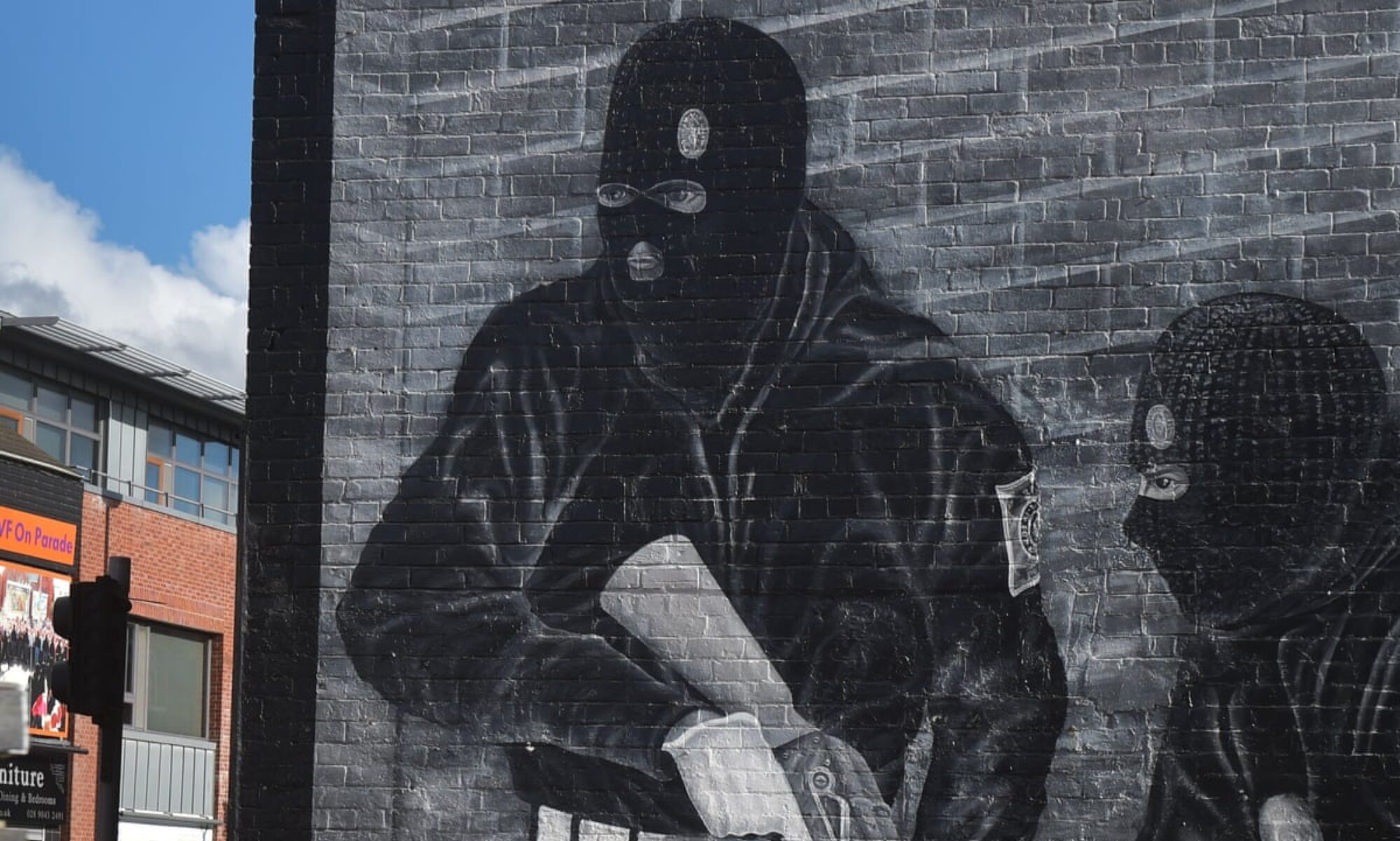
css.php