Life and Death in Divis Flats: The Enduring Symbolism of a 1960s Belfast Housing Project

The Troubles in Northern Ireland have an enduring iconography, even twenty-five years on from the signing of the Good Friday Agreement. This is partially to do with the long tradition of attaching social, political, and historical narratives to place that has been well-observed in the island of Ireland. Especially in the working-class areas of Belfast and (London)derry, one cannot go anywhere without coming across an area of significance to the Troubles (Feldman 436-437). As a result, specific neighborhoods and buildings have acquired a certain status in the public consciousness of the Troubles. One of the most notorious of these is Divis Flats, designed and built on the lower Falls Road in Belfast between 1966 and 1972 (Page 3). The flats would eventually consist of 12 interconnected eight story deck access blocks as well as one twenty-story tower, and had about 2,400 residents in 850 flats (Roy 1). 

From the beginning, the flats were controversial, as part of a slum clearance project by the Northern Ireland government. The Pound Loney, the neighborhood torn down to make way for the flats, was known as a safe and close-knit community, with family and friends living close to each other, and many small pubs and shops. However, the Victorian-era housing often lacked amenities such as central heating or running water (Roy 19). Thus, when the Divis Flats housing project was announced, the reaction amongst the residents of the Pound Loney was decidedly mixed, with many choosing to accept a move to Divis in order to stay close to family and friends, despite their reservations about the buildings. This attitude can be seen in a quote from a man who had lived in the Pound Loney before moving to Divis Flats– “the Pound Loney is where I was born and where I will die even if the Brits change the name to Divis Flats; for Christ sake, they might as well have called it Long Kesh” (Dowler 102). The flats themselves were described as “Europe’s youngest slum” even before construction had been completed (Page 3).

The flats quickly gained a reputation for violence, with a British Army base built on the roof of Divis Tower in 1972. This observation post was used for surveillance of the flats themselves, as well as the greater Lower Falls Road (Page 13-14). Soldiers lived on the top two floors of Divis Tower, and supplies were transported by helicopter (Alfaro & Roulston 28). The military made use of the design of the flats to carry out regular searches of the inhabitants (Roy 33). Resistance among the population, and the high rates of membership of first, the IRA and PIRA, and later, the INLA, meant that it became colloquially known as the “planet of the Irps,” a slang term for the INLA’s associated political party, the IRSP (Roy 8-9). Death and injury due to paramilitary or military activity were relatively commonplace, including among children as young as nine or ten (Alfaro & Roulston 28; Roy 9). 

In addition, there were several issues with the facilities of the flats, such as damp, mold, lack of laundry facilities, broken elevators, dirty stairwells, broken lights, overflowing rubbish chutes, the inability to supervise children, not enough play areas for the over-a-thousand children, broken railings, inability to stay warm, and more (Alfaro & Roulston 28-29; Roy 30-31, 33). Anger over living conditions led the residents to campaign for the demolition of the flats, which finally occurred in the summer of 1993, with only the tower (and the army base on top) remaining (Dowler 103; Roy 13-14). The army base itself stayed until 2005 (Page 21). Despite the fact that the flats are long-gone, they have endured as a symbol of the Troubles in the public consciousness, and still regularly feature in UK and Northern Ireland press relating to disappearances and murders from the time period.

Citations:

Dowler, Lorraine. “Preserving the Peace and Maintaining Order: Deconstructing the Legal Landscape of Public Housing in West Belfast, Northern Ireland.” Urban Geography, vol. 22, no. 2, 2001, pp. 100–105, https://doi.org/10.2747/0272-3638.22.2.100.

Feldman, Allen. “Violence and Vision: The Prosthetics and Aesthetics of Terror.” States of Violence, edited by Fernando Coronil and Julie Skurski, The University of Michigan Press, Ann Arbor, Michigan, 2006, pp. 425–459.

Gómez Alfaro, Garikoitz, and Fearghus Roulston. “Nostalgia for ‘HMP Divis’ and ‘HMP Rossville’: Memories of the Everyday in Northern Ireland’s High-Rise Flats.” Journal of War & Culture Studies, vol. 14, no. 1, 2021, pp. 25–44, https://doi.org/10.1080/17526272.2021.1873532.

Page, Adam (2017) Appropriating architecture: violence, surveillance and anxiety in Belfast’s Divis Flats. Candide – Journal for Architectural Knowledge (10). pp. 90-112. ISSN 1869-6465

Roy, Megan Deirdre. “Divis Flats: The Social and Political Implications of a Modern Housing Project in Belfast, Northern Ireland, 1968-1998.” The Iowa Historical Review, vol. 1, no. 1, 2007, pp. 1–44, https://doi.org/10.17077/2373-1842.1001.

Object 1: “High Life” part 1 BBC One documentary, 2010

The story of Divis Flats continues to attract attention today. This is a TV documentary from BBC One Northern Ireland first aired in 2010. As well as providing a general history and overview of the flats, it also contains several interviews of various players in the story of the flats. One of those interviewed is the architect, Frank Robertson. Interestingly, he shies away from really acknowledging issues with the design itself, instead blaming the residents of Divis Flats for issues with the facilities.

However, one of the most interesting aspects of this documentary is what it doesn’t acknowledge, namely the bias present in the planning of the flats. Similarly to the Bronx in New York City, the Pound Loney community was razed so that a highway could be built– in this case, the M1 motorway (Roy 4). In addition, by concentrating the Catholic community in high-rises, unionist politicians were able to ensure that Protestants would continue living in the nearby areas of the Shankill Road and Sandy Row, instead of moving further out and leaving room for Catholics to dominate the constituencies in the inner city (Roy 39). This process of ghettoization “implemented imperial and colonial agendas” by reducing social contact between opposing sides (Feldman 433-434). The British Army also had a hand in planning public housing in Belfast, which can clearly be seen in the design of the flats, where every door pointed towards the army post (Roy 24). 

This documentary makes no reference to any of the above, perhaps unsurprisingly, as the BBC is the national broadcaster of the UK, and is thus predisposed to slant its news coverage towards the British state. Divis Flats is instead presented almost paternalistically, blaming the poor conditions on the residents just not knowing how to live in a modern high rise.

Object 2: The British Army base on Divis Tower in the early 2000s

“A man does not have a chance in these streets in the sky. At least in the old Pound Loney if you saw them coming to lift you, you had a chance to make a break for it down the street.”

–a resident of Divis Flats, as quoted in Dowler 102

Many of the residents of Divis Flats described it as a prison, with it even earning the nickname “HM Divis” (Alfaro & Roulston 28). This was not least due to the presence of the British Army base on top of Divis Tower, and the constant surveillance, humiliation, and harassment that entailed. Although the majority of people in Divis were initially not opposed to the British Army, this quickly changed due to a series of riots in which the military shot several people, including small children (Roy 26). The resulting widespread hostility amongst the residents led the army, in turn, to regard all residents of the flats as potential IRA members, which made them even more hostile, in a vicious cycle of violence. 

The British Army took to conducting house searches, which the residents referred to as raids (Page 10). They blocked off entrances and exits by positioning soldiers on the stairs and lifts, and detained the people they rounded up in the laundry tower (Page 10-11). They also changed the flats to fit their needs, breaking and blacking out lights so that they would be harder to see, and cutting the cables on all of the lifts after the murder of two soldiers by an IRA bomb hidden in the lift shaft (Alfaro & Roulston 33-34; Roy 33).

The army frequently pasted photos of residents taken from the surveillance post onto the windows of flats below, heightening the paranoia of the residents (Page 14). This also served as a tool of humiliation, with one man interviewed telling a story of a friend of his who adjusted his zipper after he realized it was undone, and was featured on posters the next day with the caption “Do you want your children around this man?”  (Dowler 100).

Object 3: “Ulster’s Lost Generation” New York Times article by John Conroy, 2 August 1981

Divis Flats attracted attention from outside of Northern Ireland due to its status as a symbol of the Troubles and a republican stronghold. This is a New York Times article from 1981, about three months after the death of Bobby Sands. It discusses the high crime rate in Divis Flats, its perception among the community, and the everyday violence, as well as the role of the IRA in policing Divis Flats. Among the people interviewed are a Divis resident in his twenties who is not part of the IRA, the press officer for Sinn Fein, and a representative of the RUC.

One of the main focuses of the article is the prominence of kneecapping as a form of punishment used by the IRA in their policing of their community. One man interviewed in the article, who was accused of car theft, was offered the choice of either cleaning the walkways of Divis Flats or being kneecapped by the IRA, and chose the kneecapping, because he felt that cleaning walkways would be too humiliating. 

Another aspect of Divis Flats touched on by the article is its perception in the wider community of Belfast. Although the Divis resident interviewed looked for a job as an auto mechanic, as soon as he said that he was from the flats, he was turned down. This was not unusual; when applying for jobs, residents of the flats would often list the address of a friend or relative because of Divis’s notoriety (Roy 25). Partially because of this, the unemployment rate in the Falls area tended around 68 percent, and 51 percent of Divis residents depended solely on welfare (Roy 2).

Object 4: Photo of children playing outside Divis Flats by Chris Steele-Perkins, 1978

This picture shows children playing outside of Divis Flats, with the remnants of the former Pound Loney community behind them. Children in the flats were usually unsupervised, as the design of the flats did not allow parents to easily observe their children (Roy 40). This meant that they were targets, both as potential recruits for paramilitaries, and for being injured by the paramilitaries or the army. The first child killed in the Troubles was nine-year-old Patrick Rooney, who was killed in Divis Tower in August of 1969 when the RUC fired a machine gun into the flats (Alfaro & Roulston 28). In a study comparing the children from Divis Flats to those from a nearby terraced Catholic housing estate, children from Divis Flats “were shown to have significantly higher rates of emotional distress.” (Roy 20)

The poor conditions of the flats themselves also created danger for children. In a 1987 health and housing survey, 36 percent of the children in the flats had frequent coughs and 10 percent had asthma symptoms caused by the ever-present damp and mold, and in the mid-1980s, a child died by falling through a broken railing on the stairway (Roy 33-34). However, there were still moments of fun for the children, with one former resident recalling:

“I remember one of the things we used to do if we were bored was to walk round the balconies looking for black bows on the doors and go in to see the corpse. It didn’t matter if you knew them or not […] God love some of those poor people, we must of had them tortured, cos if it was a good corpse we’d go back a couple of times.”

– Veronica, quoted in Alfaro & Roulston 38

Object 5: “Riots in the Divis Flats” by Peter Marlow, 1981

Given the status of Divis Flats as a republican stronghold, riots and protests were not uncommon. This photo depicts rioters after the death of Bobby Sands, the first of the hunger strikers in the Maze prison to die. During the hunger strikes, young people living in the flats “hijacked and burned over 100 cars, buses, and trucks around the complex, barricaded all of the entrances, and turned Divis into a “no go” area,” sheets were draped over balconies to block surveillance from the tower, and armed IRA and INLA members patrolled openly (Roy 29). The security forces were not able to get into the flats for six weeks.

This is only one of many examples of resistance against the security forces. When soldiers tried to carry out raids, women would rattle pot lids off of the balconies to alert the surrounding area, and children would throw trash (Alfaro & Roulston 35). In 1983, over 50 percent of residents actively supported either the IRA or the INLA (Roy 38). These paramilitaries set booby traps in the flats for the soldiers, including a pipe bomb in a stairwell in February of 1974 that injured eleven residents, but not the patrol unit it was intended for, and fired on soldiers in Divis Tower (Roy 8, 11).

There were also more peaceful forms of protest, such as a 1971 rent strike in protest of internment that saw 100 percent participation from the residents of the flats (Dowler 103). In addition, many Divis residents attended rallies of the Women’s Peace Movement, a peaceful protest group, in 1976 (Roy 10).

Object 6: “Belfast’s Divis Flats to be demolished” Guardian article by Bob Rodwell, 9 July 1986

Loader Loading…
EAD Logo Taking too long?

Reload Reload document
| Open Open in new tab

Although residents had been calling for Divis Flats to be demolished since 1973, only a year after its completion, the Housing Executive did not accede to their demands until 1986 (Alfaro & Roulston 29). This article from the Guardian announcing the upcoming demolition cites vandalism and safety concerns for the military and police as reasons for razing the flats. This may have been the government’s stated reasoning, but for the residents, this was the culmination of over a decade of sustained protest, both through raising public awareness and forcibly rendering apartments uninhabitable. 

The Divis Residents’ Association was formed in the late 1970s or early 1980s, and aimed to “raise public awareness through publications and studies” (Roy 12). They listed violence, social problems, and structural defects as reasons for demolition, but their biggest one was the “feeling of hopelessness, of being trapped in Divis” (Page 18). The Divis Demolition Committee, meanwhile, formed in 1979, decided to take matters into their own hands. They would make recently vacated flats uninhabitable by taking windows and doors out of the frames, breaking the frames, knocking through walls, pulling out electrical fittings, and closing the flats up with cinder blocks (Page 19-20; Roy 12). They also released rats in the office of the Housing Executive to show what daily life was like in Divis (Page 19). Sean Stitt, a member of the Committee at the time, explained their actions by saying “We can say to the Housing Executive, that if they don’t demolish Divis, the people of Divis Flats will certainly demolish it” (qtd. Page 20). 

Ultimately, though all of the reasons given above may have played a role in Divis’s demolition, the major one was the same reason the Pound Loney had been torn down thirty years before: to make way for the M1 motorway (Roy 12-13). 

Object 7: Photo of mural calling for demilitarization of Divis Tower by Peter Moloney, 19 February 2003

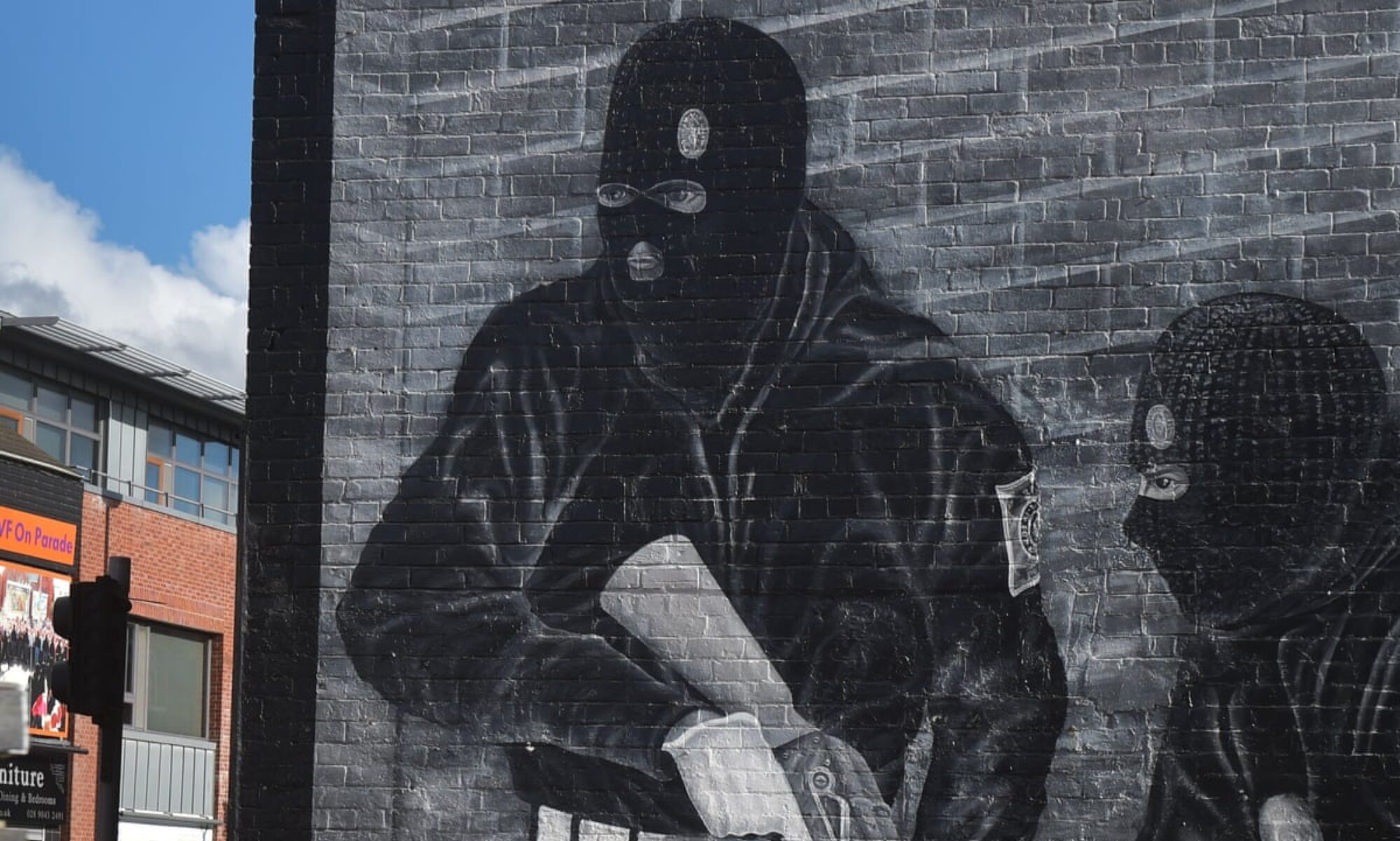
The flats themselves were completely demolished by the summer of 1993, but the tower remains to this day. The military base on the tower continued to keep watch over the lower Falls Road area until 2005, meaning that the residents there continued to feel a sense of paranoia from being observed almost twenty years after the announcement of the demolition of Divis Flats (Roy 2). This photograph, taken in 2003, shows a mural asking for the removal of the Divis Tower army base with the tower itself looming in the background. The mural was located on the International Wall on Divis Street, and was one of the first things a visitor to West Belfast coming in from the city center would see. Although the rest of Belfast is shown as a group of much shorter buildings silhouetted against the sky in the background, Divis Tower is large and bright, showing that it doesn’t belong.

Symbolically, the military base on Divis Tower was a remnant from the violent past for those living near it. It “became metonymic with the conflict itself, especially in its urban manifestation” (Alfaro & Roulston 35). While the blocks of flats became part of the fabric of a sort of mythos of republicanism during the Troubles, the Tower itself is not gone and is thus harder in some ways to reconcile with the violence that occurred there. Today, the Tower houses older people who need public housing, and is considered desirable enough that there is a long waiting list to live there.

Object 8: Photo of Jean McConville with three of her ten children, Associated Press

Though Divis Flats has (other than the tower) physically faded into the past, it is very much still alive in the public memory. This is a photo of Jean McConville, who was “disappeared” and murdered by the IRA on suspicion of being an informant in 1972, shown here with three of her ten children. She lived in Divis Flats when she vanished, and remains one of an extensive list of crimes from the Troubles that endure in public memory. She is particularly notable because of Gerry Adams’s alleged association with her disappearance and murder (Alfaro & Roulston 28). This particular case threatens the political status quo in Northern Ireland, making it clear that the violent past lurks just below the surface.

The flats’ symbolic status is furthered by the fact that their existence maps pretty closely onto the timeline of the Troubles. The first block was opened in May of 1968, four years before Bloody Sunday, and the final block was demolished in 1993, five years before the Good Friday Agreement was signed (Alfaro & Roulston 27). High and low points in the intensity of the conflict were directly echoed in Divis Flats. For this reason, it is often perceived and portrayed as a microcosm of the Troubles– the conflict centered in one area. This can be seen in movies about the Troubles. For example, the 2014 film ‘71 features Divis Flats as a nightmarish symbol for Northern Ireland as a whole (Alfaro & Roulston 36). Ultimately, perhaps a single area that experiences so much concentrated death and violence can never truly be erased from the public memory, even long after the physical structures are gone.

Bibliography:

British Army. “Soldiers Work at the Top of the 19-Storey Divis Tower.” BBC News UK, BBC, Belfast, Northern Ireland, 2005.

Conroy, John. “Ulster’s Lost Generation.” New York Times, 2 Aug. 1981, pp. 17–21.

Cunningham, Gemma, and Paul McGuigan. High Life Part 1. BBC One– High Life, Episode One, BBC One Northern Ireland, 2010, https://www.bbc.co.uk/programmes/b00v9kl0. Accessed 2023.

Dowler, Lorraine. “Preserving the Peace and Maintaining Order: Deconstructing the Legal Landscape of Public Housing in West Belfast, Northern Ireland.” Urban Geography, vol. 22, no. 2, 2001, pp. 100–105, https://doi.org/10.2747/0272-3638.22.2.100.

Feldman, Allen. “Violence and Vision: The Prosthetics and Aesthetics of Terror.” States of Violence, edited by Fernando Coronil and Julie Skurski, The University of Michigan Press, Ann Arbor, Michigan, 2006, pp. 425–459.

Gómez Alfaro, Garikoitz, and Fearghus Roulston. “Nostalgia for ‘HMP Divis’ and ‘HMP Rossville’: Memories of the Everyday in Northern Ireland’s High-Rise Flats.” Journal of War & Culture Studies, vol. 14, no. 1, 2021, pp. 25–44, https://doi.org/10.1080/17526272.2021.1873532.

“Jean McConville with Three of Her Children.” RTÉ Ireland, RTÉ Ireland, Belfast, 2015.

Marlow, Peter. Riots in the Divis Flats. New York City, 1981, https://library.artstor.org/#/asset/AMAGNUMIG_10311502840. Accessed 2023.

Moloney, Peter. “Demilitarise Divis Tower.” Peter Moloney Collection, Extramural Activity, Belfast, 2013, https://petermoloneycollection.com/2003/02/19/demilitarise-divis-tower/. Accessed 2023.

Morrison, Brian. “Divis Flats.” Troubles Archive, Arts Council of Northern Ireland, 2014, http://www.troublesarchive.com/index.php/artforms/architecture/piece/divis-flats. Accessed 2023.

Page, Adam (2017) Appropriating architecture: violence, surveillance and anxiety in Belfast’s Divis Flats. Candide – Journal for Architectural Knowledge (10). pp. 90-112. ISSN 1869-6465

Rodwell, Bob. “Belfast’s Divis Flats to Be Demolished.” The Guardian, 9 July 1986. Nexis Uni, https://advance.lexis.com/document/?pdmfid=1516831&crid=f8a0684a-051b-4614-acf1-3ac5de0a39ff&pddocfullpath=%2fshared%2fdocument%2fnews%2furn%3acontentItem%3a40GH-JC70-00VY-82XJ-00000-00&pdcontentcomponentid=138620&pdteaserkey=sr0&pditab=allpods&ecomp=-znyk&earg=sr0&prid=7527a2a9-3358-433b-bed8-1cbdd8a2e23e&aci=la&cbc=0&lnsi=62415cbb-4e27-48e7-928d-8af07d9e3e43&rmflag=0&sit=null. Accessed 2023.

Roy, Megan Deirdre. “Divis Flats: The Social and Political Implications of a Modern Housing Project in Belfast, Northern Ireland, 1968-1998.” The Iowa Historical Review, vol. 1, no. 1, 2007, pp. 1–44, https://doi.org/10.17077/2373-1842.1001.

Steele-Perkins, Chris. Outside Divis Flats. New York City, 1978, https://library.artstor.org/#/asset/AMAGNUMIG_10311511498. Accessed 2023.

How the Ambiguous Nature of Decommissioning Complicated Sectarian Divisions at the Onset of the Good Friday Agreement

The Irish Times

The Genesis of the Disarmament Issues and the Growing Political Divide

Beginning in the mid 1990’s and lasting all the way up until the 2010’s, the decommissioning of paramilitary weaponry in Northern Ireland quickly established itself as one of the central issues prolonging the peace process brought on by the Good Friday Agreement. Fundamentally, the issue centered around trust. More specifically, which political or paramilitary groups had earned it and who simply couldn’t be spared any on account of their failure to adhere to the commitment to disarmament. There are many historical cases which one could point to and claim that they specifically marked at least a symbolic beginning to the decommissioning process. However, it’s accurate to assert that the process became officially set in motion in 1995 when the British and Irish governments established an independent international body geared towards  solving the weapons issue (Van Tangen, 1998). This body, duly named the Independent International Commission on Decommissioning was spearheaded by Canadian General John de Chastelain and U.S. Senate Majority Leader George Mitchell, along with assistance from Finnish Brigadier-General Tauno Nieminen (Van Tangen, 1998). Distinguishing himself from his peers, Mitchell played a particularly important role in the peace process, as it relates to decommissioning, due to his drafting of the Mitchell Report –  a brief which clearly and explicitly resolved some of the key discrepancies concerning how decommissioning was to be carried out on a cross-party basis (​​“CAIN: Events: Peace: Report of the International Body on Arms Decommissioning, 22 January 1996,” 2023). Most worthy of note in his report, Mitchell explicitly called on the need for compromise, stating that decommissioning needed to be conducted in tandem with the peace talks in order to end the existing political gridlock between parties (Deane, 2009). 

Although significant, Mitchell’s report ultimately did little when it came to quelling sectarian tensions regarding decommissioning; especially with regards to IRA/Sinn Féin and UUP & DUP relations. In fact, by ensuring that both peace negotiations and disarmament would occur in-tandem, the stipulations of his report only created more room for political unrest. Northern Ireland is unique in that it is typically the case for post-conflict societies to go through decommissioning processes either before or after their new governmental institutions are established (Gallaher 2017). Unlike the rest, Northern Ireland undertook the burden of navigating both of these challenges simultaneously. It is precisely this dual-focus that makes way for the construction of the Good Friday Agreement and decommissioning to become ostensibly intertwined aspects of Northern Ireland’s larger bids for peace. Political leaders quickly came to realize the political benefits that would be extended to them by taking hardline stances opposed to the stances their political rivals clung to (Mitchell, 2010). This realization, coupled together with the altogether unspecific guidelines for the decommissioning process put forth by the GFA, opened the door for decommissioning to become one of the easiest methods parties could turn to in order to gain political leverage within the broader context of Northern Ireland (Mitchell, 2010). This, along with the inherent threat of violence that failure to decommission on behalf of paramilitary groups posed, only stirred the pot and ultimately led to a prolonging of the peace process that could have been entirely avoidable (Von Tangen, 1998). 

On display throughout the rest of this exhibit will be several artifacts that highlight the overtly fractionalizing role decommissioning played throughout the majority of the talks. The main point of emphasis resting upon the fact that the ambiguity surrounding the decommissioning process served as an area of volatility within the larger realm of post-Troubles Northern Ireland that effectively prolonged the conflict and inadvertently, stratified the political parties engaged to extreme degrees.


Commemorating the Fallen and Sending a Message: Funerals and Tributes to Fallen IRA Volunteers

Michael Ge

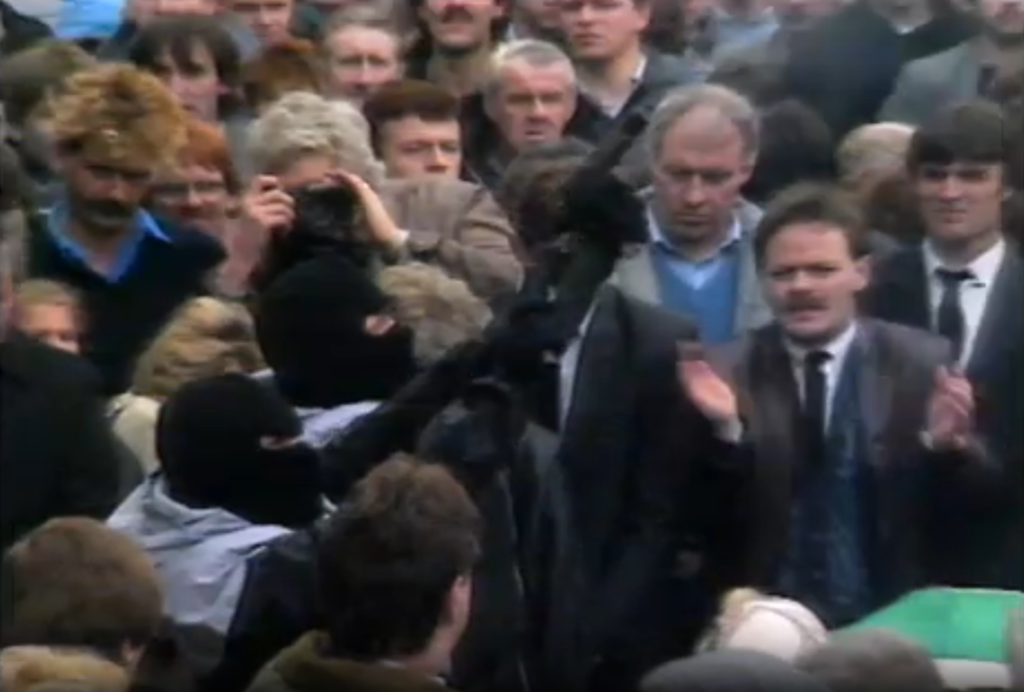
The funerals of IRA volunteers would serve as an intersection of the Troubles. Various different people and organizations would come into contact with one another at this event. Over the course of the Troubles, the IRA lost many of its members due to deaths in combat against the state security forces, in prison, and in other incidents. The IRA would take care to honor its members who were killed in the line of duty. The IRA was a military organization with a strong and clear political focus. As such, it would ensure that its funerals would be conducted in a military style manner while also making sure to make a political statement by emphasizing the cause for which the IRA volunteer died for, a united Ireland. Thus, the funerals of IRA volunteers would attract considerable attention and allow the mourning of the fallen volunteer as well as sending a clear political message.

The deaths of republican paramilitaries would constitute a relatively small number of the total deaths during the Troubles (Sutton n.d.). Even though that is the case, many of their funerals would draw a significant amount of public attention and press coverage (Mulcahy 1995).

The funerals would often draw many spectators from the community where the funeral was being conducted as well as the neighborhoods that the funeral procession would pass through (Mulcahy 1995). There would also be Sinn Féin making an appearance and speech at these funerals, which is no surprise given the links between the political party and the IRA. The IRA would use these very public funerals to show their presence and honor its dead. The sacrifice of their volunteers would be able to be used to maintain their legitimacy as the organization leading the struggle for Irish unity (Sweeney 1993). The fallen volunteers would be remembered and honored at these funerals regardless of whether others in Northern Ireland would consider them to be terrorists and murderers. These public remembrances of IRA volunteers show a specific part of the human loss that was all too common during the Troubles and serve as a way of expressing republican identity.

Some of those being honored had taken lives and yet they were being honored. Their victims did not receive anywhere near as much coverage and attention as the funerals of IRA volunteers (Mulcahy 1995). This juxtaposition drew controversy from members of both communities in Northern Ireland. These funerals would gradually evolve from the Troubles to the present as the conflict winded down and some practices regarding funerals would have to change. The variety of ways the IRA was able to honor its members shows both its adaptability and consistency which it also demonstrated throughout its campaign against the British security forces.

Ultimately, the funerals of IRA volunteers would serve as a poignant reminder of the lives lost during the Troubles and remind all those observing the funerals, whether they agreed with the IRA or not, of what the volunteer believed in, fought for, and ultimately died for.

Artifact 1: The Funeral of Bobby Sands

Irish Times/Getty Images

This picture was taken at the funeral of Bobby Sands. Bobby Sands’ coffin is flanked by IRA volunteers as it is carried by the pallbearers. Sands’ family follows closely behind his coffin.

Bobby Sands, a well known IRA volunteer, had died on hunger strike as a protest against the policies of the British government. Sands’ actions received significant international attention, spreading awareness of the republican cause (McKeown 2021).

Looking at the picture, the funeral of Sands appears to have welcomed a large number of onlookers of all ages. Indeed, the funeral of Sands attracted thousands to mourn and watch in Belfast (Mulcahy 1995). The presence of the IRA would mean that its appearance would be at the very least tolerated by the family of Sands. Even with the presence of the IRA, Sands’ mother, Rosaleen, called for peace at the funeral (Downie Jr and Washington Post Foreigh Service 1981).

At the funeral, the IRA would conduct a volley salute and escort the coffin of Sands. Gerry Adams would also make an appearance at the funeral and he paid tribute to Sands (Downie Jr and Washington Post Foreigh Service 1981).

The funeral of Sands and this picture in particular represents the many complex and intertwining factors at play at the funeral of an IRA volunteer. There is the military and political aspect which would feature the volley salutes of the IRA and the tributes from Sinn Féin. Then there is the family of Sands and their wishes regarding the violence faced by the people of Northern Ireland. Finally, there is the public who have come to commemorate the life of Bobby Sands. The funeral would show the high degree of community support enjoyed by Sands (Mulcahy 1995). This support would allow for a political message that had the added bonus of legitimacy to be sent. All of these factors combined would allow for an effective political message to be sent with the funeral.

Artifact 2: The Three Volley Salute

Derek Speirs

This picture was taken at the funeral of hunger striker Joe McDonnell (Hanna 2016). At McDonnell’s funeral, there are three IRA volunteers front and center in military uniform and with their rifles raised. Surrounding them is a crowd of mourners and onlookers who have come to pay their respects to McDonnell.

In accordance with a military style funeral, there will be a three volley salute conducted. This form of salute would involve three soldiers each raising their weapons and firing three shots in unison, such an action would traditionally symbolize the continuation of fighting (Welch 2022). In this picture the three IRA volunteers performing this action.

The other eye-catching part of this picture is the Irish tricolor laid on McDonnell’s coffin. When combined with the presence of the IRA, there would be a strong message of Irish republicanism on display. The message would be clear for all to see, McDonnell had died for Ireland and the IRA would continue what McDonnell had fought for.

Despite its portrayal of itself as an army, its members still choose to hide their faces with masks and sunglasses. The IRA is aware that despite claiming to be an actual army, they would still have to hide their identities like how a fugitive would. Certainly the IRA would recognize that they were still fighting an insurgency as a paramilitary group and not as the military of a sovereign state.

The clear and elaborate way in which the IRA took to honor its dead shows how much it would value the sacrifices of its members. The military style funeral of an IRA volunteer is both one of commemoration and serves a large political purpose.

Artifact 3: The Unionist Response to the Funeral of Bobby Sands

It would be important to address how the unionist community of Northern Ireland would  respond to the funeral of IRA volunteers. The unionist community constitutes a significant part of Northern Ireland’s population and it would be important to note how they reacted to the funeral of Bobby Sands. The high profile funeral of Bobby Sands was met with a strong reply and condemnation of the life and death of Bobby Sands from the unionist community.

This gathering was held in the center of Belfast and around two thousand people attended it. The gathering was held at the same time as the funeral of Bobby Sands and served to commemorate those who were killed by the IRA. Civilians made up most of the deaths that occurred during the Troubles (Sutton n.d.). Furthermore, the gathering served as a condemnation as what they would perceive as the glorification of the IRA and paramilitary violence. 

The Union Jack is laid over the table next to Ian Paisley as he delivers a speech, sending a very explicit message of where they stood politically. Paisley’s speech can sum up the prevailing attitudes commonly associated with the Unionist community towards the IRA. Paisley condemned Sands as a terrorist and argued that the death of Sands was a suicide rather than a sacrifice. Bobby Sands would have a choice in choosing whether or not to live or die but the victims of the IRA did not have that choice is the feeling which sums up the attitude held by the unionists.

It is important to remember the highly polarized environment in which these funerals were held. The funeral of IRA volunteers would be no exception. The controversy which surrounded the funerals of IRA volunteers should be remembered. One side would view the funerals as honoring the fallen while the other would see it as glorifying the actions and lives of terrorists.

Artifact 4: The International Response

The deaths of IRA volunteers could often lead to a great deal of attention both on the island of Ireland and across the world. Oftentimes, the international response to these events would be much more sympathetic towards the nationalist cause. It is important to remember that the international condemnation of the British government was considerable (McKeown 2021). The IRA would be able to use the funerals for their political advantage by harnessing sympathetic coverage towards their movement.

This article from the Irish Press, a newspaper with its circulation based primarily in the Republic of Ireland. Here, the death of Bobby Sands received front page coverage from the newspaper. A collection of various responses from individuals and organizations were printed. The paper included a message from Taoiseach Charles Haughey who urged for peace and dialogue in the region. From the United States came a statement made by Senator Edward Kennedy which criticized the British government for allowing Sands to die.

What is most interesting from the front page is the statement from the IRA. The statement urged its members to have discipline while condemning the . The IRA would assert its authority over the death of Sands and make sure that any response would be by its order and not from any form of impulsive attack.

Importantly, the press coverage of the funerals would allow for the martyrdom of the IRA fighters to happen. And allowed for the IRA to maintain its legitimacy and authority as the face of the republican struggle. The IRA would also use these events to help drum up international support. With the funeral of Bobby Sands, Sinn Féin’s demands for no rioting were followed as they wanted the international media who arrived to cover the funeral to not be distracted by other events (Mulcahy 1995).

Artifact 5: Law Enforcement at Funerals

At the funerals of some IRA members, the state security services would try to actively thwart the IRA from paying tribute to its fallen members. This was the case at the funerals of IRA volunteers Edward McShaffrey and Patrick Deery. The RUC’s justification for their actions would be that they would be against the funerals becoming a display for paramilitary activities.


The RUC came out in large numbers and riot gear as they walked next to the crowd as they walked to a church. Afterwards, the RUC and the mourners would come into conflict and clash with one another. The clashes would initially be resolved and the cortege would continue towards the cemetery. When the cortege was moving towards the cemetery, a masked individual, presumably a member of the IRA, would fire off a volley near the two coffins. At first, the crowd would duck but they then broke out in applause once they realized what was happening. The RUC fired off plastic bullets at the mourners who responded with stones. Sinn Féin leader Gerry Adams would also be at the funeral and later condemned the RUC’s actions (Northern Ireland Conflict Videos 2022b).

The funerals of McShaffrey and Deery show a defiance against the might of the state security services. The goal of the RUC to prevent a paramilitary display was thoroughly thwarted.

The ability of the IRA and Sinn Féin to maintain their presence at the funerals of IRA members shows their tenacity even in situations where rendering a funeral with a clearer IRA presence was impossible. Even at funerals there would still be conflicts and violence. The funerals acted as a continuation of that violence.

Artifact 6: Public Criticism of IRA Funerals

Frame of Video from RTE Archives

https://www.rte.ie/archives/collections/news/21267090-ban-on-ira-funerals-lifted/

The manner in which the funerals of IRA members were conducted would draw scrutiny and condemnation from both members of the public and officials. Specifically, the firing of bullets into the air by IRA members when they were conducting a salute over the coffin of a fallen IRA Volunteer led to a ban on IRA funerals being conducted in 1987. The argument made by the clergy in implementing the ban would be that the usage of firearms should not be allowed on church grounds as they would be inappropriate for funerals. The presence of firearms and salutes using them would also be avoided by the IRA on certain occasions. A scuffle between the crowd of mourners and the RUC at the funeral of an IRA Volunteer meant that the IRA chose to avoid conducting the salute out of concerns toward the safety of the funeral attendees. The Secretary of State for Northern Ireland Tom King would argue that the funerals would have to be conducted lawfully and in a dignified manner. The definition of what would be considered dignified by the Northern Ireland Secretary would be much different from that of the IRA. Ultimately, the ban on IRA funerals was lifted by church authorities in 1988 (RTE 1988a).

The hastily conducted volley shows that it is much more disorganized than the elaborately conducted funeral of the hunger striker Joe McDonnell. The circumstances of the volley also showed the ability of the IRA to adapt to the situation at hand.

The condemnation that came towards the conducting of IRA funerals shows the scorn toward the IRA from many members of the community. It is important to remember that despite the large number of mourners at an IRA funeral, there would still be resentment and disdain towards the IRA. The views toward those who died and their activities did not draw universal support even from their own communities.

Artifact 7: Descents into Violence

Frame of Video from RTE Archives

https://www.rte.ie/archives/collections/news/21272007-soldiers-killed-at-ira-funeral/

IRA funerals were subject to violence during the Troubles. At Milltown Cemetery, an attack by a loyalist gunman would kill three and injure dozens more (Beiner 2007). One of the killed would be Kevin Brady, a member of the IRA. At the funeral of Kevin Brady, the mourners would descend upon two off-duty British soldiers, Derek Wood and David Howes, who were conducting surveillance duty at the funeral.

This video gives a clear view of the ensuing reaction of the mourners. The emotionally charged atmosphere of the funeral meant that when the two soldiers were discovered, the response was one of fury. Their car chaotically reverses as an enraged crowd surrounds it. The car tries to accelerate away, but its path is blocked by a car that maneuvers right in front of them. A furious crowd then surrounds the car preventing any means of escape. The next scene shows an individual in a light blue jacket breaking the passenger side window and kicking at the car door and the crowd then proceeds to surround the vehicle.

The actual killing of the two soldiers is not shown in the recorded footage. Later on, two bodies covered by blankets are shown following a police response.

This event shows how charged the atmosphere would be during the Troubles even at funerals. Even more so, the presence of or even hint of British security forces was not tolerated. The violence of the Troubles would continue even during times of mourning.

Artifact 8: Modern IRA Funerals

After the Good Friday Agreement, the IRA would decommission their weapons and end their military campaign (The Belfast Agreement 1998). This would mean that funerals would now have to be conducted differently from the way they were during the Troubles. This would mean that the previous way of conducting funerals for IRA members would have to change.

This video shows the funeral of Rita O’Hare, a member of Sinn Féin and the IRA. O’Hare would be arrested in Northern Ireland for attempted murder but ended up fleeing to the Republic of Ireland, and she would also serve three years in an Irish prison for explosives charges (Irish Times 2023). Afterwards, O’Hare would serve in a variety of high profile positions in Sinn Féin including as general secretary and represented the party in the United States. 

The leader of Sinn Féin Mary Lou McDonald, deputy leader Michelle O’Neill, and former leader Gerry Adams were all present at O’Hare’s funeral and served as pallbearers. Adams would deliver the eulogy for O’Hare as well. In the eulogy, Adams made O’Hare’s paramilitary activities no secret and proudly stated that she was a member of the IRA.

The funeral shows a more civilian feel to it than previous funerals, showing the end of the Troubles and the long road to peace. The Irish tricolor is still present, but the lack of a paramilitary presence is the most telling. Even though there is a lack of paramilitary symbolism, Gerry Adams did not hesitate to name O’Hare’s paramilitary activities as something that should be honored by her grandchildren. So, even while Sinn Féin peacefully pursues its goals through the political process, they do not forget to honor their past members even if their way of honoring former members of the IRA has changed.

Works Cited

Ban On IRA Funerals Lifted. 1988a. RTE. https://www.rte.ie/archives/collections/news/21267090-ban-on-ira-funerals-lifted/ (May 31, 2023).

Beiner, Guy. 2007. “Between Trauma and Triumphalism: The Easter Rising, the Somme, and the Crux of Deep Memory in Modern Ireland.” The journal of British studies 46(2): 366–89. http://dx.doi.org/10.1086/510892.

“Bobby Sands Died 35 Years Ago Today: How The Irish Times Covered the News.” 2016. Irish times. https://www.irishtimes.com/culture/books/bobby-sands-died-35-years-ago-today-how-the-irish-times-covered-the-news-1.2636487 (May 31, 2023).

Downie, Leonard, Jr, and Washington Post Foreigh Service. 1981. “Thousands Mourn at Sands’ Funeral.” Washingtonpost.com. https://www.washingtonpost.com/archive/politics/1981/05/08/thousands-mourn-at-sands-funeral/b3d0f22e-9693-404e-a9a8-5cdba17557db/ (May 31, 2023).

“Funeral of Rita O’Hare.” https://www.youtube.com/watch?v=3uPgU3M3gp4 (May 31, 2023).

Hanna, Erika. 2016. “Photographing the Hunger Strikes.” Irish times. https://www.irishtimes.com/culture/books/photographing-the-hunger-strikes-1.2552410 (May 31, 2023).

McKeown, Laurence. 2021. Time Shadows: A Prison Memoir. UK: Beyond the Pale Books.

Mulcahy, Aogán. 1995. “Claims-Making and the Construction of Legitimacy: Press Coverage of the 1981 Northern Irish Hunger Strike.” Social problems 42(4): 449–67. http://www.jstor.org/stable/3097041.

Northern Ireland Conflict Videos. 2022a. IRA Hunger Striker Bobby Sands’ Funeral, While Unionists Hold a Peaceful Rally to Remember Victims. https://youtu.be/-n9pdnPghuc?t=140 (May 31, 2023).

———. 2022b. “RUC Clashes with Mourners at the Funerals of IRA Members Edward McShaffrey and Patrick Deery, 1987.” https://www.youtube.com/watch?v=SD7SuvCa61g (May 31, 2023).

“Rita O’Hare Obituary: Leading Light in Republican Movement Had a Violent Past.” 2023. Irish times. https://www.irishtimes.com/obituaries/2023/03/11/rita-ohare-obituary-leading-light-in-republican-movement-had-a-violent-past/ (May 31, 2023).

Soldiers Killed at IRA Funeral. 1988b. RTE. https://www.rte.ie/archives/collections/news/21272007-soldiers-killed-at-ira-funeral/ (May 31, 2023).

Sutton, Malcolm. “CAIN: Sutton Index of Deaths.” Ulster.ac.uk. https://cain.ulster.ac.uk/sutton/tables/Status.html (May 31, 2023).

Sweeney, George. 1993. “Irish Hunger Strikes and the Cult of Self-Sacrifice.” Journal of contemporary history 28(3): 421–37. http://www.jstor.org/stable/260640.

The Belfast Agreement. 1998. https://assets.publishing.service.gov.uk/government/uploads/system/uploads/attachment_data/file/1034123/The_Belfast_Agreement_An_Agreement_Reached_at_the_Multi-Party_Talks_on_Northern_Ireland.pdf (May 31, 2023).

The Irish Press. https://www.irishnewsarchive.com/ina_wp/wp-content/uploads/2016/05/Irish-Press-1931-1995-Tuesday-May-05-1981.pdf (May 31, 2023).

Welch, Michael. 2022. “Consecrate and Desecrate.” In The Bastille Effect, Berkeley, CA: University of California Press, 171–83.

css.php