Part 2: The Issue of Trust – Party Reactions to Decommissioning and the Ensuing Political Fallout.
Tearing Down Trust, Demilitarization in Northern Ireland (1995)
- Video link
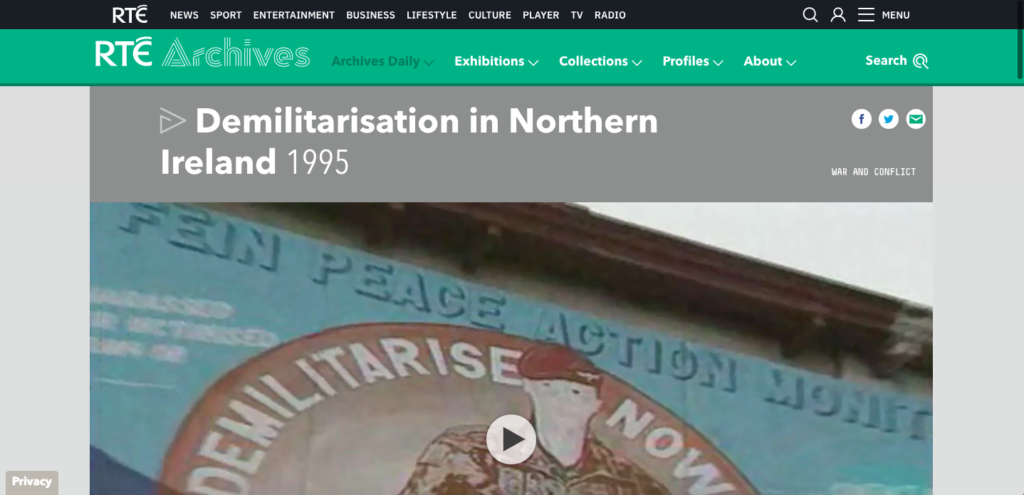
https://www.rte.ie/archives/2015/0324/689293-end-of-british-army-patrols/
A central tie-in to the peace talks more broadly, but more specifically with regards to decommissioning, was the issue of establishing and maintaining operable levels of trust between the parties involved. As rhetoric around decommissioning began to gain more momentum, and as support for it’s enforcement began to grow, parties such as Sinn Féin who were opposed to the disarmament measures, began to call for action to ensure that their political strength wouldn’t be tested since they had been stripped of their weapons. What these parties elected to do was motion for demilitarization on behalf of the British government in order to ensure that they wouldn’t be overtly vulnerable having been newly disarmed, and thereby ostensibly weakened.
The above clip is a RTE news report broadcast from March 24, 1995 covering the beginning of what would ultimately lead to 400 British troops being sent back to England. In the clip, Martin McGuinness – head of Sinn Féin, is seen discussing how demilitarization is a necessary step on the road to initiating decommissioning. He explicitly illustrates his party’s frustration, with other actors involved, due to the fact that Sinn Féin’s willingness to engage in political negotiations is seemingly being disregarded. Additionally, he asserts that the actions being taken with regards to demilitarization aren’t sufficient. In relation to the exacerbation of sectarian divisions, this clip illustrates a key moment in time, one in which demilitarization forced Sinn Fein’s hand when it came time to begin the process of decommissioning. This pressure no doubt heightened tensions between Sinn Féin and other actors involved in the Peace Talks. Sinn Féin no longer had the excuse of military presence to turn towards when coming up with reasons as to why decommissioning hadn’t properly begun yet and other actors involved knew that the party was now boxed in.
Statement from Dr. Paisley, DUP Stance on Decommissioning (1996)
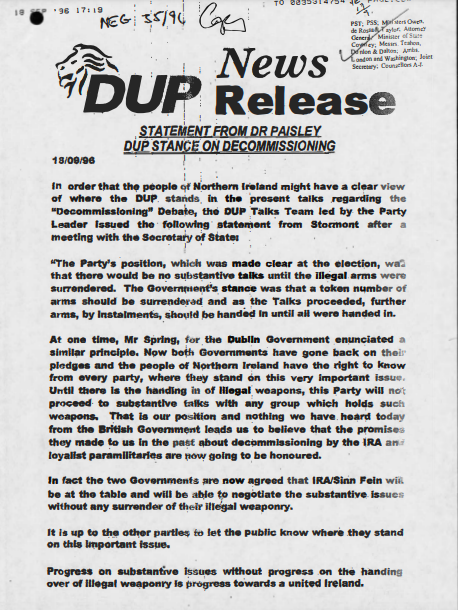
As the issue of decommissioning began to gain more prominence within the larger realm of the talks, prominent parties throughout Northern Ireland began to issue statements on what their respective factions desired to achieve through decommissioning. For the DUP, decommissioning was a non-negotiable issue (Mitchell, 2010). In their eyes, negotiations with a “terrorist” movement such as the IRA, and Sinn Féin by extension, were unacceptable (Mitchell, 2010). The party, spearheaded by Ian Paisley, fervently made clear their stance that they would not engage in the peace process until radical republican paramilitary groups began the disarmament process (Ginty, 2007).
As can be seen in the above statement – Issued by Paisley to the Secretary of State at Stormont in 1996 – one year before the DUP walked out of the negotiation process because of the inclusion of Sinn Féin, Paisley and his constituents were already expressing their reservations regarding the enforcement of disarmament. Paisley adamantly expressed how the issue of successfully fostering peace through the agreement would fall on all other parties involved to denounce the prolonged decommissioning process. In so doing, Paisley and the DUP hoped to draw sympathy from other political actors in order to fortify the symbolic backing to their stance on the disarmament issue. Ultimately, the significance of this statement relays the message to the rest of Northern Ireland that decommissioning was beginning to become a real hurdle in the way of fostering a successful negotiation process.
Press Release: Gerry Adam’s Comments on the Mitchell Principles (1996)
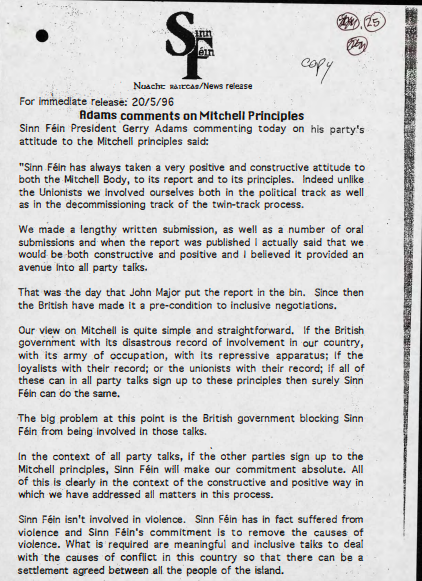
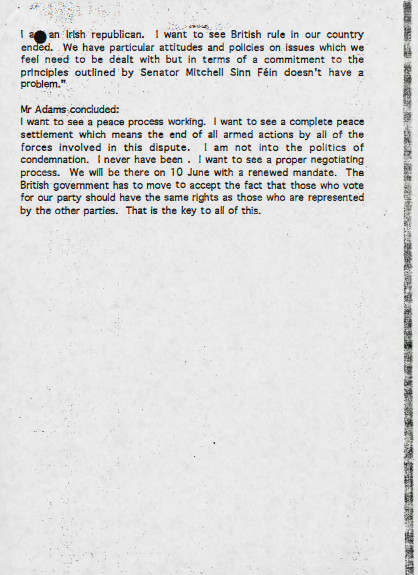
As has been the case throughout the entirety of the decommissioning crisis in Northern Ireland, a good deal of the focus centered around Sinn Féin and the IRA. This is due to the fact that throughout the Troubles, violence on behalf of Republican Paramilitaries far surpassed the amount committed by Loyalist radicals (Gallaher, 2017). This led to a great deal of external pressure being centered on Sinn Féin’s reactions towards motions in support of decommissioning.
This statement, issued by Sinn Féin leader Gerry Adams in response to the Mitchell Principles, was a direct testament to Sinn Féin’s willingness to engage in the peace talks contingent on other external parties’ overall acceptance of Sinn Féin’s positionality. In this press release, Adams condemns Britain’s role in obstructing Sinn Féin from having a meaningful seat at the table while simultaneously reminding everyone of England’s notoriously poor performance relating to governance over Northern Ireland. The condescending nature of the message is no doubt intentional and serves as a reminder that Sinn Féin is committed to the peace talks but also aware of how others’ reactions towards their political positions has increased instability in terms of Northern Ireland’s political landscape.
Document: Ulster Unionist Party, Addressing Decommissioning (1996)
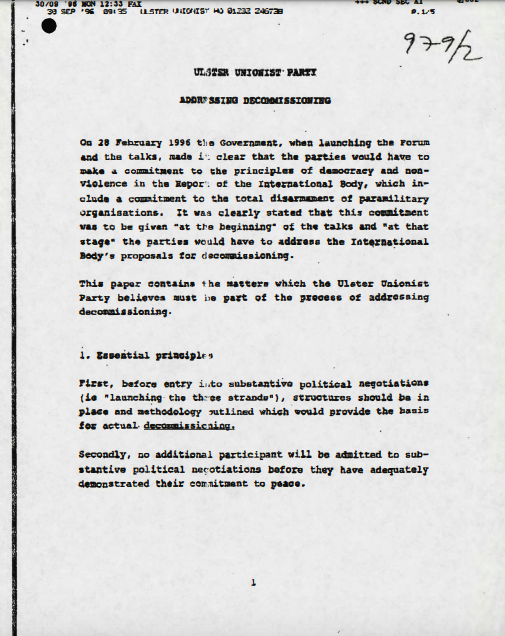
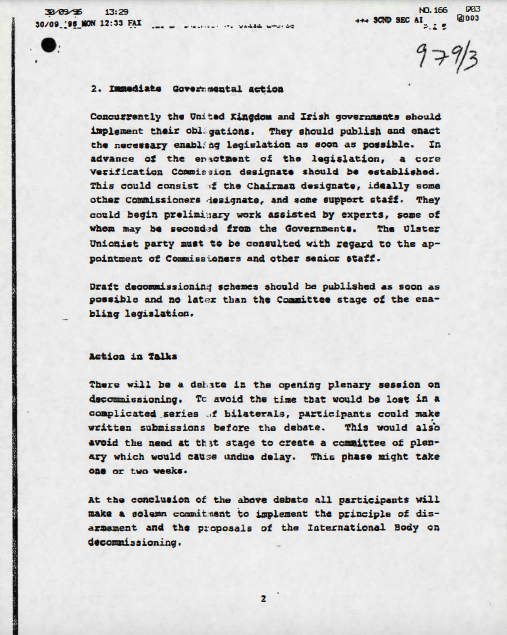
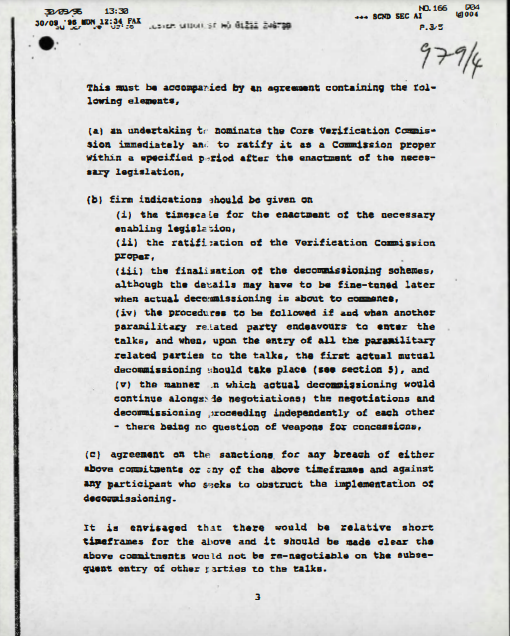
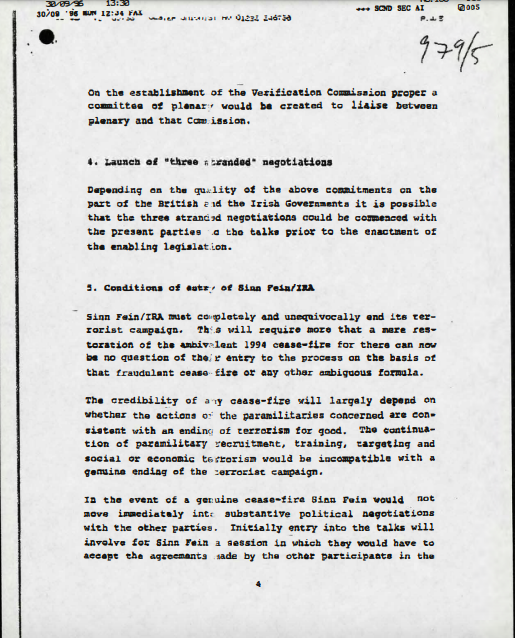
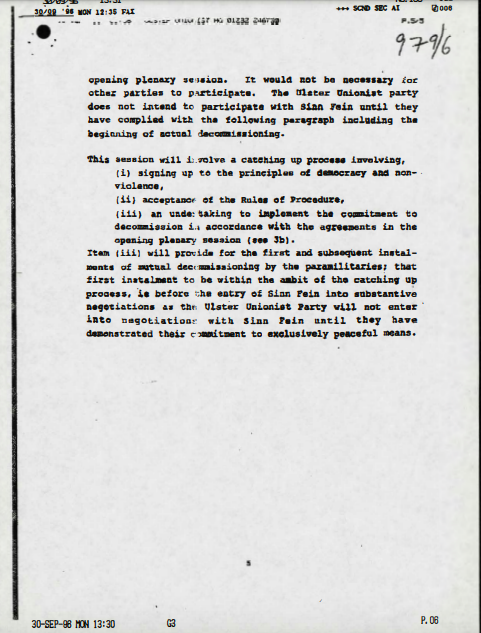
Much like the DUP’s public address regarding decommissioning, this paper written by representatives from the UUP on September 30, 1996, firmly proclaims their desire of not wanting to let the peace talks begin until disarmament had been achieved. In a much lengthier address, the paper presents forth several of the UUP’s “essential principles” on the topic of decommissioning. The first being, “ before entry into substantive political negotiations (ie. “launching the three strands”), structures should be in place and methodology outlined which would provide the basis for actual decommissioning.” And the second being, “No additional participant will be admitted to substantive political negotiations before they have adequately demonstrated their commitment to peace.” Although they don’t explicitly mention them, these two principles are addressed towards Sinn Féin and the IRA and are reflective of how the majority of Unionists viewed the topic of disarmament troubles overall (Mitchell, 2010). By publishing this paper, the UUP effectively announced to the whole of Northern Ireland that tolerance towards radicalized paramilitary groups should not be afforded and that there was no room to give any ground on the issue of decommissioning.
After review of these historical documents relating to partisan views on disarmament, we can now obtain a better understanding of how decommissioning as a whole served as a dividing force throughout Northern Ireland’s political legislature. Each party understood that there was a real tangible threat, wether that be literal or ideologically, posed on their behalf on account of decommissioning and that action in order to define their stances on the issue would need to be taken. These fears eventually led to dramatic changes in the political landscape in Northern Ireland (Mitchell, 2010). These changes, included the reconstruction of the partisan power structure (ie. the DUP eventually usurping the UUP as the dominant Unionist party in the 2005 election) – (Mitchell, 2010), tactical concessions on behalf of parties such as the SDLP in order to see the peace process through to fruition (Mitchell, 2010), and a general heightened sense of insecurity and uncertainty throughout the region as the issue of disarmament seemed to be one that had the potential to unravel all the prior progress achieved leading up to the Good Friday Agreement.
