
Exhibit
Part 1: The Documented Guidelines Relating to Decommissioning
Document: Joint Proposal by Governments on Handling of Decommissioning (1996)
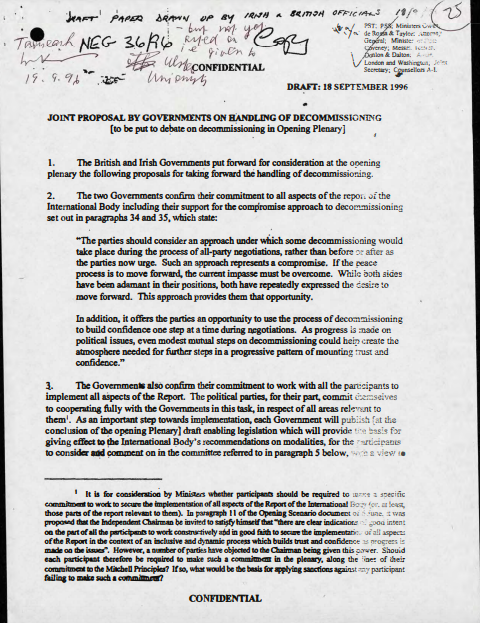
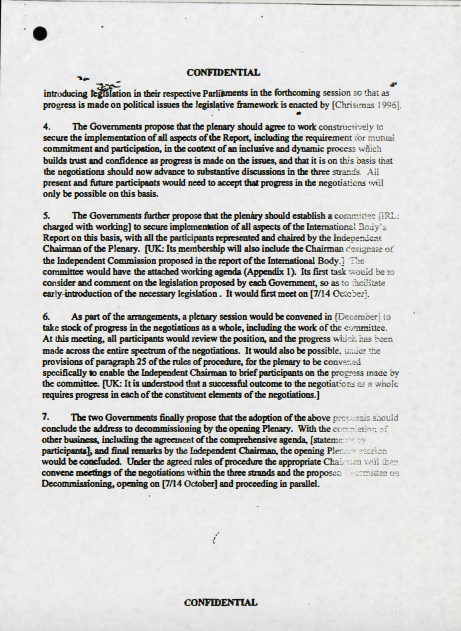
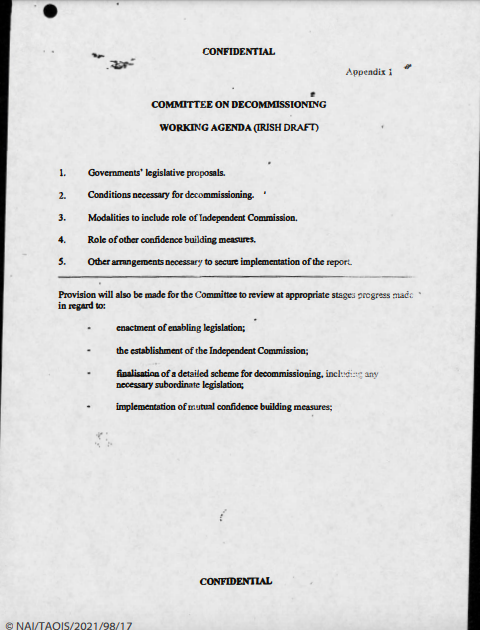
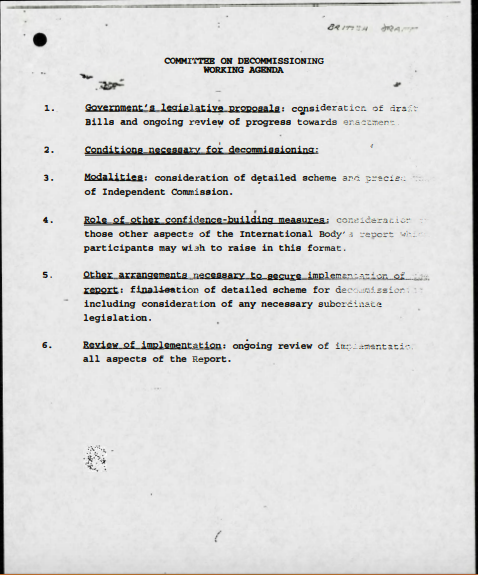
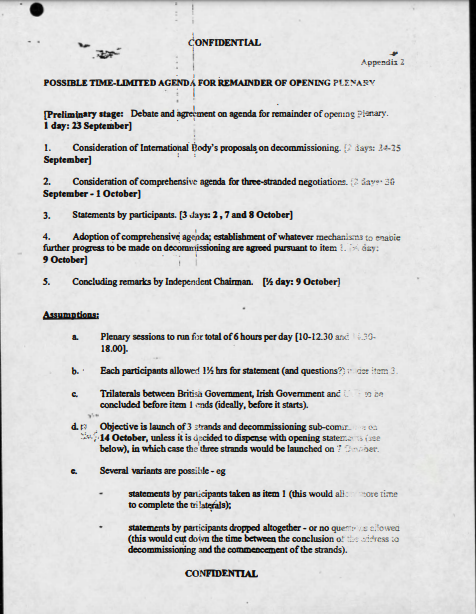
The document above is a draft put forth by both the British and Irish governments on September 18, 1996 that outlines the way the newly established independent body on decommissioning would function. In its opening remarks, the proposal outlines how for far too long the issue of decommissioning has been disturbing the prospect of peace in Northern Ireland. It then goes on to address how the negotiations have become stagnant on account of no parties’ willingness to entirely agree upon when decommissioning should take place. Some argue that it must take place before while others argue that it must take place directly after the agreement has been signed. In order to ameliorate this issue, the British and Irish government, in section 2 of their proposal, introduce the idea of having decommissioning occur in tandem with the peace negotiations. The principle hope being that all sides would come to an agreement on this compromise in an attempt to finally move forward past the period of prolonged gridlock that had been grinding negotiations to a fervent halt.
Having now laid the groundwork for a possible avenue towards the end of the tunnel in regards to the decommissioning crisis, the issue now turns to the parties involved. In terms of significance, this document did finally dislodge the ideological blockage relating to decommissioning that had been impeding the process for far too long. However, it would also lead to new controversies regarding how incorporating decommissioning into the two-track approach of the peace process would ultimately play out. Inextricably providing a solution to the problem but also inadvertently increasing tensions between parties over how decommissioning would impact their respective legislative positions.
Exert from the Good Friday Agreement Regarding Decommissioning (1998)
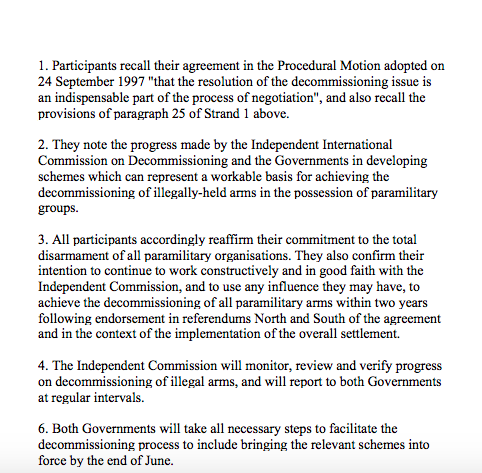
The above text is the segment of the Good Friday Agreement’s Third Strand which is dedicated to addressing the issue of decommissioning throughout Northern Ireland. Upon examining the text, the vague wording and inconclusive measures stipulated in regards to the decommissioning process are ill defined and poorly laid forth. This lack of clarity, and failure to clearly establish guidelines in the Agreement itself is what has led to many claiming decommissioning to be one of the principle points of weakness in the document (Deutsch, 2002).
If you turn your attention towards sections 4 & 6, you’ll notice vague phrases such as: “take all necessary steps”, “relevant schemes”, and “monitor, review and verify progress”. The lack of clear and decisive language used particularly in these sections serves as the basis for which a good majority of the ambiguity around how decommissioning is actually supposed to be structured originates. What exactly is progress and moreover what does it look like? What constitutes a necessary step? What do the relevant schemes all look like? These are just a few of the questions that the unspecific rhetoric of the Agreement leave us wondering. In addition, the sheer brevity of the portion of the agreement dedicated to disarmament is additionally telling of how the document failed to give proper credence to the nuances of the issue. Perhaps the reasoning for this lack of explicit clarity was intentionally employed in order to somewhat curtail the issue of decommissioning due to the inherently charged political nature of the issue (Deutsch, 2002). A sentiment that is not too out of touch considering the ramifications garnered from explicitly choosing a side on the issue.
Document: The Mitchell Report, Statement to Parliament, 24 January 1996
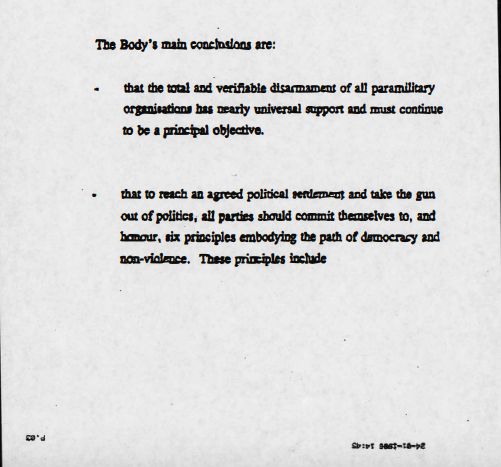
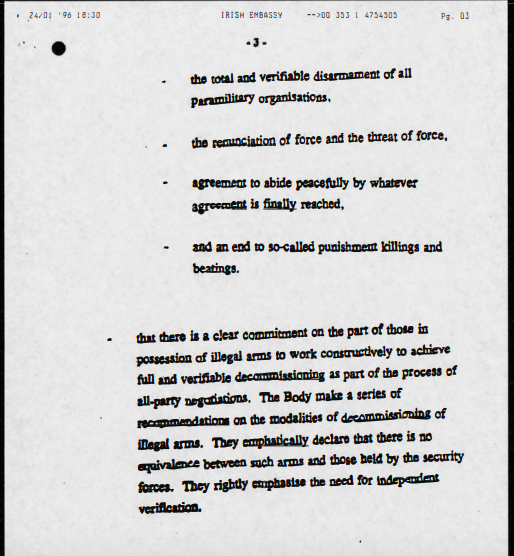
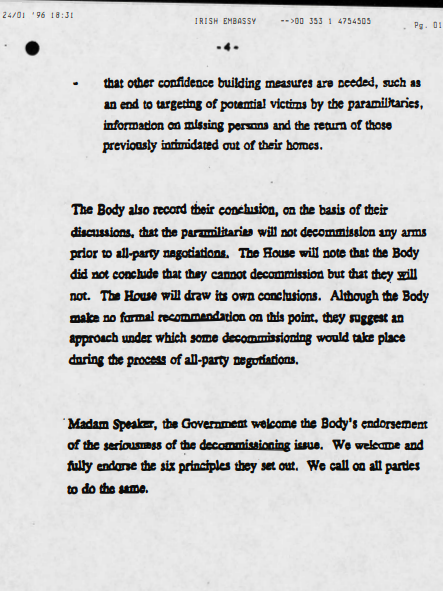
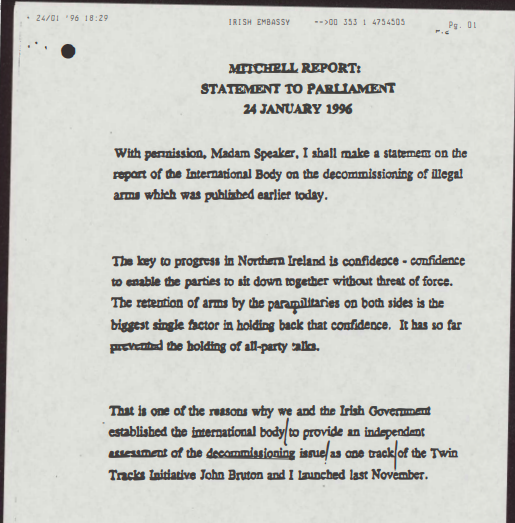
The Mitchell Report is the brief mentioned in the introduction that outlines a way for Northern Ireland to end the standoff regarding decommissioning. It was created by U.S. Senator George Mitchell, along with the help of Canadian John de Chastelain and former Finnish prime minister Harri Holkeri (Rafter, 2008). Displayed above are the first four pages of a statement to the British Parliament, by then Prime Minister John Major, regarding their thoughts on the report which had been published earlier that day. The report itself was meant to reignite the stalled peace process (Rafter, 2008). In the eyes of the British, as is evidenced in the latter portion of the exerpt, the IICD was entirely fulfilling its role of beginning the mediation of the disarmament process.
Other reactions to Mitchell’s report, regarding what it set out to accomplish, General de Chastelain is quoted saying:
“ We moved outside our remit and addressed the lack of trust between political parties by suggesting six principles of democracy and non-violence that we believed the parties could be invited to adopt if they were to take part in the talks”.
These six principles referenced above, centered around commitments to democratic and overtly peaceful means of conflict resolution with regards to decommissioning throughout the region (Rafter, 2008). This document is significant because it highlights the overwhelmingly positive reactions to the Mitchell report (on behalf of the British government) which would later go on to play a crucial role in helping to de-escalate the decommissioning crisis.
