Socio-Political Growth in the 20th Century
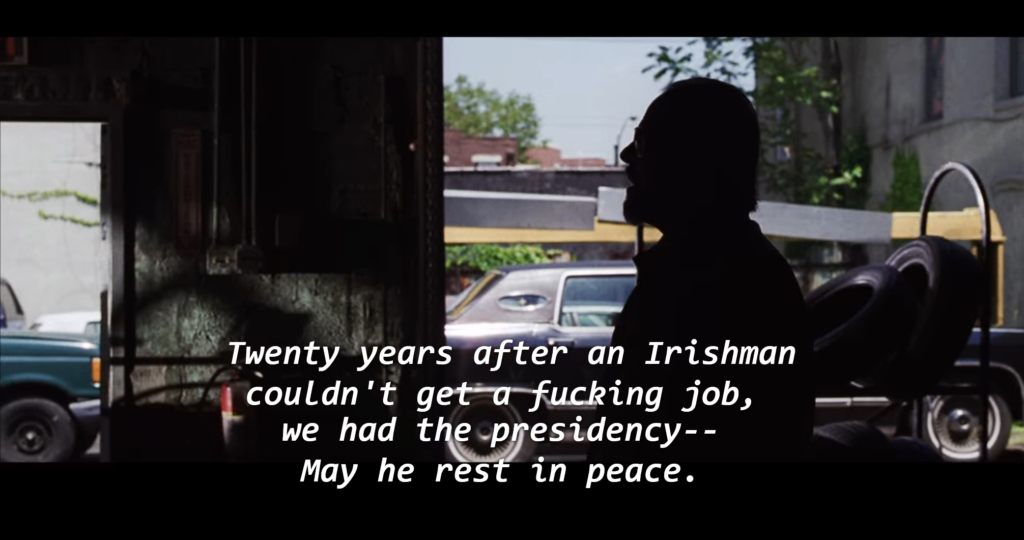
from Martin Scorsese’s The Departed. Sourced from Netflix.
As appealing as the “American Dream” seemed to those suffering in Ireland, hopping on a boat wasn’t a fast-pass to golden opportunity. While the existence of real “No Irish Need Apply” signs is debated as possibly a false cultural memory, the widespread hatred and discrimination against Irish immigrants and their descendants was very real. While the levels of anti-Irish sentiment weren’t always as high as during the minor political success of the blatantly racist Know Nothing party in the mid-19th century (Levine 2001), most Irish-Catholics remained confined to poor, working-class ethnic neighborhoods such as Boston’s “Southie” well into the 20th century (Morgan 1978).
This began to change around the time of the American Civil Rights Movement that would inspire the beginnings of the Troubles. Delaney (2006) quotes Tim Pat Coogan wondering at how “the Irish nevertheless managed to battle their way to pinnacles of political and economic success, epitomized by the entry to the White House of John Fitzgerald Kennedy.” Put more simply, see the image above. The quote is from Martin Scorsese’s The Departed (2006), in which Jack Nicholson plays Irish-mob boss Frank Costello (loosely based on real Southie mobster Whitey Bulger). This opening scene of the movie quickly recaps the trials and tribulations of this rapid Irish rise to power as well as the overwhelming Irishness of Boston’s South End. Poor socioeconomic conditions are what leads to organized crime, as ethnic mobs provide some level of safety and support for their communities.
However, the line above does show an alternative. Frank celebrating an Irish President shows the glimmer of hope Irish Americans got in the 1960’s, when for the first time it seemed like they could improve their situation through political participation. JFK, “the descendant of a Famine emigrant from county Wexford,” was only the first, and as Irish Americans gained more political power throughout the Troubles they became able to influence both their own plights and the Troubles at a larger, more acceptable scale (Delaney 2006).
