The Four Horsemen: Influencing Peace
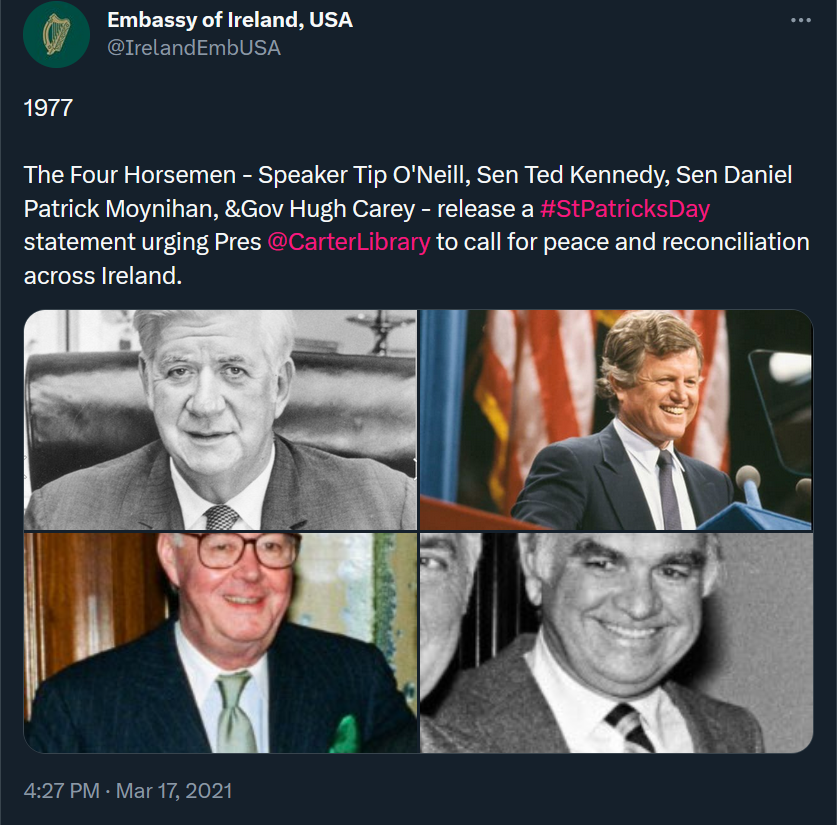
This tweet, posted by the US Irish Embassy, commemorates the “Four Horsemen” of Irish American Politics. Tip O’Neill was elected by Massachusetts to the Federal House of Representatives in 1977, where he served as Speaker of the House for ten years. Ed Kennedy was elected a Massachusetts Senator in 1962 and held that position through the turn of the century. Daniel Patrick Moynihan was elected New York Senator in 1977. Hugh Carey was a representative from 1961 until 1974, when he took up a new office as governor of New York until 1982.
Thus, during the height of the Troubles, Irish Americans in Massachusetts and New York managed to get on the frontline of US politics. Two powerful Senators, the Speaker of the House, and a major governor proved useful towards large scale political influence. Previously, the US policy on Northern Ireland was, simply, don’t get involved. Cochrane (2007) identifies that Northern Ireland was formally treated “as a constituent part of the United Kingdom, and therefore as a purely internal matter for the UK government.” The four horsemen were able to get Northern Ireland on the docket, Kennedy specifically putting pressure on President Carter to discuss the issue with British PM Margaret Thatcher (Dumbrell 2018).
Likewise, these powerful politicians were approached from across the pond by John Hume and the SDLP, who wanted the horsemen to condemn the IRA’s violence to promote a peaceful, constitutional solution. Due to the close relationship John Hume formed with the four horsemen, Dumbrell (2018) noting that he was closest with Kennedy, this request was granted. The Embassy’s tweet here commemorates the four horsemen’s “St. Patrick’s Day Statement,” which did in fact condemn republican violence in favor of a peaceful resolution to the conflict. It’s no stretch to trace these accomplishments back to the working-class Irish American voters in Southie, and elsewhere, by whom the horsemen were voted in and in turn influenced.
