Crunching the Numbers
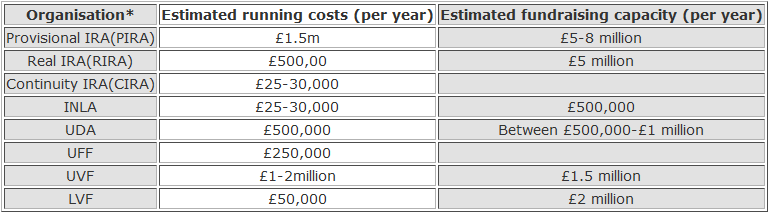
This graph from a UK parliament website shows how this made an impact. While the “fundraising abilities” are not entirely attributable to American donors, since much of those abilities are credited as known criminal enterprises of the PIRA, the website still clarifies that it does take into account foreign donations. Considering this table is from 2002, after the ceasefire, a lot of money is involved. Looking back to the peak of NORAID’s action, it “sent approximately $3 million to Ireland between [1969] and 1986” (Guelke 1996). While this would only cover the UK’s cost estimate for two years, that’s two free years in addition to their other funding. In addition, it is speculated that “NORAID raised funds additional to those it declared,” and “[this money] was used directly for arms purchases” (Guelke 1996).
Thus, as some pursued a peaceful resolution to the conflict there were many who supported violence from a distance. Despite “six-monthly returns to the Justice Department,” the known link between this “community organization” and a paramilitary group slipped by for years. Many Irish Americans saw it as a very valid method of support for the struggles of their fellow Catholics. The full impact this money really had on PIRA operations is questionable, as Cochrane (2007) points out “the most violent phase of IRA activity took place in the early 1970’s with a low-tech, low-cost bombing campaign that was not substantially funded by the Irish-American Diaspora.” However, it is clear that NORAID’s ability to tangentially link any average Irish American to the conflict in Northern Ireland was powerful for the mindset of those communities and their desire to give support.
