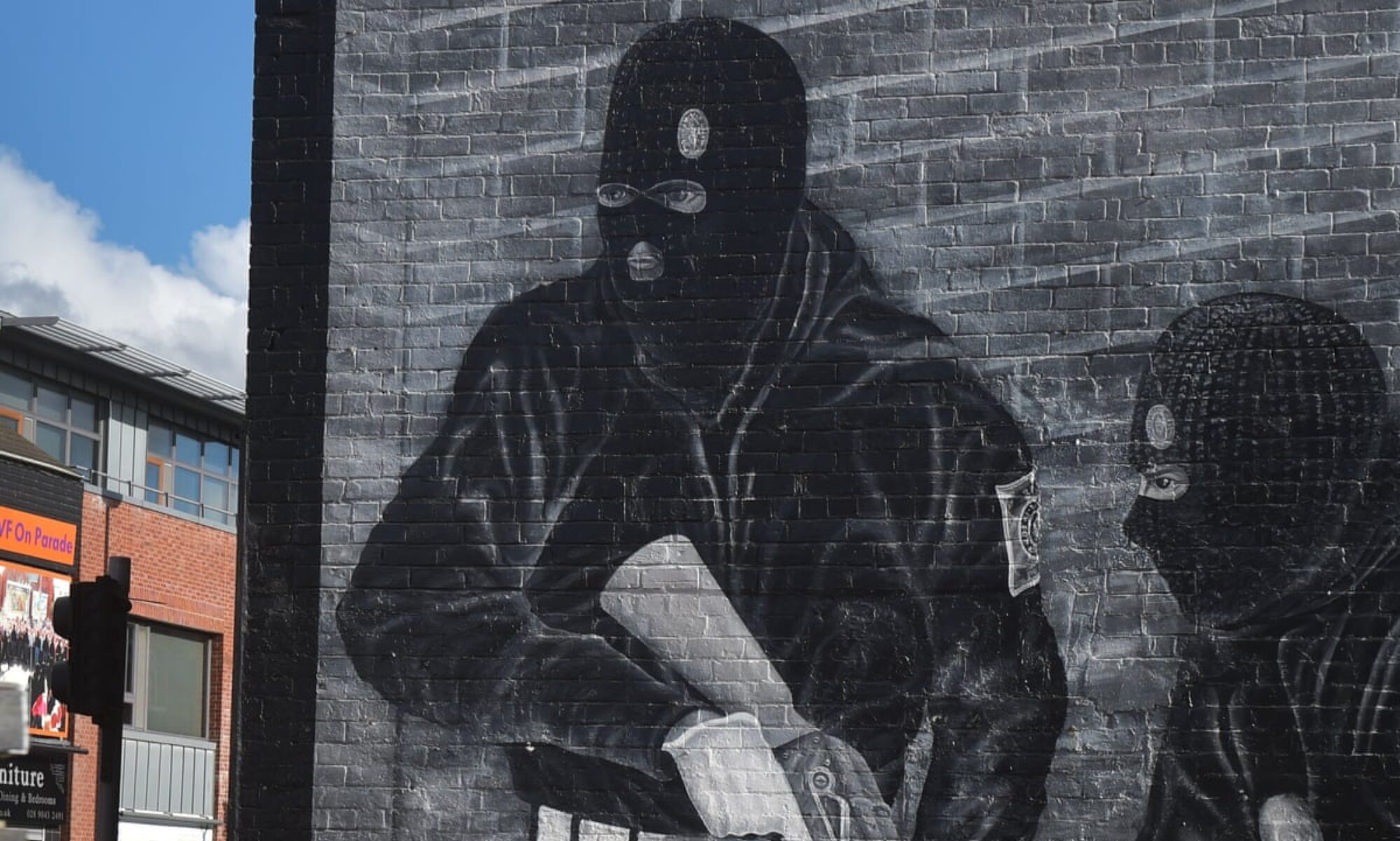
Exhibit 9: Parades Commission: Solving Conflict over Orange Order Parades?
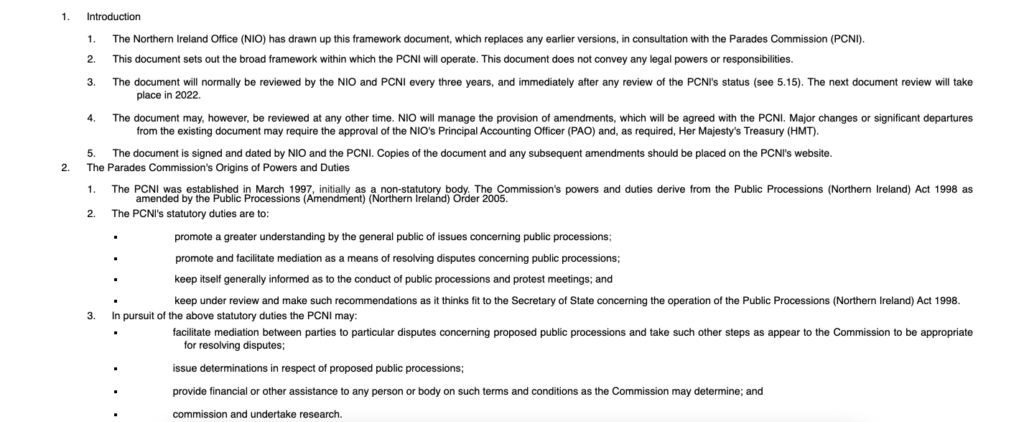
Parades Commission NI Framework Document was created in 1998 and is revised every year.
The Northern Ireland Parade Commission serves as a quasi-judicial organization whose primary purpose is to impose restrictions on parades in Northern Ireland that may spark violent or rebellious activity. The above image shows a portion of their framework, in which the introduction highlights the overall operations of the Parades Commission of Northern Ireland (PNCI).1 By setting out a broad framework, the PCNI can work within a structure that provides clarity and transparency for its operations within Northern Ireland. The document itself is reviewed regularly and allows for changes to be made, allowing for adaptability and flexibility if the situation within Northern Ireland were to change in the future. This enables the organization to manage parades and public processions effectively. The powers and duties section of the document has notable implications for maintaining public order and community relationships within Northern Ireland. Their main goal is promoting education regarding public processions and moderating disputes. The third portion of the snippet from their documented framework is the powers that the PCNI has to pursue its duties to enhance the management and resolution of parade-related issues. These powers include research, facilitation between disputing parties, financial or other forms of assistance, and many others.
The PCNI’s role in Northern Ireland is immense within the Unionist community. The PCNI is very influential regarding the Orange Marches because these parades are often a source of community tension, as they have been known to pass through or near predominantly Catholic neighborhoods. As shown in the framework of the PCNI, they act as a moderator meant to balance the rights of the Orange Order, promoting peace and stability within the communities they are a part of. This may involve promoting dialogue and a mutual understanding of the parades with Unionists, showing them why restrictions are necessary to implement. From the Unionist perspective, they have viewed the PCNI as an infringement upon their right to celebrate their heritage as they see fit.
In years after the initial agreement was introduced, there have been efforts to push forth new legislation that would further deal with the parades, but the Order and the DUP have expressed unhappiness towards it.2 This creates a dynamic between the two groups where the Parades Commission perceives themselves as promoting peace within Northern Ireland by avoiding violent conflicts over parades, as frequently seen in the late 1990s. In contrast, members of the Orange Order and the DUP wish for the commission to ease restrictions or be abolished, claiming that the dampening of parades further contributed to their removal from relevance.3
Footnotes
- Parades Commission NI Framework Document. 2019. Northern Ireland Parades Commission. 1 May https://www.paradescommission.org/Publications/Parades-Commission-NI-Framework-Document.aspx
- McAuley, J.W. and Tonge, J. 2007, “For God and for the Crown”: Contemporary Political and Social Attitudes among Orange Order Members in Northern Ireland. Political Psychology, 28: 33-52. https://doi.org/10.1111/j.1467-9221.2007.00550.x
- Stevenson, C., Condor, S. and Abell, J. 2007. The Minority-Majority Conundrum in Northern Ireland: An Orange Order Perspective. Political Psychology, 28: 105-125. https://doi.org/10.1111/j.1467-9221.2007.00554.x
