Exhibit 4: Lambeg Drums and the Use of Music in Orange Order Marches
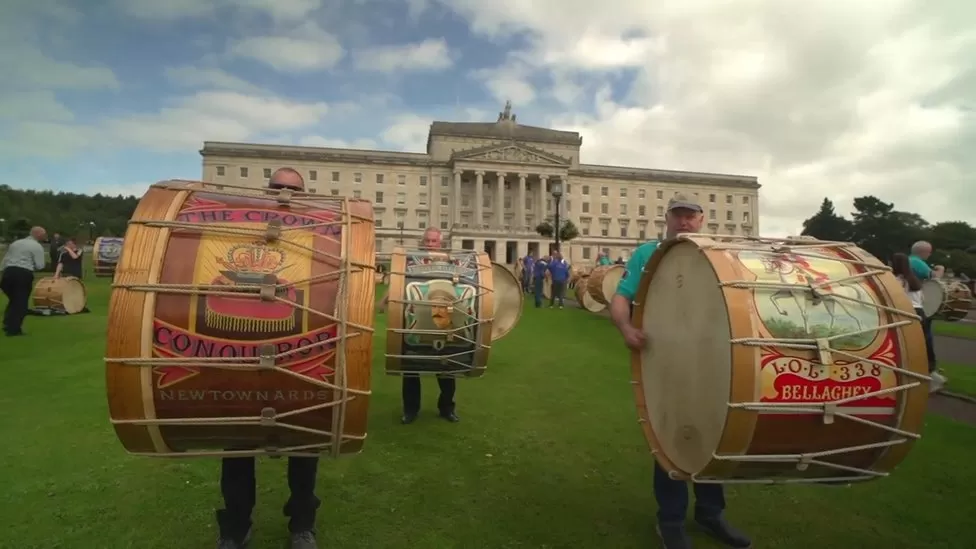
Traditional Lambeg drums from the Orange Order outside of Stormont to celebrate Northern Ireland’s centenary year (September 18, 2021)1
https://www.bbc.com/news/uk-northern-ireland-58612163
Lambeg drums hold great significance for the cultural and musical traditions of the Unionist community in Northern Ireland, and they are typically associated with the Orange Order’s Twelfth of July festivities. In addition, these large drums are known for their distinctive deep sound, as it is one of the loudest acoustic instruments in the world, reaching a volume of more than 120 dB.2
The rhythmic beating of the drums makes a powerful and distinctive sound that adds to the spectacle and atmosphere of the Orange Order marches. Lambeg drums have a long tradition in Northern Ireland Unionists communities, dating back to the 18th century and reflecting the historical ties of Unionism with the Ulster Scots. 3
The Lambeg drum tradition is passed down through the generations, with veteran drummers mentoring/training the youth. Communities actively engage in preserving this cultural practice, organizing workshops, competitions, and Lambeg marches to ensure the continuation of the art form. Therefore, the Lambeg drum fosters a sense of community and shared heritage among the Orange Order and Unionists in Northern Ireland.
This specific photograph by the BBC pictures Lambeg drummers in front of Stormont, the Northern Irish Assembly, to commemorate Northern Ireland’s centenary year in 2021.4 The event organizers claimed it was essential to showcase Northern Ireland’s rich tradition of Lambeg drumming and encourage the next generation to participate in the cultural tradition by exposing them to the sights and sounds of the Lambeg drums.
The drums featured in this photograph highlight how each drum is a unique piece of artwork. These specific drums feature prominent Protestant historical figures and motifs, including King William of Orange (right), a soldier from the 36th Ulster-Divison in WWI (center), and the British Crown (left). The depiction of historical Protestants and symbols exemplifies the cultural identity and heritage of the Orange Order traditions.
The depiction of historical Protestant figures and symbolism on the Lambeg drums highlight the time-lapse effect within the Unionist community. Despite the Battle of Boyne taking place in 1690 and the sacrifice of the 36th Ulster Division occurring at the Battle of the Somme in 1916, the Orange Order continues on the legacy of these Protestant heroes by prominently painting them on Lambeg drums. The modern Unionists desire to preserve their traditions and heritage to ensure future generations fight to maintain Northern Ireland’s status as a part of Britain. Therefore, the Orange Order continues Unionist cultural practices, such as the Lambeg drum, and paints historical figures on these instruments as a reminder of the necessity to keep the pulse of Unionist ideals alive and “beating” for future generations.
Footnotes
- BBC. 2021. “NI100: Stormont hosts largest ever gathering of Lambeg drummers.” BBC News, 18 September. https://www.bbc.com/news/uk-northern-ireland-58612163
- O’Boyle, Claire. 2019. “Why is the Lambeg drum associated with 12 July in Northern Ireland?” Belfast Live, 26 June https://www.belfastlive.co.uk/whats-on/arts-culture-news/lambeg-drum-associated-12-july-16468719
- Ibid.
- BBC. 2021. “NI100: Stormont hosts largest ever gathering of Lambeg drummers.” BBC News, 18 September. https://www.bbc.com/news/uk-northern-ireland-58612163
