Exhibit 7: Anti-Parade Mural: “No Consent, No Parade”
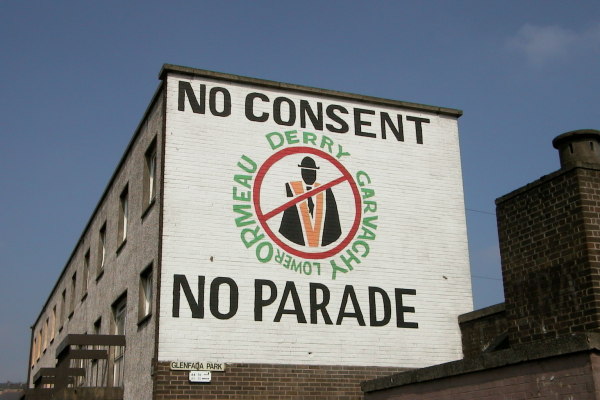
Mural in Bogside, Derry against Orange parades in Natioalist Neighborhoods, photo by Martin Melaugh captured in 1999 (CAIN)
This image taken by Martin Melaugh, a professor at Ulster University, in April of 1999, depicts a mural in the Bogside area of Derry, which is a heavily Nationalist neighborhood that borders several Loyalist areas.1 Murals have long been used as a method of communication and political expression in Northern Ireland by both Nationalist and Unionist communities. However, this particular mural is Nationalist as it presents the community’s stance against Orange Order parades in interface areas—areas in which members of both communities live in close proximity.
The mural depicts a member of the Orange Order with a red x, as the figure in the middle is wearing the iconic Orange Order member sash. Surrounding the crossed-out figure is the name of three towns that all experienced violence and exacerbated tensions in the late 1990s due to Orange Walks: Derry and the Lower Ormeau Road in Belfast, and the most famous clash at Garvaghy Road in Portadown in 1996. Additionally, the entire mural is framed with the phrase “NO CONSENT…NO PARADE,” which refers to Nationalists’ demands to be consulted about Orange Order parades in their neighborhoods.
Considering the Drumcree Parade in 1996 led to violence against Nationalists when Orange Order members marched through Garvaghy Road despite local authorities initially prohibiting the march in that area. Nationalists voiced their opposition to the parades in Catholic areas through protests and murals such as the one displayed in the photograph.2
The mural is a non-violent platform where Nationalists can express their frustrations and anger towards the Orange Order parades and demand change without risking a clash between protestors and the marchers. This anti-march mural demonstrates the Nationalists community’s frustration with the parade tradition and showcases the complexity of Orange Walks in Northern Ireland society.3 Just as the Order has a right to express their customs and beliefs, Nationalists also retain the right to live peacefully without fear of violence or being forcefully subjected to Orange Walks in their neighborhoods. Therefore, the parades highlight the complex legacy of sectarianism and Northern Ireland’s ongoing struggles.
Also, the Nationalist plea for changes or a say in parade routes, as observed through the mural, coincides with the establishment of the Parade Commission in 1998 to avoid parades that could incite violence between communities.4 The mural thus serves as a visual reminder of the challenges associated with maintaining peace, respect, and reconciliation within Northern Ireland, given the Orange Order’s parade traditions that antagonize the Nationalist community.
Footnotes
- Melaugh, M. (1999). “No Consent, No Parade” [Photograph]. CAIN. https://cain.ulster.ac.uk/images/photos/derry/murdy2.htm
- Bryan, Dominic. Orange Parades: The Politics of Ritual, Tradition and Control. Pluto Press, 2000. JSTOR, https://doi.org/10.2307/j.ctt18fs351. Accessed 1 June 2023.
- Ibid.
- Parades Commission NI Framework Document. 2019. Northern Ireland Parades Commission. 1 May https://www.paradescommission.org/Publications/Parades-Commission-NI-Framework-Document.aspx
